
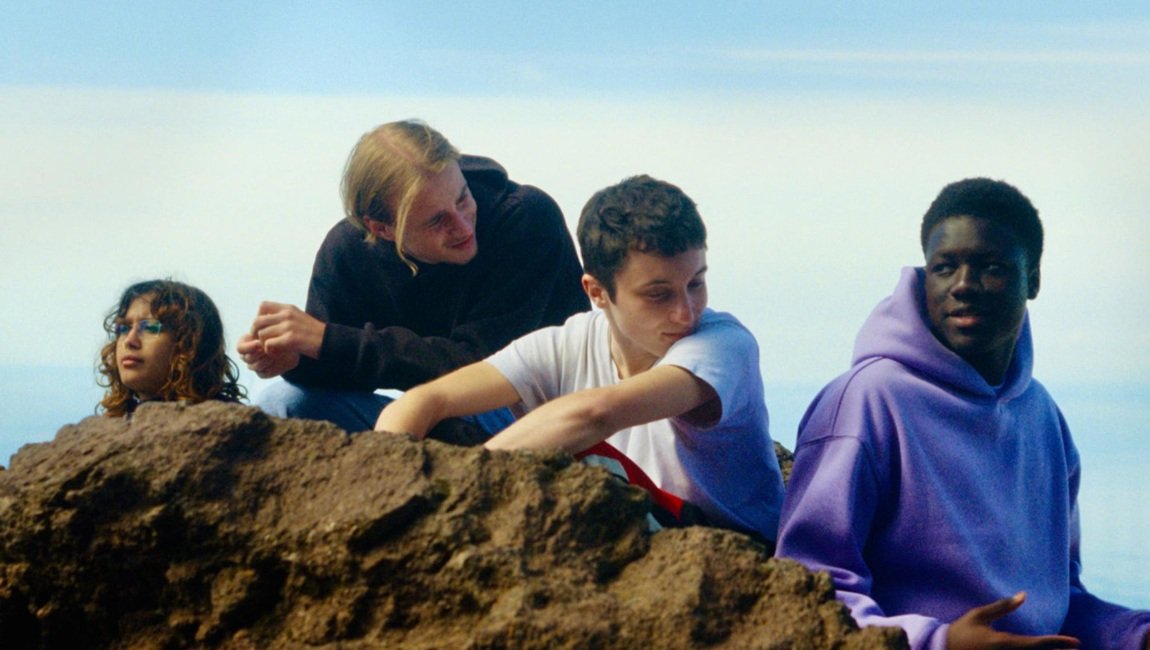
If you were to flip past Marine Atlan’s film La Gradiva on TV (which used to be a thing you could do), you might think you’d stumbled onto an unseen Luca Guadagnino project. This is a film filled with beautiful young people attractively strewn across the landscape in and around Pompeii, on a senior class trip as they approach graduation. And while there are indeed some academic lessons imparted — one of La Gradiva’s finest scenes involves the class collectively interpreting the Dionysus fresco in the House of Thiasus, dating from 40 BCE — most of the action is interpersonal. This is a novelistic film about a group of fitful young people on the cusp of adulthood, and while it is an above-average specimen of that conceit, it’s not particularly original.
What it is, though, is expansive. Across 150 minutes, Atlan takes great care to flesh out her main characters and even a few secondary ones as well. That art history lesson mentioned above, for example, clarifies who the studious kids are, including artistically minded wallflower Suzanne (Suzanne Gerin). It also shows us that one of the most popular and charismatic boys, Toni (Colas Quignard), is a bit of a willful fuck-up, more concerned with having fun and cruising guys on Grindr than the trivialities of high school. Caught somewhere in between is Toni’s best friend James (Mitia Capellier-Audat), a sensitive young man struggling to articulate his identity apart from his bourgeois mother’s expectations.
This film is sturdily written and beautifully shot. But as with Guadagnino’s work, La Gradiva can feel a bit fastidious at times, offering little room to breathe. This is the sort of film in which a group of girls, discussing Angela’s (Hadya Fofana) recent hook-up with James, describe his “Oedipus complex,” and it isn’t a throwaway comment. Rather, it’s an explicit setup for a later narrative development. There are a lot of such moments, and as a result, one’s reaction to La Gradiva comes down in part to one’s appreciation of its airtight construction, an aspect that seems at odds with its open landscapes and sprawling interpersonal perspective.
Atlan certainly offers the viewer lots to chew on. The main teacher, Marianne Mercier (Antonia Buresi), for example, doesn’t have much patience for Toni. This is understandable, because he tends to make a big display of his academic apathy. At the same time, we see her fixate on Toni, refusing to see when he’s actually making an effort. Nevertheless, we learn things about Toni that she as a teacher would probably know as well. He is one of the few poor kids in the class. His mother appears to be mentally ill. And of course he is gay, something the other students don’t care about one way or another but that obviously presents challenges for any young adult. Isn’t Toni the sort of student to whom a concerned teacher should grant grace and leniency? La Gradiva never suggests that Ms. Mercier is prejudiced. She’s just burned out and doesn’t want the hassle.
Again, all of this is handled with aplomb, and Atlan never lapses into didacticism. But it is all so heavily etched, the dividing lines so clearly drawn, that this character work nevertheless demands attention. It is unsubtle in its subtlety, asking us to admire the threads of meaning Atlan refrains from connecting for us while making sure we cannot possibly miss them. There are other difficulties with the film, from its relegation of students of color to background decoration to its regrettable conclusion, which, while undoubtedly affecting, lapses into a dreaded queer-coded narrative trope.
None of this makes La Gradiva a bad film, but it tends to make it an exhausting one. It is beautiful and stately and does a fine job of opening up its young characters to the wider world. They don’t exactly abandon their teenage concerns, but the transitory nature of youth is meaningfully contrasted with antiquity and the broad scope of human history. In a scene where the students examine the cast made of a woman who was killed by Vesuvius, there is a palpable tension between empathy and disconnection, a sense that they are looking at the remains of someone much like themselves, but also long dead, possessed of a consciousness utterly foreign to them. When death finally touches them, they are suitably shocked, despite the fact that Vesuvius has been looming over them the whole time, a sentinel and a warning.
Comments are closed.