
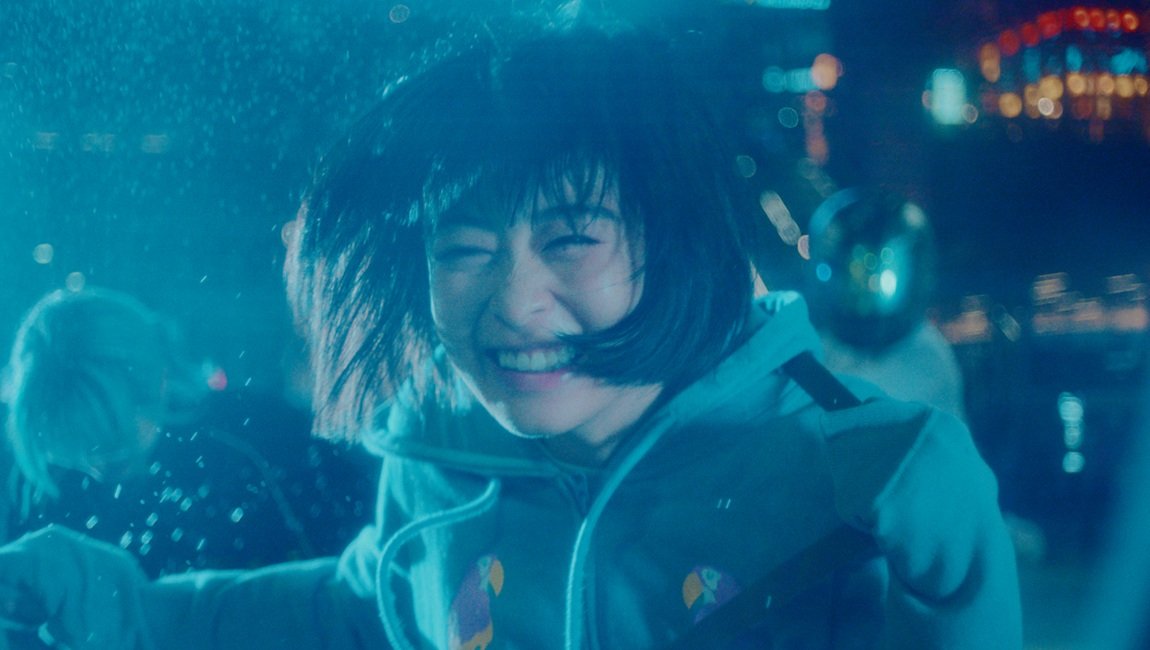
Makoto Nagahisa’s Burn walks a very fine line, attempting to infuse a miserabilist, post-neo-realist tale of urban destitution with a candy-colored pop aesthetic while putting us inside the subjective experiences of young Ju-Ju (Nana Mori) as she flees home and takes up with a band of street urchins in a downtown Tokyo entertainment district. When we first meet Ju-Ju, she and her younger sister are being beaten by their father. They pray for his death nightly, and when it finally happens, their mother steps up to take over the deceased man’s brutal attacks. Fed up, Ju-Ju leaves home with a promise to eventually send for her sister. All of this is accompanied by Ju-Ju’s voiceover narration, a constant stream of verbiage that will last for the entire film.
Nagahisa shoots these early scenes alternating between extreme close-ups and oblique, claustrophobic compositions that isolate bodies with windows and doorways, often creating frames within frames. But the world explodes once Ju-Ju arrives in the city, the camera movements and editing becoming freer and more ecstatic. She meets a bevy of other lost children, including Wris (Ryosuke Sota) and potential interest AQ (Kanata Mori). The whole group is overseen by Kami (Wataru Ichinose), a seemingly friendly, benevolent man who rents a room for them to share, but who will eventually reveal a more sinister purpose. One might assume that the bulk of the film will follow Ju-Ju’s experiences with this newfound family, but it switches gears suddenly when Ju-Ju accidentally overdoses and is picked up by the authorities. She’s placed in a supervised outpatient home of some sort, and quickly makes friends with Mitsuba (Aoi Yamada). Mitsuba is outgoing and experienced in ways that Ju-Ju is not, and once the duo escapes the center and returns to the city, Mitsuba promptly introduces Ju-Ju to the lucrative act of sex work. Our intrepid heroine isn’t pleased by the work, but accepts it as the fastest way to save money to make a new life for her and her sister.
Given the subject matter on display — prostitution, drug addiction, mental and physical disabilities — one might suspect a moralizing slog of a film. And while the narrative does eventually arrive (or devolve) to that point, Nagahisa and cinematographer Hiroaki Takeda infuse the proceedings with a vivacious energy and joyfully anarchic spirit. Nagahisa spent time with actual people living on the streets while working on the screenplay, and Ju-Ju’s subjective experiences are coupled with a genuine feel for life on the fringe. Pastel colors pop everywhere, and expressionistic interludes allow for a sort of poetic counterpoint to the doldrums of drugs and suicides. There’s a sort of freedom here, even as the film refuses to sugarcoat the darker fringes of this story. Even Ju-Ju’s interactions with clients, while fairly disturbing, are carefully filmed to elide any hint of titillation. Things do sour, though, and it’s a shame that the filmmakers refuse to entertain any potential utopian ideals of a new makeshift society free from the binds of familial violence. There’s no escape here, only a fleeting, temporary reprieve.
Published as part of Japan Cuts 2026 — Dispatch 1.
Comments are closed.