
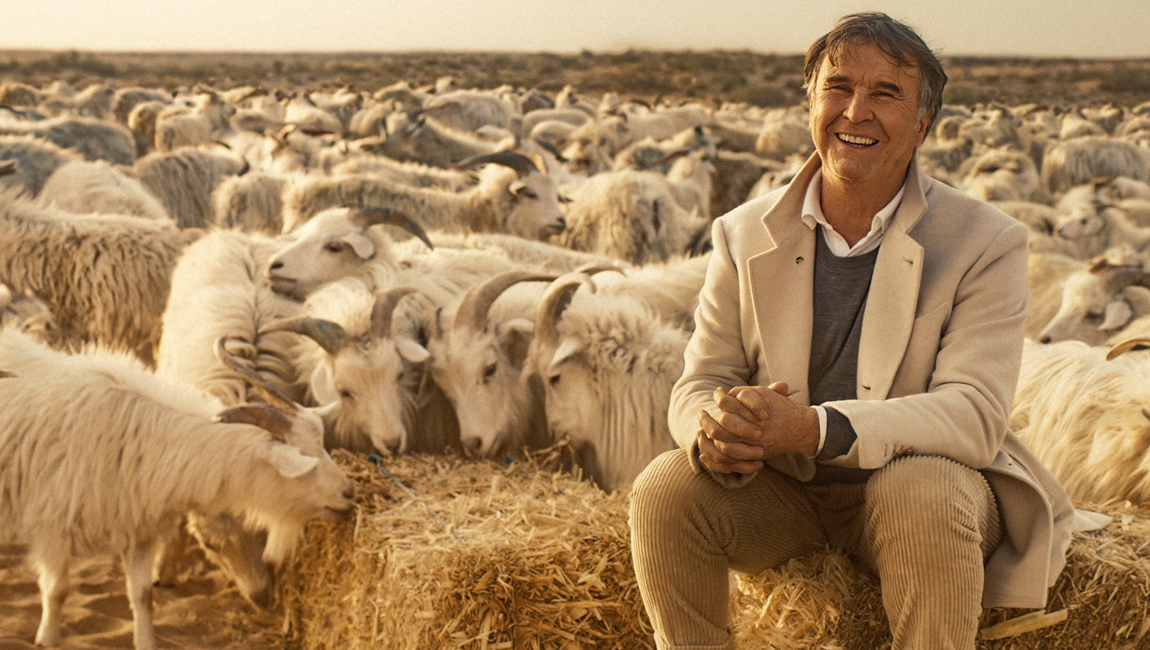
Billionaires are a funny breed. A hardworking and often altruistic bunch, they nevertheless carry the scarlet letter of corruption wherever they go: they may do some good with the wealth they’ve accumulated, yet the very nature of that accumulation necessitates exploitation, and no slick docu-fiction can cover that fact up. Produced by the man himself, Brunello: The Gracious Visionary gallops through the storied life of wildly successful fashion designer and billionaire Brunello Cucinelli while interspersing his ideas for a benevolent economic system he calls “humanistic capitalism.” The film frames him as a sort of demigod for ethical production, and it’s a contradiction as potent as the film is ridiculously fawning: Brunello Cucinelli may be gracious, but if Brunello: The Gracious Visionary is all we have to go on, we will never know whether the man is truly as upstanding as the philosophers he so badly seeks to emulate.
We will also never know whether director Giuseppe Tornatore (of Cinema Paradiso fame) was held captive for the duration of the film’s making or if he took the gig out of genuine enthusiasm. With style that punches above the weight of your average biographical documentary — the film opens on a tracking shot of a man (Cucinelli) lighting fires in a vineyard, then cuts to a sweeping drone shot which reveals a vast network of controlled burns to protect the grapes from frost — it suggests a visual daring befitting the ingenuity of its subject. Then Oprah shows up to introduce a parade of talking heads, and it becomes clear that Brunello: The Gracious Visionary is merely another in a long line of filmed hagiographies.
Tornatore is more patient with, and curious about, his subject than one might expect, however. In between gushing interviews, he’ll follow Cucinelli as he walks around the places of his past to reflect on his agrarian childhood, time spent gambling and pontificating at local bars, and unlikely success as a purveyor of colorful cashmere. If this were all it offered structurally, it might have taken on the quality of a Straub-Huillet movie: patient, rigorous, and intellectual. (Enough great thinkers get called upon, certainly — this writer clocked the names Socrates, Kant, Schopenhauer, Kierkegaard, Heraclitus, and Thomas Aquinas.)
But Tornatore anchors these reflections in rote recreations echoing History Channel’s The Men Who Built America (one half expects Cucinelli to shout “Eureka!” when he dips a sweater in orange dye), and if they were divorced from the documentary around them, the scenes would play like parody. There’s a childlike wonder in the shooting and a slight magical realism in the interpolation of Cucinelli into many of these scenes to offer color commentary, but a Big Mac by any other name would smell as greasy. The film follows generic rise-and-rise beats with a bubbly zeal that only marginally distracts from the empty calories being served up.
As far as vaunting billionaires go, it could be worse: Cucinelli at least feigns real compassion, and he’s a watchable figure onscreen. Yet his very watchability renders him — and the film about him — suspect. One can’t tell what’s history and what’s myth. Several members of Catholic clergy are enlisted to sing his praises, for example, and midway through the film Tornatore cuts to archival footage of Cucinelli performing as Christ in a rendition of the Passion Play. The footage is presented as tongue-in-cheek, but like in last year’s Clemente, the juxtaposition is enough to suggest a deliberate correlation between Cucinelli and God himself. Just ask the staff of Brunello Cucinelli S.p.A.
The film culminates in a tour of a contemporary Brunello Cucinelli factory, a space flooded with natural light and plenty of room for the employees to move around. Taken at face value, the sequence is a winsome celebration of hard work done with a little thought; it asserts that with some focus on wellbeing for your employees and the opportunity for them to enjoy a hearty meal together on their lunch break, you can make billions and rest easy at night. Perhaps Cucinelli’s employment practices are sincere, but when held up against the cold light of reality, the sentiments ring false. Brunello: The Gracious Visionary is a beautiful illusion, and in that way valuable as a utopian vision of 21st-century capitalism. It can be fun to get drunk off the infinite upward spiral of the free market, but the lived realities of it are much different for the workers who hold that spiral up. As such, Brunello: The Gracious Visionary should be forever joined at the hip with Wang Bing’s Youth: Spring to offer contrasting perspectives on the clothes manufacturing industry. It’ll never happen, of course. Then again, neither will humanistic capitalism.
DIRECTOR: Giuseppe Tornatore; CAST: Bruno Cucinelli; DISTRIBUTOR: Blue Fox Entertainment; IN THEATERS: July 24; RUNTIME: 2 hr.
Comments are closed.