
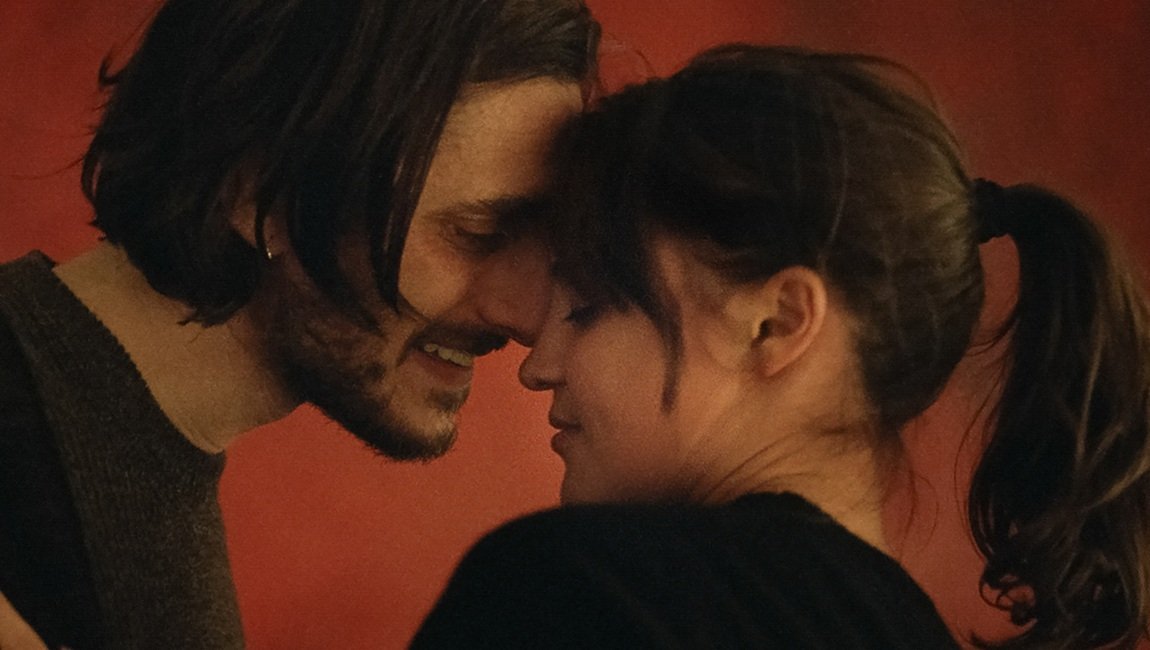
Bernardo Bertolucci passed away in 2018, but his unfinished film is still echoing. Andrea Pallaoro’s The Echo Chamber unfurls from the final screenplay Bertolucci conceived, later developed with Ilaria Bernardini and Ludovica Rampoldi. Fittingly, then, the film itself becomes an echo: one filmmaker’s unfinished idea reverberating through another’s vision. After all, an echo chamber is a space where sound returns to you, distorted and amplified by the walls around it, and Pallaoro turns that principle into a relationship — and, ultimately, into a study of human connection.
Leo (Luca Marinelli) is a drug-dependent music producer who seems almost incapable of opening himself up and lives alone in an apartment, despite the fact that it is both physically and metaphorically inhabited by Anne (Alicia Vikander). First his back-pain therapist, then his girlfriend, Anne is never quite allowed to become a true life partner in Leo’s world. Into the absences and silences of their relationship arrives Ava (Susan Sarandon), an aging singer whose career is no longer what it once was, and as she develops a recording project with Leo, their professional relationship gradually turns into a profound friendship. In The Echo Chamber, all of these characters are searching for connection, yet they constantly seem to elude one another. Leo, suffering both physically and emotionally, appears determined to keep pushing himself toward self-destruction. Anne, meanwhile, struggles to carve out a meaningful place within a relationship whose boundaries Leo refuses to define, while Ava finds in him a different kind of intimacy, one that perhaps exists precisely because it does not demand the same commitments.
Back in the Venice Competition for the third time, following Hannah (2017) and Monica (2022), Pallaoro remains firmly attached to his established visual language. His camera is static, patient, and often painfully lingering, as in an early sequence in which an intoxicated Leo begins to dance to Jamie xx’s “Gosh.” It’s a striking moment, but also an early indication of the film’s limitations, as Pallaoro’s rigorous control creates a distance from his characters that The Echo Chamber struggles to overcome. Once again adopting his familiar 4:3 aspect ratio, Pallaoro confines his characters within a frame that resembles a social prison — one they have largely built for themselves. In Hannah, isolation follows the arrest of the titular character’s husband; in Monica, the ghosts of the past and present disrupt the protagonist’s attempt to rebuild her life. Here, the same constricted frame becomes an extension of Leo and Anne’s relationship, turning the apartment into a refuge, a prison and — appropriately — an echo chamber.
There is, however, an intriguing tension between Pallaoro’s cinema and the material he inherited from Bernardo Bertolucci. The latter’s final screenplay was conceived around absence, desire, control, and the uneasy proximity between two people who share a space without truly being able to share a life. These are unmistakably Bertoluccian concerns, and the film occasionally feels haunted by the presence of the filmmaker who conceived them. Yet Pallaoro approaches them through a radically different sensibility: where Bertolucci often allowed desire and sensuality to erupt through his characters, Pallaoro suppresses them, observing his subjects with almost clinical restraint. The result is formally coherent, but it can sometimes feel as though the material has been bled of some of its original pulse.
That restraint is particularly problematic as it concerns the film’s central relationship, with Marinelli and Vikander struggling to generate the chemistry necessary to make Leo and Anne’s co-dependence feel truly convincing. Their performances are so carefully contained that their intimacy remains largely theoretical. There’s an understanding that these two people are obsessed with one another, but The Echo Chamber rarely convinces us of why. Marinelli gives Leo a convincing physical fragility, but his emotional opacity makes it difficult to invest in his suffering. Vikander, meanwhile, is similarly hemmed in, and Anne too often feels like an intellectual extension of the screenplay’s ideas rather than a fully lived-in character. The film’s greatest strength, then, is Sarandon, and it’s at its most compelling when she figures into its calculus. As Ava, she brings a warmth, mystery, and unpredictability that the central couple conspicuously lack. Her scenes with Marinelli have a looseness and emotional immediacy that make the rest of the film feel even more rigid by comparison.
But this is also where the film’s formal precision begins to work against it. The long takes and static compositions are clearly intended to offer the audience an experiential measure of the characters’ emotional paralysis, but the distinction between deliberate stasis and dramatic inertia gradually becomes harder to sustain. Pallaoro’s slow pace is initially evocative, but eventually it begins to feel less like a reflection of his character’s paralysis than a limitation of the movie itself. And perhaps that is the film’s most frustrating contradiction. Pallaoro builds an immaculate apartment — beautiful, controlled, and saturated with the traces of lives that never quite seem to materialize — but the people inside it remain strangely elusive. The space becomes more convincing than the relationship it contains.
Ultimately, then, The Echo Chamber lands as an intriguing encounter between Bertolucci’s unfinished ideas and Pallaoro’s austere filmmaking, but not always a fruitful one. The former supplies the film with potent themes of desire, dependency, and control; the latter realizes them in a precise visual language, but one that can also feel too hermetic to let them resonate emotionally. The echo is present, but what it returns is much fainter than the original notes Bertolucci played.
Comments are closed.