
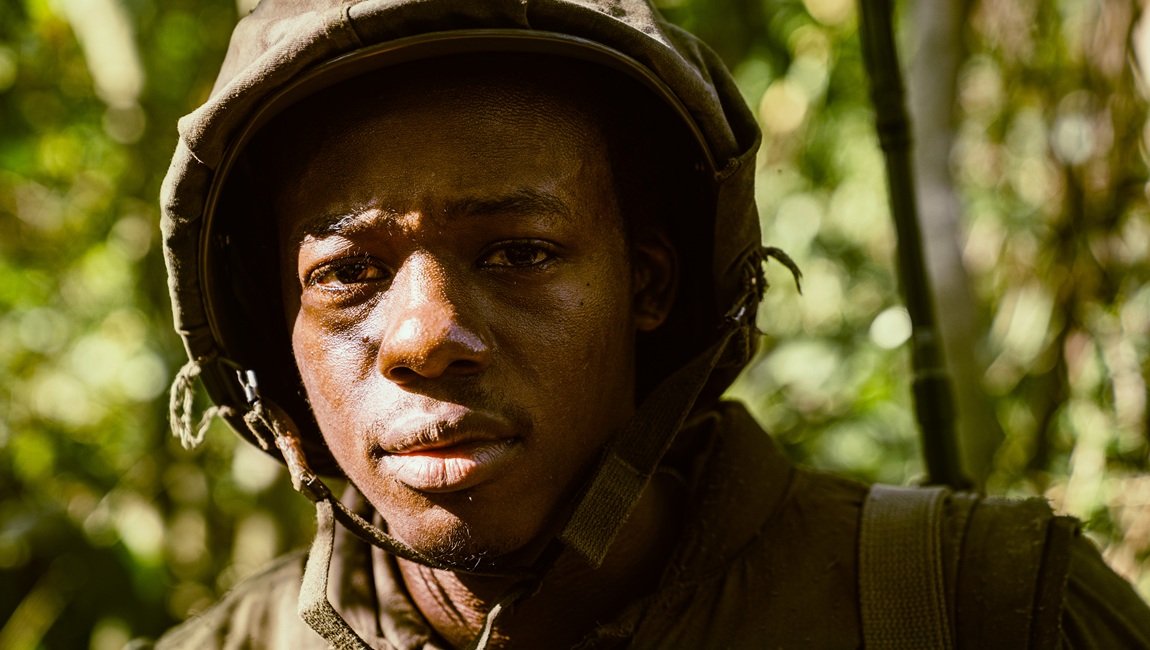
The title of Shinya Tsukamoto’s latest foray into historical war drama comes from a question asked by a child to a Vietnam War veteran. Allen Nelson (Mark Merphy), suffering from PTSD and currently living in an abandoned building, has been invited to speak to a classroom of fourth graders about his experiences in the Marines. He describes to the kids his experience of life in the forest (hot, crawling with insects) and the reality that not everyone makes it home, but until this girl bluntly asks, “Did you kill people?” he elides his own actions. That he killed enemy combatants is a given, an expected and accepted possibility of warfare, but coming to grips with the atrocities he committed in Vietnam will take up the rest of both Allen’s life and Tsukamoto’s overlong film.
Years later, Allen’s (now played by Rodney Hicks) material conditions have improved drastically: he is married with a young stepson and is employed, but his PTSD persists. Unable to sleep peacefully, his medication ineffective, Allen seeks the help of Dr. Daniels (Geoffrey Rush), who pushes Allen to bring his old memories to the surface. Tsukamoto’s script, his second in English, awkwardly takes the most literal approach to the material. This manifests in Daniels, as he tries to unravel the psychological dimensions of his patient, simply asking “Why did you kill people?” ad nauseam at the conclusion of all their sessions across many years.
For a while, Allen’s answer is simplistic, avoidant, and unchanging. It was war; what was he supposed to do? The flashbacks Tsukamoto employs, however, tell a story of cold-blooded murder and massacre, no matter how much Allen insists on the heat of combat fueling his decisions. Mr. Nelson Did You Kill People?’s approach to war is protest by extremity, befitting its director’s roots in an aggressive, discordant horror aesthetic. War is realized as a gory, unpleasant affair, filmed with shaky cam intensity and focusing on the most repugnant encounters. Allen’s unit — made up predominantly of other Black soldiers, a fact which Tsukamoto only engages with in passing — becomes increasingly ruthless, and while they are initially fighting for their lives, soon enough they are using their hunt for the Viet Cong as an excuse for slaughtering entire villages. Much of what we see here is pedestrian in the context of the many other movies about the conflict, but a handful of images are so repellent that they threaten to stick in the viewer’s mind.
But it’s not all therapy. By the time Dr. Daniels reaches a breakthrough with Allen, a whole hour of Mr. Nelson remains. Tsukamoto’s effective war scenes in the rearview, the rest of the movie focuses on Allen’s domestic life, his work toward inner peace, and the stumbling blocks of various triggers, most notably an incident in which his teenage stepson brings home a Marine recruitment pamphlet from school. On the rare occasion that the film depicts a panic attack, the Tsukamoto who made Tetsuo: The Iron Man shows up with a few visual sequences that disorient and render familiar settings unrecognizable. But largely, the film’s second half looks terrible, with the plain digital filmmaking landing well below par for even bad television, even if the expanded space of the film’s domestic drama gives Hicks the room for a nuanced, powerful performance that almost overcomes the deficiencies of the thudding script and lifeless direction.
Yet for however much Mr. Nelson, Did You Kill People? is a repetitive slog, a symptom of the late style’s dark side, it remains an effective and intelligent work about the lingering effects of war, thanks primarily to the insistent agitation of Tsukamoto’s stronger instincts and Hicks’ gravitas at its center. At the end of the film, as Allen embarks on a long speaking tour throughout Japan, the movie denies the simple healing framework a more facile psychological study might take. Allen has taken steps toward a healthier reckoning with his past, yes, but old wounds remain open, with redemption and forgiveness left lingering appropriately, painfully out of reach.
Published as part of TIFF 2026 — Dispatch 5.
Comments are closed.