
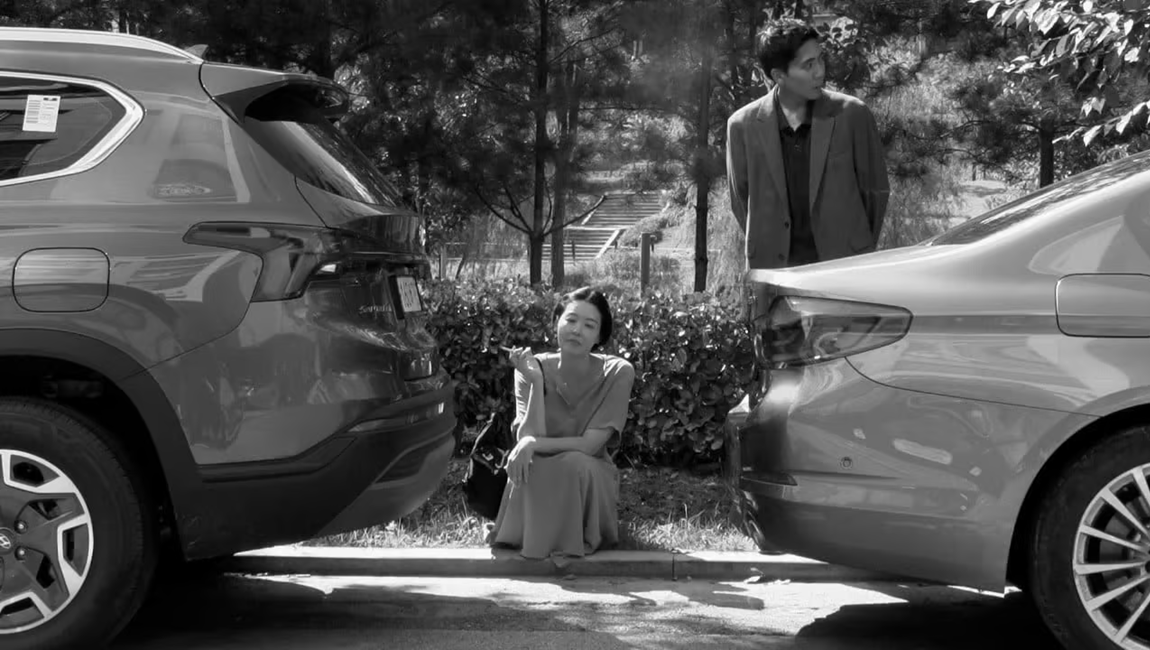
Every time a Hong Sang-soo film plays at a film festival, one can assume someone in the audience is encountering the prolific filmmaker for the first time. An artist with a legion of devotees, Hong is often written about by completists (or the nearly) who are properly attuned to the master’s formal rigidity, structural games, and ever-evolving experiments. But the initial impression of a newcomer will likely be that whatever film in front of them is simply lifelike, that the mundane situations are recognizable to anyone, and that the characters seem to go on beyond the confines of the movie which is only a glimpse into their days. That this ordinariness persists alongside Hong’s rigor is worthy of celebration. The Day She Returns is another film in this mold, one where the lives of the characters on screen expand beyond the strong margins Hong applies.
But the films are also lifelike in that, once one has seen a handful, they can start to blur together like one’s own memories, especially as they star a recurring troupe of actors in similar situations. Taxonomy is therefore useful. In reviewing this year’s Nowhere to Lay My Eyes, Lawrence Garcia sets out by sorting the filmography between films “where the structural play with narrative is upfront and unmissable, explicitly marked with title cards or numbers” and those where that structure is hidden. He places The Day She Returns into that first category — the first image after the title card is the numeral 1 — and we can go further to sort the film into a few more simple descriptive categories. The film is in black-and-white; it is one of the director’s films that principally concerns women, the men in the film remaining mostly unseen; and it is another Hong Sang-soo film about characters involved in filmmaking.
The film is split into five chapters, and there are hardly twice that number of camera setups. In the first three sections, Bae Jeongsu (Song Seon-mi), an actress who has recently returned from retirement, sits in a restaurant and allows herself to be interviewed by three young women, ostensibly about her new independent film. Each interviewer, however, seems more interested in facts surrounding Jeongsu’s personal life and celebrity than in her movie, the second interviewer going so far as to admit she knows little about cinema and didn’t appreciate it. They all seem destined to file dull puff pieces. By filming each of these interviews in the same static two-shot, Hong communicates the exhausting repetition of a press day from the artist’s perspective, where a meager few hours of the actress’ time seem longer, especially as each interviewer returns to the questions of the last and her answers, while different each time, also begin to seem canned.
Once in each meeting Hong will cut in to a close-up before characteristically zooming out to the original framing. The implied ellipsis and Hong’s limited framing call attention to the unknown beyond the frame. The director of Jeongsu’s film, for example, recurs throughout the film but always offscreen, his voice ending each interview. And then, of course, there’s the matter of Jeongsu’s personal life, the subject of the bulk of these interviews but one that is still mostly circumvented. She speaks in generalities about her daughter and her divorce, an event that we can infer precipitated her return to the cinema, if not for financial reasons then at least for personal fulfillment. All three interviewers push her on her divorce — search “Hong Sang-soo divorce” and read this inclusion as you will — but she resists divulging out of fairness to her ex. Like most Hong characters, she drinks, not so much now as she used to, but her playful insistence that she and her interviewer order a beer in each segment points toward something more than just a casual tendency to drink.
Then, in the final sections, Hong’s structure further reveals itself. In her evening acting class, Jeongsu is tasked with writing a script based on the day’s events and performing it with a classmate. The reenactment draws upon material from all three interviews but embellishes — or fills in elliptical gaps — to provide new information and insight. Jeongsu’s response to the banal question — “any advice for young people?” — that ended each interview is particularly expanded, like a better, more detailed answer to the question, obviously advice she’d like to have given her younger self, has only come to her now that the moment has passed. She has to refer to her own script several times to recall her own lines.
The added layer of abstraction gives Song a showcase to play her character differently, displaying a variability between the natural performance she gives in the film’s first half and the performed naturalism of the acting exercise. Jeongsu’s performance is like her projected real self from earlier, only with the addition of mannered gestures that suggest an actorly realism. What Hong accomplishes with this last section is externalizing a process by which a combination of experience and internal thought becomes a work. Jeongsu misrepresents her reality not out of malice or shame, but out of a desire to know herself better and make acting a transformative practice. We only know artists through what they tell us, either via interviews or, more tellingly, their art, but they exist beyond these brief glimpses. Even the minor characters in a Hong film feel the same way. The Day She Returns ends in transit to another destination. There’s a world beyond its walls.
Published as part of NYFF 2026 — Dispatch 3.
Comments are closed.