
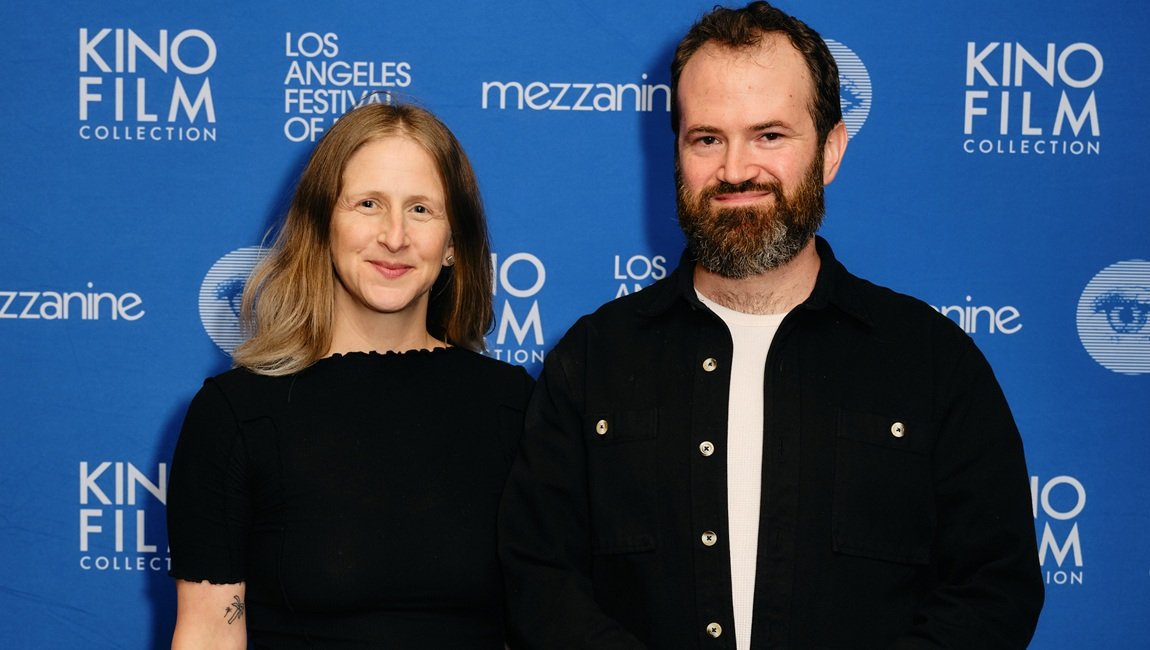
Los Angeles Festival of Movies (LAFM) wrapped its third edition a couple weeks ago, and festival co-founders Micah Gottlieb and Sarah Winshall have made incremental changes each year in a deliberate and organic manner. They’re not hamstrung by preconceived notions of what their festival is or, more importantly, who their audience are. In Gottlieb’s words, LAFM’s “primary goal is always to have an eclectic group of good movies that showcases a holistic view of independent film today.” And so, while LAFM is consciously not an industry-driven festival, adding benefits like a daily happy hour or making headshots available for their largely-filmmaker audience does not fight against this core mission. LAFM recognizes L.A. as a city where the various artistic scenes, whether comedy, fine art, or film, all interact fluidly. Case in point, the festival programmed Conner O’Malley and Danny Scharar’s Rap World in year one, Tim Robinson’s Friendship last year, and now this year’s opening film was comedian John Early’s directorial debut, Maddie’s Secret.
I caught up with Gottlieb and Winshall on the opening day of the festival, where we discussed their brand new vendor market, avoiding useless pessimism, and program highlights which saw a stronger contingent of Los Angeles filmmakers.
Caleb Hammond: From year two to three, how has the festival evolved?
Sarah Winshall: This year we have a vendor market, which is something we’ve wanted to do, but hasn’t had the bandwidth until now. So at 2220 Arts and Archives in our lounge, there will be several local businesses and various sponsor partners with booths on Saturday and Sunday. There’s Videotheque and Stories, and a few magazines, like The Big One — all different organizations that share a mission with us. We’ve also partnered with Cinecamp, which is providing child care for people who want to attend the festival. Presidium Overactive curated a local filmmaker shorts program, which will be fun and rowdy. These are all things that we’ve wanted to do in the past, but we’re finally growing into.
Micah Gottlieb: Compared to previous years, this year we have a really strong local presence. In addition to Creston Brown’s shorts program, we have a number of features by local filmmakers, like Christine Haroutounian’s After Dreaming and Tucker Bennett’s In the Glow of Darkness. We also have a film by a French filmmaker that was shot in L.A., Selegna sol, which is one of the most striking and beautiful films about L.A. that we’ve seen in a long time. We’re always happy to have a local presence, and it’s something we’ve tried to be more conscious of this year.
CH: Highlight a few films in the program that you are excited for.
MG: Mary Stephen’s Shades of Silk is an example of an independent film made for very little money in the ’80s that looks three times its budget, with beautiful cinematography, clothes, and textures. I’m proud to have Christine Haroutounian’s film After Dreaming in the festival. It reminds me of a lot of the transcendental art films that I came of age loving in the late ’90s, early 2000s. The fact that Carlos Reygadas is an EP on the movie is not surprising. It’s a movie that deserves a bigger platform, so I’m really happy to have it.
SW: Selegna sol is such a revelation to me. It reminds me of Varda’s L.A. movies, where there’s this travelogue element, and you’re getting such a beautiful texture of local scenes through the 16mm cinematography. It’s a great hangout movie. Our talks are exciting this year. I feel particularly proud that we’re having two very different conversations around the same topic. Our talk with film critic Melissa Anderson and writer-artist William E. Jones is sure to be an exciting and punchy exploration of what cinephilia means these days. Then we have Josephine Decker and Lisa Hanawalt talking about their own filmgoing and appreciation habits. It’ll be revelatory to learn more about how these two artists take in art in their day-to-day. That’s what I want to know about people’s lives.
MG: We try to make our talk topics as collaborative as possible with the participants. When chatting with Melissa and Bill Jones, they wanted it to be something a bit more optimistic, and not just a panel of people complaining about how terrible things are—which we’re all aware of already.
CH: I appreciate LAFM’s optimism in the sense that it’s not head in the sand, saying that things are fine, when they’re not.
SW: I’m a pragmatist. I don’t need to do another panel where we’re clutching our pearls and wondering what’s wrong with the industry. Either fix it and stop talking about it. Or let’s talk about what is working. Or let’s watch the movies. What’s wrong with the industry is that we spend more time talking about what’s wrong with the industry than watching movies—that’s my hot take.
MG: Life is short. I just want to watch good movies that feel like they’re expanding my consciousness with other people and have a drink and talk with them about it, and do that over and over again.
CH: Who do you see as your core audience, and have you been surprised by your perception of who your audience might be versus who comes to the festival each year?
SW: We set out to serve the people that go to the movies on a regular basis in L.A. That other guy in the three o’clock screening of whatever’s playing at the Laemmle Glendale on a Friday afternoon is, in some ways, who I’m looking for. But then at the same time, we’ve learned that so many of our audience are young filmmakers who want to meet each other and spend time together. That has been a surprise, because we’re so focused in our mission on filmgoing and not being a festival that is teaching someone how to make it in Hollywood. So it’s actually a pleasant surprise to learn that our audience of cinephiles are filmmakers, because so often I feel like the issue is that filmmakers aren’t watching movies. It’s nice that our audience is that cross section of filmmakers who do watch movies.
MG: I really want to cultivate an audience that is curious and open-minded about what cinema is and can be. We’re lucky to be operating in a part of the city where the same audiences that go to arthouse and repertory screenings are the same people that go to literary events, gallery openings, poetry readings, music shows, etc. And so, being able to have a festival that is not defined by Hollywood, that is trying to be multidisciplinary, in conversation with other art forms, and that is showing work that hopefully feels original and fresh. Those are the people that I like to hang out with anyway. That’s what makes this so satisfying and fun.
CH: Can you highlight the opening and closing films? Both slots say something about what a festival is going to be in a given year.
MG: Maddie’s Secret is an ideal opening night movie for us, because it checks off so many boxes. It’s a great L.A. movie. It’s an amazing independent film that is in conversation with film history and film culture in a subtle way. It brings to mind Todd Haynes, Douglas Sirk melodramas, but also films like But I’m a Cheerleader — movies that are in love with film artifice and are colorful, both in terms of the script and the aesthetic of the movie. But these are also movies that are tackling real social issues at the same time. The sincerity of the movie will sneak up on people. People will go and expect it to be a laugh-out-loud comedy, which a lot of it is, but then it becomes an emotional and sincere movie. For closing night, I was bowled over by Blue Heron. Over the last decade, Sophy Romvari has made a lot of accomplished short films that are all to some degree autobiographical, and to see her make a feature that delivers on the promise of those short films, with something that feels textured, both on a sound and image level, is really wonderful. We’re proud to host the U.S. premiere of this movie.
Comments are closed.