
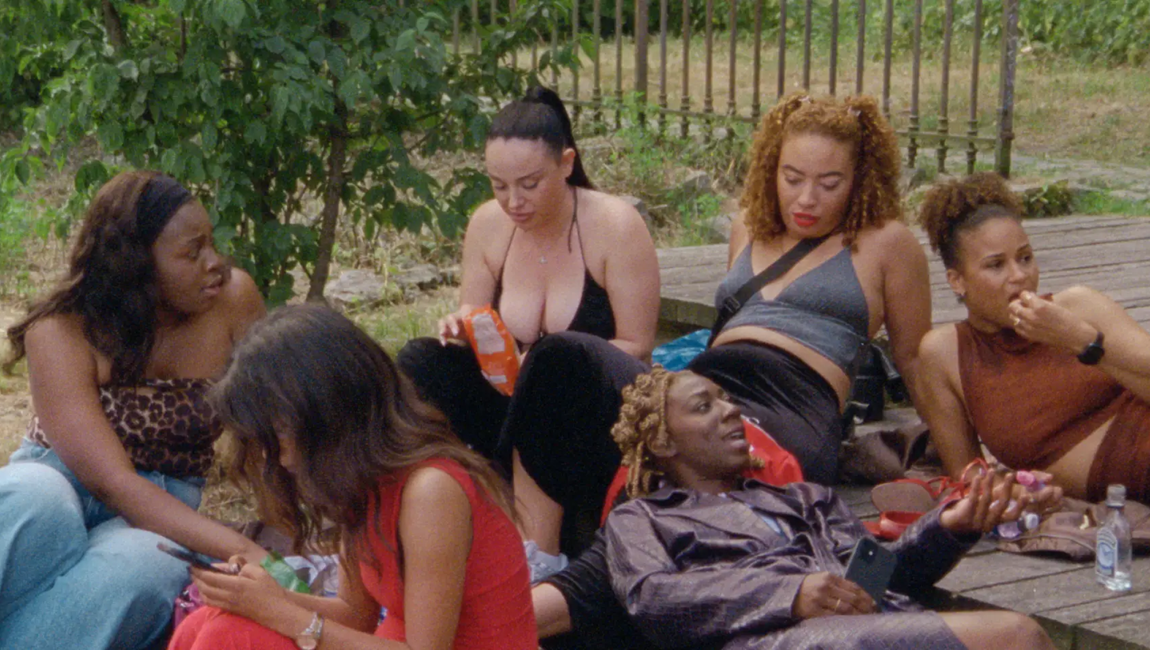
Shana, Lila Pinell’s debut narrative feature, centers on a character who is immediately compelling, yet whose complexities and internal contradictions unspool gradually throughout the film’s brief runtime. Shana (Eva Huault) is a young Parisian woman who has a strained relationship with her family, an active yet tumultuous social life, and an abusive boyfriend currently serving a prison sentence. The film, written by Pinell with Catherine Paillé and Elie Wajeman, is at first an observational character study. But Shana’s inheritance of her late grandmother’s treasured ring and her boyfriend’s sooner-than-expected release, however, heighten the stakes of her unfocused life, and therefore escalate the film’s narrative momentum. Pinell, to her credit, does not allow Shana’s charismatic and multivalent characterization to be subsumed into a Safdie-style quest of humiliation; rather, she uses the narrative framework as sturdy scaffolding for a fully-realized portrait of Shana. Bolstered by an energetic and palpably emotional performance from Huault, Shana succeeds as an engaging exploration of the struggle to achieve independence and self-worth, even when surrounded by stifling relationships and hostile social systems.
Shana begins with a series of episodes establishing its titular character’s brash personality and the different spheres of her life. We first see Shana exploding at a group of friends after she is eliminated from a role-playing game, then celebrating Passover with her family; during the Seder, she confronts her mother (Noémie Lvovsky) for criticizing her recent lip injections. In contrast to her typical defensiveness, when she talks on the phone with her boyfriend, Moïse (Sékouba Doucouré), she is sweetly deferential, despite her friend Inès’ (Inès Gherib) frequent admonitions that she should leave him. Pinell moves through each scene efficiently, while giving each enough time to provide a clear picture of Shana in different contexts.
By steadily steering Shana through everyday episodes, Pinell establishes—largely within dialogue, rather than exposition — that Shana was left in foster care by her mother at 12 years old, and that she was “rescued” by Moïse when she was 18. These two significant events in her coming-of-age add depth and context to her tense relationship with her mother (who has been planning a bat mitzvah for Shana’s younger sister, sparking Shana to remember how her mother treated her at the same crucial age), and her devotion to Moïse despite the fact that she knows that his physical and verbal abuse has harmed her. It takes much of the film’s first two acts to establish this key information; while some viewers may find this pacing overly leisurely, the careful characterization and emotional scaffolding prime the audience to empathize with Shana once she faces serious obstacles. These episodic scenes are compelling in their own right, too, largely due to Huault’s dynamic performance: She convincingly shifts into defense and vigorous self-preservation with ease, while communicating the depths of Shana’s pain in quieter moments with equal conviction.
When Moïse returns to his and Shana’s shared apartment, he soon discovers that she has been spending money that he had entrusted her to save. He unleashes a torrent of misogynistic and anti-Semitic abuse toward Shana in response; she hurries out of the apartment, and he demands that she come back with the missing cash. Shana’s predicament, in a lightly supernatural subplot, is compounded by the fact that she recently sold her grandmother’s ring for a paltry amount. The ring was supposed to protect Shana from the “evil eye,” and she soon finds herself encountering misfortunes of Biblical inspiration.
Pinell struggles to draw these different narrative threads to a logical close; while she does not leave any loose ends, she also creates resolutions somewhat perfunctorily and with uncharacteristic abruptness. One senses that Pinell may be reserving Shana’s character for future installments, as Shana ultimately reads more like an episode in a larger story than a self-contained narrative. Whether or not Pinell and Huault revisit Shana, though, they have effectively created a captivating character, and have given her a lively and affecting showcase.
Comments are closed.