
Where experimental film is concerned, that subsection we call “structural film” is characterized by a radical transparency. This may seem like an odd claim to the uninitiated, but like all aesthetic claims, it must be understood in historical context. While structural films are by no means “normal” films (i.e., narratives), they tend to adopt a set of principles and procedures and follow them through to their logical conclusion. So if you pay attention to the pattern — numerical, alphabetical, looping or repetition with incremental differences, what have you — you can usually infer what the film is likely to do. Structural film tends to reward pattern recognition, letting the viewer make hypotheses and test them out over the course of the viewing.
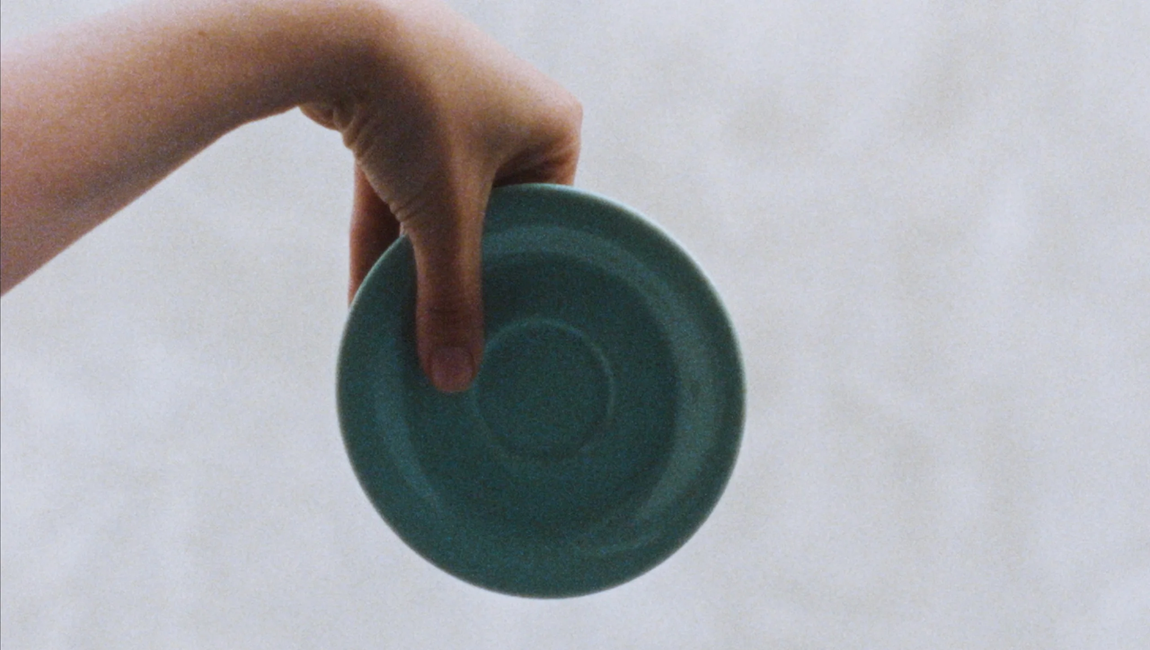
Sofia Bohdanowicz’s latest film Pure Reason certainly partakes of the methods of structural film, but in some fairly significant ways it avoids actually being one. It does indeed introduce a set of images arranged in a particular order. Each of the film’s seven iterations is centered around a particular color. With each pass, Bohdanowicz tracks right to left over a set of Greenbergian color field images, with thin unmixed paint applied to a surface so that the various colors bleed into one another. (For reference, these sequences look a lot like the canvases of Sam Francis or Helen Frankenthaler.) Then, in almost every instance, we see the following: a written list; a hand holding an object of one particular color; a full screen of pure color, a digital paint sample as it were, with a serial number in the lower-right-hand corner of the screen.
After this, Bohdanowicz shows us a textured wall that appears to be the color associated with that iteration. However, the hue is typically lighter and inconsistent, shifting in relative intensity from moment to moment. In most cases, we then see the camera move laterally, with the brighter, purer color imprinting itself on the film like an end flare. The accompanying sound varies from segment to segment. Sometimes we hear ordinary domestic sounds, like a canary singing or a child asking a question. Other segments have distinct musical motifs. Most notably, the purple segment features the first three notes of Prince’s “Purple Rain,” before ambling off into a more generalized drone.
This use of variant sound textures is the first signal that Pure Reason is diverging from the path of structural film. Typically, the sounds would be the same, or they would metamorphose in some discernible progression or regression. But each is wholly distinct, bearing little relationship to the others. In fact, the use of “Purple Rain” in the purple section miscues the listener to expect similar textual references in the selections (for example, “Greensleeves” in the green section) or leads us to wonder whether the other sounds feature some color-based reference we simply don’t recognize.
But more importantly, in the fourth section (green), Bohdanowicz alters the order of presentation. Instead of list/object/paint sample/wall, we get list/wall/object/paint sample. This is not a palindrome or a simple reversal. There is no obvious way for the viewer to make sense of this change. The fifth and sixth sections (blue and teal) revert to the original order, and the final section (orange) uses the same order as green.
The more we reflect on Pure Reason, the more anomalies begin piling up. What exactly is happening in the colored wall segments? Sometimes, but not always, we hear the clicking of a slide projector. So there is a good chance that we are seeing the same neutral wall, with Bohdanowicz projecting colors in the general vicinity of the wall, so that we are seeing ambient light spilling over onto the wall. But the written lists we see at the start of each section seem to break those colored-wall sections down into precise increments of time. After noting what one assumes to be a lens selection (“91/50mm”), the list provides a breakdown. From the orange section:
6:24 am orange wall
6:29 am orange wall6:31 amm orange wall
And so on, until we get to: 6:47 am drank orange juice. The list continues through 7:02 am, with all times labeled “orange wall” except for 6:51 am (“sunrise”) and 6:55 am (“drank tea”). All the other lists are similarly interrupted with “distractions” from the wall. The red section features notations such as “the red still hasn’t appeared,” and later on, “I’m bored.” The teal list includes “sliced some mango” and “offered Dorota mango.” And so forth.
So what are we to make of this? The lists would indicate that Bohdanowicz is simply observing chromatic phenomena, rather than generating them. And various daily tasks pop up here and there to interrupt her attention to said phenomena. But what is crucial here is that there is no way for the viewer to know. Bohdanowicz provides data without giving us the framework for interpreting that data. So we understand that a structural procedure is being enacted, but we cannot know exactly what it consists of, or what it might mean.
This uncertainty, it seems, cracks Pure Reason wide open. Rather than appearing as mistakes, these inconsistencies point to the film’s unwillingness and maybe even the overall impossibility of making a perfectly systematic film. The title, after all, directs us to Kant’s Critique of Pure Reason, in which the philosopher distinguishes between a priori and a posteriori judgment. A priori judgments are derived from universal abstract principles, whereas a posteriori judgments are based on experience, especially sensory experiences. So in some respects, Bohdanowicz follows in the footsteps of structural filmmakers like Paul Sharits, attempting to take the sensory data of color perception and organize it according to a conceptual system. But Pure Reason’s system is impure. The painted sections show us colors blending into each other, and the wall sections provide only suggestions of the color under investigation. Time, available light, and human perception are muddying the waters of pure theory.
This leads us to other curious aspects of the film, and what Bohdanowicz might be telling us about the legacy of structural film. For instance, we discover that the blended, “impure” colors may in fact be the studio walls of Canadian painter Jaan Poldaas. Poldaas’ canvases are composed of sharp blocks of color that abut one another but never intersect. Bohdanowicz could be referring to these clean, systematic paintings by looking at the environment of their making, which is far messier than the products that emerge from them. This might mirror the domestic sounds we hear on the film’s soundtrack, or the list notations that tell us that the contemplation of (im)pure color has been interrupted by commonplace human tasks.
The critical rap on structural film in its heyday was that it was an axiomatic cinema, one that radically narrowed its parameters so as to subject them to an almost scientific kind of control. This made the resulting films vaguely akin to research. But every artwork, every creative artifact, comes from somewhere. The making of art is an immanent process, even when it aspires to transcendence. Pure Reason alludes to strict compositional controls but also appears to invite the chaos of lived experience, which also happens to be where the phenomenon of color — a perceptual artifact, not an essential element of things — actually resides. Pure Reason dangles the temptation of absolute knowledge before our eyes, and by distracting us from that theoretical chimera, directs us to a greater, more grounded form of truth.
Published as part of FIDMarseille 2026 — Dispatch 1.
Comments are closed.