
Latvian cinema, and especially animation, has been under either a spotlight or a microscope, depending on the vantage point, since Flow took home the country’s first-ever Academy Award. The 2025 French industry event Cartoon Movie spotlighted the Baltic country’s animation, and the country has even further capitalized on the film’s success with promised investments for animation. Latvian was also the focus country for Lisbon’s MONSTRA Animation Film Festival 2026. It’s in this pressurized context that Latvian animated feature director Edmunds Jansons’ new film, Born in the Jungle, blunders its chance to follow the successful path of Riga’s dark grey cat.
The concept is essentially Home Alone but in a jungle. In 1950s Venezuela, Elizabeth’s parents decide to spend the summer in the middle of the jungle, far from their social lives in Caracas. Elizabeth, at just nine years old, already knows the jungle isn’t for her. Her yet-to-talk younger brother Leo has a different story. The chaotic jungle is just a green playground to him. When mom and dad head to the city for a day, they leave an unprepared Elizabeth in charge. Alligators, leopards, sloths, monkeys, and more greet the siblings in their day-long adventure into the jungle near Angel Falls. The two make friends with a mythical otter-hamster creature they name Fluffy, a little Indigenous kid named Nev, and wind up in a game of cat-and-mouse with poachers who want the creature for their own grubby financial gain.
Keen viewers may note that Jansons’ colorful and friendly animation finds its closest Western comparison in Rugrats, and that’s not by accident. Rugrats creators Igor Kovalyov and Klasky Csupo, Russian and Hungarian filmmakers respectively, were tremendously influenced by the work of Estonian auteur animator Priit Pärn (Triangle, Night of the Carrots) and his graphical surrealism. Jansons was an actual student of Priit Pärn at the Estonian Academy of Art, where he earned an M.A. in animation. Keeping the creative colorist and unpolished homey appeal, Jansons’ films don’t simply regurgitate the master’s: the former is less serious and always beautiful, the latter is more moralistic and occasionally willing to let his films get ugly.
Loosely based on the life of Latvian explorer Aleksandrs Laime, the visuals and context of Born in the Jungle together promise something like a Latvian Rugrats-style kids’ adventure with the political awareness of Hayao Miyazaki. But Jansons’ film shows none of the reflection you would expect in 2026 for a story about Europeans “discovering” parts of Venezuela. Faithful to the neo-colonial ambition of Laime, who searched for a “diamond river” in the South American jungle and became history’s first recorded human to reach Angel Falls, Born in the Jungle exploits Venezuela artistically.
The all-European co-production shows no interest in the Venezuelan context in any specific ways, nor even in the 1950s. Indeed, should the film taken place in any other jungle in the world, the only change necessary would be to perhaps adjust the skin tones of the handful of Indigenous people Elizabeth and Leo encounter. Meanwhile, the mid-20th century setting makes for some cutesy propeller plane animations and might explain the parents’ willingness to let a nine-year-old babysit a toddler in a jungle, but it adds little to the world as conceived by Jansons. There aren’t even any real concepts being juggled. Originally produced in Latvian, not Spanish, along with an almost seamless English dub, the language doesn’t get any closer to the culture of record either. Most strangely, the unapologetic romanization of European “exploration” of South America and the absence of the turbulent political context of this specific country in this specific time as they experience a military dictatorship is simply flabbergasting.
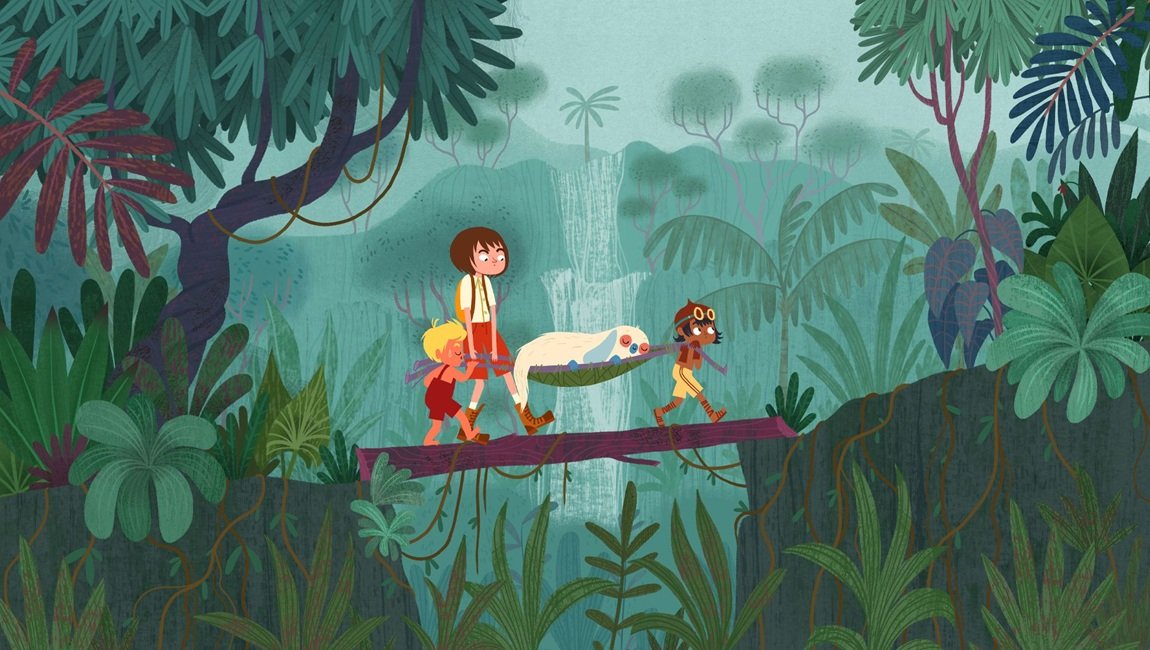
The aforementioned Indigenous people of the jungle are marginally more personified than the animals in Elizabeth and Leo’s single-day adventure. Leo, who can’t talk, seems capable of what sounds like a stereotypical Native American war cry one finds in Westerns. A minor plot about returning a giant diamond to the “mountain spirits” becomes distasteful when the “spirits” are, in fact, Nev’s people. His language stays untranslated — forever foreign and mysterious to the viewer — as he rescues the siblings and traverses rivers and mountains to evade the poachers. He also shows a (stereotypically) crafty side as he materializes a stretcher to carry the drugged Fluffy. Nev is an ideal case study for the tired native guide trope that reduces Indigenous peoples to navigators with the upper hand over nature, in the service of white protagonists. Crossing off myopic native character types like a checklist, Nev saves animals, guides the siblings to safety, and leaves them with a magic gift before returning home, where their explorer father and mother await them with his loving arms. This exotifying writing would be better off confined to museums as a relic of the previous two centuries than as the backbone for 2026 feature film.
Jansons’ romanization of European exploration does function to route his visual genius. Combining cut-out and 2D computer animation, the jungle is both geometrically expressive and fluid; foreign and familiar. The flora evoke a sublime otherworld, and the plethora of adorable animals are rendered distinctly and empathetically in an almost arts-and-crafts style. (Only Fluffy strikes a derivative aftertaste: the off-white colored mammal can fly, and its parent at the film’s end is the size of a school bus. If that description conjures an image of Appa from Avatar: The Last Airbender, you won’t be alone in thinking so.) And the colors of the jungle pop like a more prudent, sylvan Jack Kirby comic: as if holding other colors hostage, various woodsy yellows and greens hold power over the film’s look and cautiously allow a single contrasting color, like a cardinal red or an angelic white, to enter the jungle’s chartreuse palette. All of which is to say, the film’s beautiful animation truly romances with style. It’s just a shame it’s all in service of romanticizing the colonialist European exploration of the Americas.
Published as part of Fantasia Fest 2026 — Dispatch 1.
Comments are closed.