
In dreams, everyone is equal. Regardless of age, status, or character, we all sleep. In sleep, we all dream. And there, what happens is, for the most part, beyond our control. The waking hopes and aspirations, the fears and concerns, the preoccupations with past, present, and future, all of which we may alternately run from or cling to — all are surrendered to a logic that lies past logic. As indefinably unique as each person’s dreams may be, they yet unite us.
In Jonas Bak’s Somewhere Between Sleep, Lisa (Lucia Deyi) sleeps twice, and dreams twice. Her first dream is dark and abstract, a gloomy collage of lights and shapes resembling a city street at night. Living alone in a small town in rural Germany, and working evening shifts in a local bar to support her goal of opening a Chinese medical practice, a goal she’s struggling to reach in her anxiety and loneliness, she’s as trapped in dreams as in reality. Though she has difficulty remembering certain details from her past, she’s stuck in it nevertheless, unable to take the brave steps she needs to into an uncertain future. She paints the walls of her practice the same blue as her childhood bedroom; when her sister tells her the blue looks too dark, she replies that the light is darker now.
Lisa’s second dream, much later in the movie, will be quite different. Between them, she meets Anke (Anke Bak), a widow preparing to leave the town she’s spent her life in to join her pregnant daughter in Berlin. Packing up her decorations, she’s confronted by reminders of her past, a longer, though less burdensome one than Lisa’s. Despite her age, Anke looks to her future — when taking down her daughter’s paintings of the town, she calls her to ask if she’s still attached to them and, upon hearing her daughter’s response, decides to donate them to the church where she used to work.
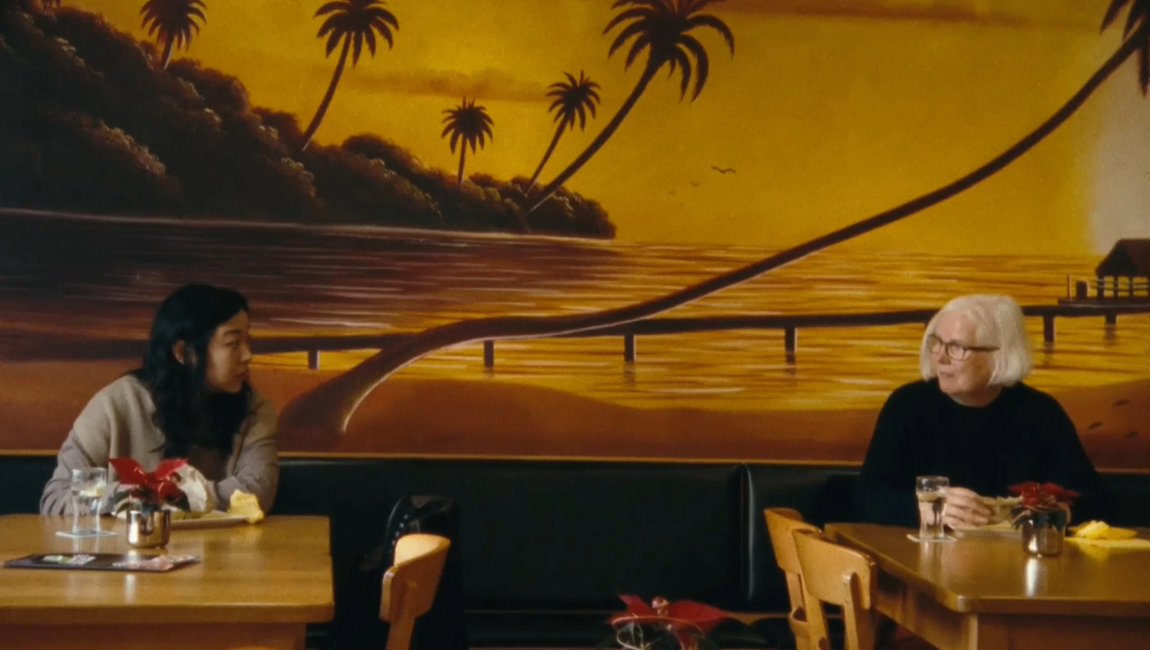
Lisa and Anke meet over shawarma at separate tables in a kebab restaurant. Anke brings Lisa a napkin, and they strike up a tentative conversation. Upon leaving, and both heading in the same direction, they continue their talk, and forge a brief, gentle, but sincere bond. One young, anxious, and aspiring to work in sciences, the other old, calm, and retired from a job in the church, but both isolated from family, the short connection they share may have a profound effect, at least on Lisa. The next time she dozes off, she’ll dream about the summers she spent in China, and about a story of friendship Anke mentioned to her on their walk.
As Lisa’s dreams change with her perspective on life, so does Bak’s style undergo a similarly subtle but significant change. His harsh, somber, compositions begin to move, light suffuses the frame, and people become the focus of, rather than figures within, his compositions. They become more attuned to their environments, no longer defined by them but part of their definition. Bak has a sublime feel for space and place — the texture of objects, the atmosphere of one’s surroundings, the tactility of the sound mix and image grain. Frequently, he positions his characters behind windows or in reflections, showing both the space they’re in and the space they observe. Yet his camera, almost spectral in its reserved distance, never feels intrusive. Bak’s not embellishing his story with unnecessary flourishes, he’s building it through necessary gestures.
Such is the quality of Bak’s evocation of a real world that his second dip into dreams feels a little underwhelming. Though one senses the importance of what Lisa experiences during her slumber, its imprecision and the relative lack of ingenuity in Bak’s method in this sequence lack the persuasive potency of the rest of the movie. It’s a small, momentary lapse, however, in what is otherwise a work of true serenity and sensitivity. Romantic and optimistic but never unduly sentimental, Somewhere Between Sleep is a sweet dream of a movie.
Published as part of 2026 FIDMarseille — Dispatch 2.
Comments are closed.