
Beyond that upper tier of ubiquitous classics like Ring, Ju-On, Audition, and Pulse, Kōji Shiraishi’s Noroi: The Curse has cemented itself as a “you’ve gotta see this” next step for J-horror fans looking for something that can stand alongside the heavy-hitters everyone’s seen. Noroi, a faux-documentary investigation into a string of paranormal incidents, makes better use of the found footage form than just about anything, taking an omnivorous approach to the subgenre and incorporating all kinds of created archival video to enhance its eerie sense of reality. Shiraishi has made many other films, some in the genre and others outside (like his great pink eiga revival film Safe Word), but his big hit is of particular interest as it’s been cited as a major inspiration for the novel About a Place in the Kinki Region, now adapted as Shiraishi’s latest feature.
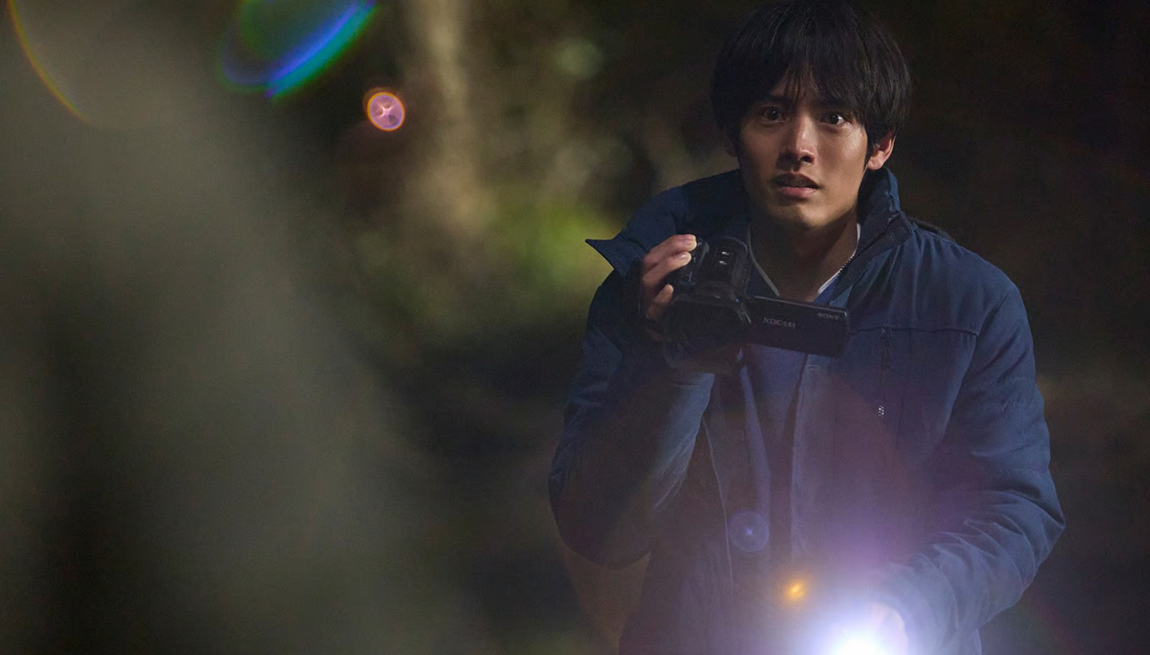
Indeed, KINKI shares a lot with its predecessor, down to a similar set of explored locations, like haunted apartment complexes and mountainside forests. The concept is taken one giant step further this time as the film’s uppermost layer of reality is presented traditionally (i.e., not found footage), though the film also disorientingly introduces this through embedded video on a Twitter feed. Principal characters Ozawa and Chihiro, employees of a paranormal magazine, dig through the materials left behind by their vanished editor in search of both an answer to his disappearance and guidance toward finishing the big story on which he had been working. As they comb through seemingly unconnected media — home video, TV documentaries, Twitch streams, interviews, and even some crude anime — we see what they do.
The types of horror explored in these segments are as diverse as the formats, ranging from unnervingly tinged videos of schoolchildren at play to folk-horror retellings of local mythology to Blair Witch-style freakouts. Throughout, Shiraishi hits upon indelible, haunting images, like in the segment wherein a live streamer explores a supposedly haunted house where hundreds of multicolored nooses hang from the ceiling, and identical children’s drawings plaster the walls. As the streamer pushes through the mess of rope, he finds a loop made of barbed wire.
Each video suggests its own world, a scenario that could sustain its own feature, but soon connections emerge and send Ozawa and Chihiro into an on-the-ground investigation into the strange happenings in the Kinki region (more commonly referred to as Kansai). At the same time, one of the videos in the collection, a cursed tape called “Watch This and Die,” has manifested a haunting around Ozawa, so their investigation takes on dramatically personal stakes.
Naturally, by the time KINKI reaches its bizarre, cosmic horror-inflected finale, we’re left with more questions than answers. Even when Shiraishi’s evils take corporeal form, they remain impossibly strange, too formally complicated to describe with accuracy. But once the film finally zooms out to its cell phone video frame, the director’s game is, if not totally clear, at least understood. The cursed videotape at the heart of Hideo Nakata’s Ring (and Koji Suzuki’s source novel) is a safe artifact to anyone who simply does not watch it. What KINKI does is riff on that film for the contemporary era, where we constantly see images and video without our total consent in an endless feed of information. The characters in Ring chose to watch the tape; Ozawa is subjected to “Watch This and Die” unwittingly. For Shiraihi, horror is no longer an opt-in proposition.
Published as part of NYAFF 2026 — Dispatch 2.
Comments are closed.