
It’s fairly easy for an artist to commit themselves to a concept, less easy for them to do it justice through their art. Lê Bảo’s exploration of the human senses — initiated with two shorts, Scent and Taste, in the 2010s, then followed by the features Taste (2021) and now Hearing — has bountiful conceptual promise, but how to elaborate on these themes, both broad and specific, in an audiovisual medium? Taste was a striking but stagnant semi-exploration of its title, but Hearing is a significant step forward for Lê. Looser than its predecessor stylistically, and with substantially more purpose and momentum, it makes more sophisticated use of Lê’s fabulous sensorial craft, even if it ultimately proves still a little too ambitious for him to control.
Ninh (Quốc Tuấn) installs decibel meters in homes and businesses, devices that blast blue-purple light when the noise reaches a level deemed unacceptable by his clients — bars, discos, graveyards, even one private residence where a woman has seemingly demanded near silence from her husband. Ninh is mostly estranged from his ex-wife, and seeks to repair the broken bond between his parents now that his mother has fallen ill. He works in silent spaces, and exists in them too, the personal relationships around him having ruptured and left him lonely and somewhat resentful. But whether or not he can work his way out of this rut is beyond his control.
It’s also rather beyond Lê’s concern. Much of Hearing is comprised of sequences of minimal narrative relevance (including a series of sequences toward the end of a most enigmatic nature), while the plot fragmentation and ellipses obfuscate clarity. A lack of dialogue would further aggravate were it not for the function it serves: Lê focuses the viewer’s own hearing not on what his characters say, but on what they do and on where they do it. Action and environment are more influential to Ninh and to others than their individual intentions, and those who surrender to this deprivation of agency are the movie’s most contented figures. The devices he installs are designed to control and manipulate these environments, and the value they add to their recipients’ lives is questionable.
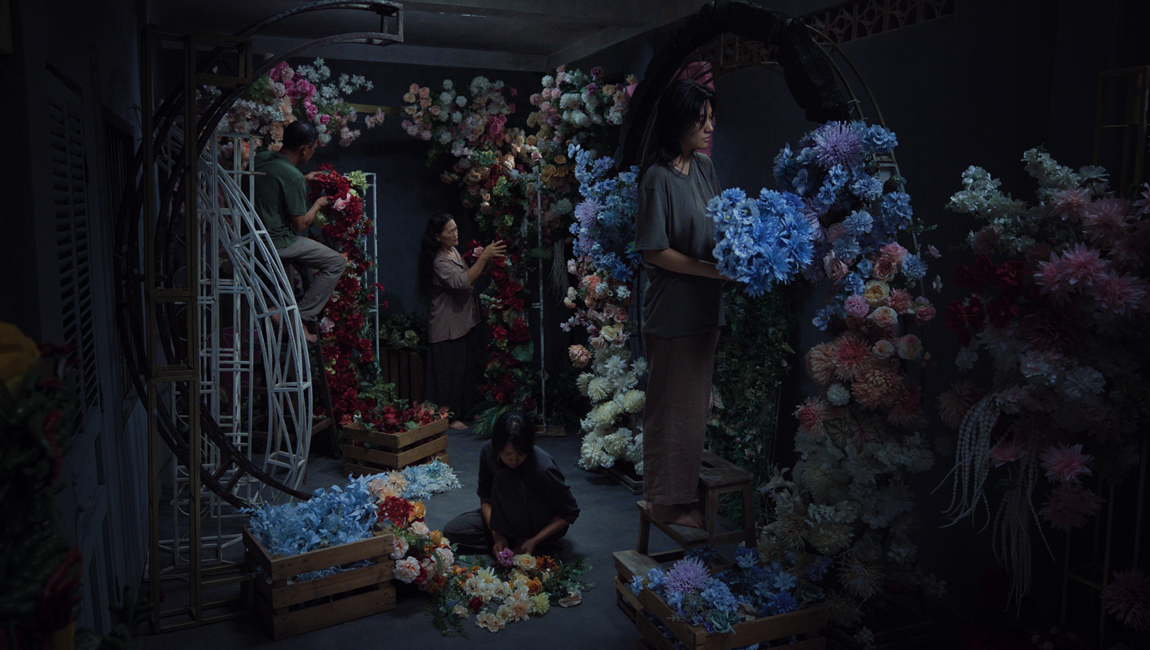
Until its final 15 minutes, where Lê indulges in some underdeveloped, mildly fantastical tangents, Hearing is too plain and literal to be mysterious, but it’s certainly cryptic. He asks a similar surrender of his characters as of his viewers — that we give in to the sensory pleasures this movie has to offer. And it has many: from curious sights (a boy stood inexplicably on one leg amid a magnificent floral arrangement above a rowdy bar) to strange encounters (a man delivers a eulogy for his tooth before wrenching it out with string; off camera, in keeping with the tranquility of the movie’s tone) and subtle flourishes (compositions in which characters seem to become almost invisible in their surroundings). It has a unique feel, meditative yet without the long takes commonly associated with slow cinema. Lê has an elegant perception of pace and composition relative to the on-screen action, slowing and simplifying as the action’s rhythm does, and intensifying with it too.
Yet the narrative imprecision of it all takes its toll, leaving one with a slight sense that Lê may intend only to show off his technical skill. The various diversions and asides hold little contextual value, as do the scenes concerning Ninh’s family members in his absence. It’s a beautiful movie, but one that fails to make a clear point for itself beyond said beauty. One may marvel at how Lê captures a mood of stillness and diligence in an opening scene in which most of the screen is filled with noise and movement, but scenes such as these, while impressive in isolation, have less lasting impact than they ought to. They isolate themselves, and Hearing feels fractured as a result.
But it’s wonderful nevertheless to see a filmmaker break free, even if only a little, from the conceptual confines they’ve imposed upon themselves — and particularly to do so with such stylistic sensitivity. He may not yet have his storytelling down, but Lê has made real improvements in this regard after Taste, and his appreciation for how to use his excellent eye and ear within a story has sharpened. This is a fine, rewarding movie, as beautifully put together as anything else this year.
Published as part of Locarno Film Festival 2026 — Dispatch 4.
Comments are closed.