
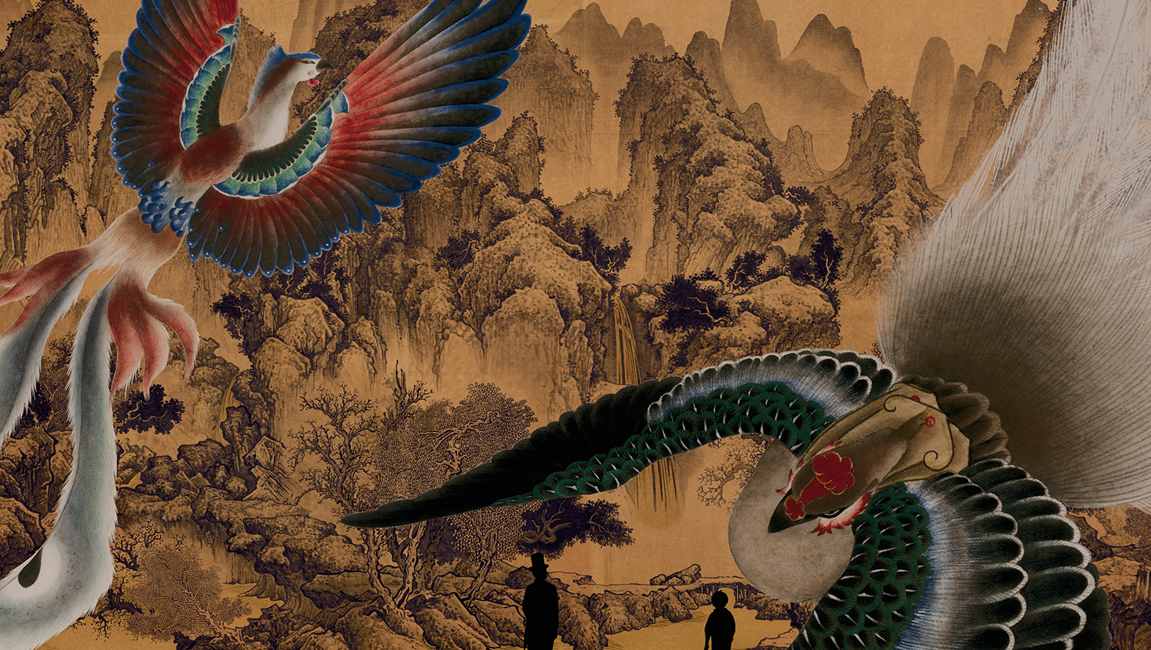
True objectivity is, practically speaking, virtually impossible when analyzing art. Each individual approaches each work of art, whether film, painting, music, literature, or so on, from a perspective informed by their own outlook and experiences. A song about heartbreak might be more meaningful to someone going through a breakup; a painting of religious transcendence might be more impactful to someone of deep spiritual faith; a book about revolutionary politics might be more convincing to someone with left-wing beliefs; etc. With some films, it’s better to watch them knowing as little as possible beforehand. With Sun Xun’s Magic Atlas, though, the opposite is the case.
There’s one extra-diegetic detail that it may help to know before watching Magic Atlas, though it’s one that’s eminently clear from the film itself: its production took a whole 10 years. If the artistry displayed here isn’t impressive enough on its own, the dedication it took to display it must be. Otherwise, this astonishing animated fantasia is almost aggressively obtuse in divulging much meaning behind its extraordinary imagery. Its contextual collage of political history, cosmic spirituality, and horror-fantasy might imbue it with a richness fully appreciable only to those better versed in these specifics than this writer — it’s like an untranslated text, decipherable by those who can speak it. But though its meaning may not be clear, its marvellous beauty certainly is.
Sun tells his story with a logic-defying looseness that befits a film of such stylistic variety, though that doesn’t exactly make it any easier to follow. Essentially, the film concerns a young boy in the fictional empire of Luocha, where coal is king, the inhabitants are a mix of talking animals (including humans), and flight is a criminal offense. A magician arrives in the region, and is instantly imprisoned on the eve of a national festival, where the authorities have planned a terrible surprise for their subjects. Details of the plot are of some significance, though rarely much. Rather, they serve as vehicles for Sun’s artistic explorations, combining an array of media, most notably extensive wood carvings whose frequency and intricacy boggle the mind. By the film’s final stretch, almost all semblance of narrative has fallen away.
If Sun is trying to create a mood rather than tell a story, he’s surely succeeded. The abundance of visual information overloads, and the intoxicating mysticism of the last act baffles, but the world Sun has imagined into existence out of wood, paper, and pixels is vivid and compelling. His style is vibrant, with relentless detail generating transfixing chaos even in monotone wood, and every artistic choice feels informed by its thematic importance and its impact. There’s a sense of bleak austerity one moment, then lush wondrousness the next, then raucous humor the next, and references from Dalí to Itô. The opening functions like a tapestry, with the image moving rightward over warriors on horseback; black-and-white turns to sepia-and-white before turning to color, which becomes gradually more vibrant.
With such a wealth of ideas, from stylistic to thematic to narrative, it’s both a wonder Magic Atlas isn’t more engaging and no wonder. The film is simply so congested with material, and so opaque in elucidating upon it, that it’s potentially impossible to understand it all on one viewing. Whether it’s possible on repeat viewings or not will be a matter for those willing to endure the task, though what a thrilling task to witness such artistic excellence multiple times. And what an achievement too — early on, narration relates time, space, and existence to ink and woodcutting, with its temporal aspect seen in the time it takes to create and its physical aspect in being actual tangible matter, not just dots on a screen. You can see the time in Magic Atlas, all 10 years of it, and it’s quite evidently 10 years well spent.
Published as part of Locarno Film Festival 2026 — Dispatch 4.
Comments are closed.