
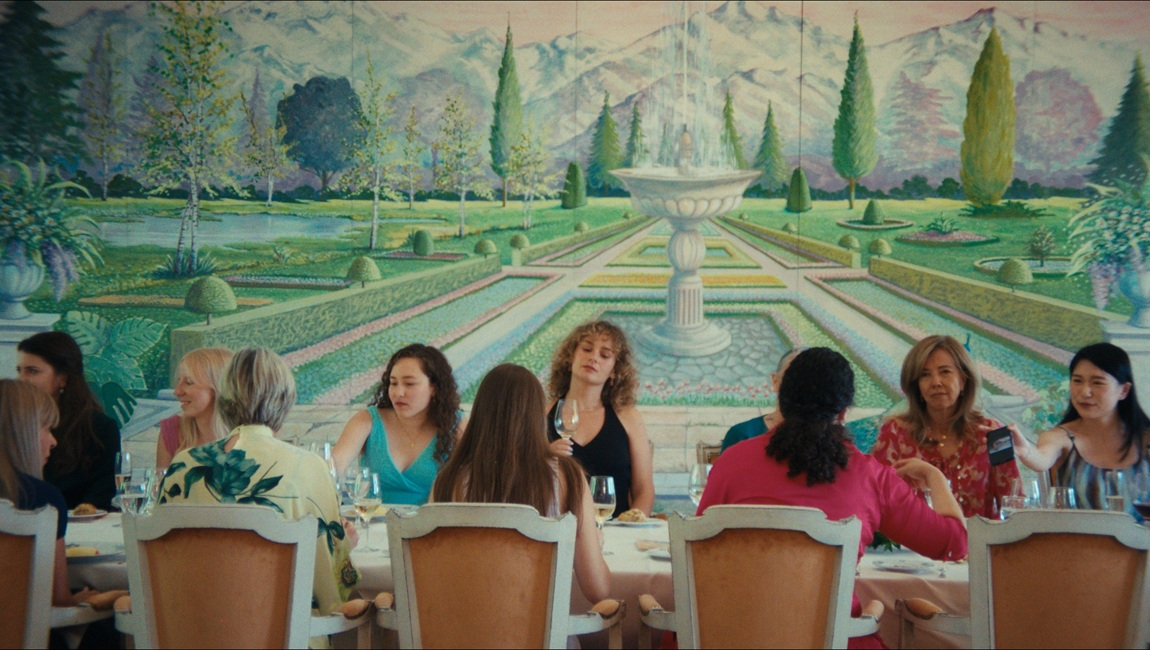
Small talk counts more critics than supporters. Pleasantries about families, careers, mutual acquaintances, or — if the conversation really gets dire — the weather, despite their obvious centrality to everyday life, are typically thought of as shallow and boring, if thought of at all. Director Mateo Ybarra is interested in those who take the opposing view. In his docu-fictional film that itself bears the title Small Talk, Ybarra plants the fictional Charlie (Hélène Bares) within an actual summer course at the Institut Villa Pierrefue, the last extant Swiss finishing school, perched on a hilltop overlooking Lake Geneva. Small talk is serious business at the pricy Institut, with instructors describing it as an “appetizer” to a main course of more substantive conversation, and teaching students how to subtly steer subjects away from controversial topics and prioritize appearing “interested” over being “interesting.” The principles of effective small talk correspond to other manners of etiquette: each lesson taught at the Institut, whether on table-setting or descending a staircase in heels, entails molding one’s behavior to a socially contingent structure of unwritten rules designed to elevate one’s status by ensuring the comfort of others. Ybarra effectively encases the actual practices of the Institut within a loose narrative frame, and in doing so enacts an ethnographic, productively ambivalent critique of an institution that prepares wealthy women to operate in spaces shaped by patriarchal capitalism.
The lines between documentary and fiction are blurred in Small Talk, but they are not impossible to parse. It is unclear the extent to which the conversations between Charlie and the other denizens of the Institut are scripted or improvisatory; based on the structured nature of the scenes that occur between Charlie and the film’s other subjects, though, it would seem that Ybarra has orchestrated these encounters, while presumably presenting the actual subjects’ viewpoints and personalities within these narrative frames. The courses and exams sync up precisely with how they are described by the Institut itself and in past journalistic accounts (most notably in a perceptive 2018 New Yorker article written by Alice Gregory), and the Institut’s history and current personnel also align neatly.
Ybarra, with the collaboration of writer-actor Bares and co-writers Louis Rebetez and Milan Alfonsi, deftly crafts Charlie as an audience surrogate. Charlie is a French woman who works in the fashion industry and aims to obtain a new job in Dubai, and in an effort to shape up her manners to suit her ambitions, pays the steep price (over €30,000) to attend the Institut. Charlie, portrayed with seamless naturalism by Bares, is as unpolished as she is ambitious. Amidst high-powered businesswomen and beneficiaries of familial wealth, Charlie’s flippant, mildly awkward personality sets her apart. She struggles to remember the correct placement of silverware, and she admits that officially verboten conversational topics — “love, politics, [and] money” — are her favorites to discuss. Ybarra, though, does not impose a narrative of ostracization on Charlie; rather, she is a mild fish-out-of-water who her instructors are keen to help and who her classmates take to quickly. Charlie’s narrative arc, then, follows how she wrestles with the stringent values and social codes embedded in the course of study, and how her behavior changes over the summer. By keeping Charlie’s character development largely internal, Ybarra frees up the actual instructors and students from fulfilling specific narrative roles as allies or antagonists, allowing them to present themselves on screen without explicit value judgments from behind the camera.
The instructors, including headmistress Viviane Neri, present the Institut as a place to obtain vital social knowledge, with importance placed on cross-cultural communication and women’s empowerment. Their emphasis on the social and business skills that they aim to impart comes across as defensive, given the image of finishing schools as outdated and anti-feminist — note a scene in which some students complain about friends and family dismissing the program as a training ground for “princesses” or “housewives.”
The program is indeed business-centric, and Ybarra depicts courses and lectures involving dressing for the workplace, leadership styles, and journalism — alongside tea-serving and party-hosting. Emphasized in every aspect of the coursework, though, is an extremely narrow presentation of womanhood: the students are cautioned against dressing in a “sexy” way or speaking in a pitch deemed either girlishly high or mannishly low. When Charlie receives private feedback from her instructors, they encourage her to “tone down” her personality, which one describes as “too much” and “fake.” This particular scene is slippery — since Charlie is a fictional character, it is unclear whether Ybarra scripted this feedback, or if the instructors delivered the feedback that they would have given to Charlie were she an actual student — but it does emphasize how rigid, yet unclear standards of behavior designed to appeal to men are given equal weight as more concrete codes of ethics. Ybarra also emphasizes the cloistered world of wealth that the school represents: one particularly out-of-touch lecture focuses on the issue of hiring household staff, and the lecturer encourages the students to run credit checks on potential hires as a means of screening against potential thieves.
The students are shown to have a variety of responses to the coursework. Some are devoted to the type of etiquette taught at the institute, and others were sent by their parents and are personally non-committal. A plurality describe pragmatic reasons for attending, such as working in roles that require entertaining colleagues from various cultures. The most fascinating conversation occurs between Charlie and a student who has made a series of clear-eyed calculations to obtain professional success as a woman. Prior to attending the Institut, she made a spreadsheet of qualities that she believes an “exquisite” woman should hold and hired a vocal coach to help craft a lower voice, with the aim of being taken seriously by male colleagues. She reports seeing herself as “playing the game,” but worries about the implications of an educational program that encourages women to be “reserved and quiet.” This monologue is remarkable both as a trenchant analysis and a self-justification, and it marks the most explicit acknowledgment of the double bind that the wealthy, ambitious women attending the program exist in.
For all its deeply embedded social critique, Small Talk is pleasant and breezy to watch. Director of photography Lucie Goldryng’s sun-saturated cinematography is idyllic and pictorially beautiful, and the students are depicted as having a natural, easy camaraderie. There are few significant conflicts, and Charlie is even given a happy ending — though Ybarra ably suggests how she has sublimated central aspects of her personality in order to fulfill the program’s objectives and reach her personal goals. In Ybarra’s canny, sneakily complex depiction, the Institut Villa Perfue acts as a microcosm of larger social dynamics. Within and outside its walls, no individual can be held personally responsible for the upholding of women’s subjugation by patriarchy and instrumentalization by capitalism, yet no individual lives innocently outside of these systems.
Published as part of Locarno Film Festival 2026 — Dispatch 4.
Comments are closed.