
i. Far on the ringing plains of windy Troy
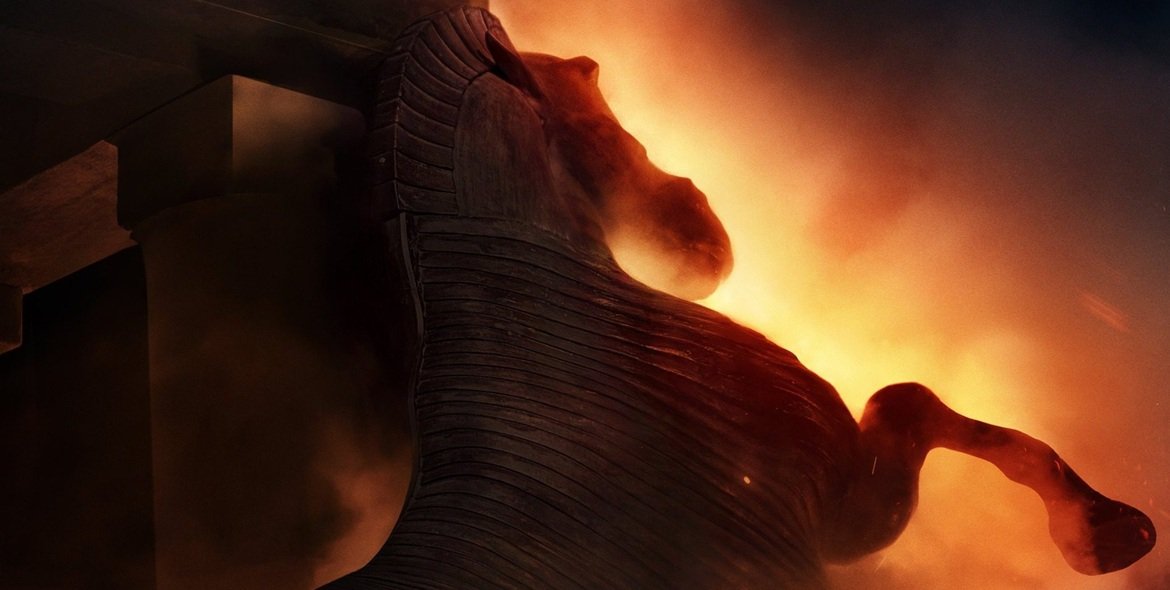
It was Thymoetes, erstwhile soothsayer, who first took to that almighty horse. Hooves aloft, eyes heavenward, an attractive centerpiece to the Trojan municipality, he said, if positioned before the Pergamum in the midst of the city. As he described the various opportunities this vast horse presented — that it may propitiate the gods, that it may bring smiles to young children, that it may enhance Troy’s equine reputation (both regarding and among horses) — Laocoön’s javelin whistled past his ear. It pierced the wood, translating the flex and shudder down its shaft. Thymoetes trembled like the spear. No good will come of piercing colossal horses with bronze. Vindication was instantaneous: a tangle of serpents descended on Laocoön to silence his incoherent jabberings about what may or may not exist within the horse. His suggestions had included (though were not limited to): some kind of cursed artefact that would disintegrate Trojan walls; a large quantity of snakes (this became immediately ironic); a contingent of Greek soldiers led by the trickster Odysseus; a foul gust of wind; or perhaps nothing, but a sinister, reductive nothing. Accepting the verdict of the ravenous serpents, the Trojan mass hauled this horse up toward their city. Thymoetes was for a moment lost in luster: he imagined the bards singing of his decision, O that noble Thymoetes, who knew best the right positioning for a fine equine effigy. So would end the songs of the Trojan War.
Several hours of excruciating supervision were born of this poetic dream. Just a cubit to the right, no that’s too far, let’s try splitting the difference, how about we turn the whole thing around? — an almighty groan — actually it was better the other way — such another groan that one might assume it had come from inside the horse. When the rearing horse had finally met with an orientation satisfactory to Thymoetes (he resented it being the exact position the men of Troy had initially placed it in, thoughtlessly and without art), they stopped a moment to dry their brows. Most thought of the decade of loss, of the fallen, of the days of peace to come. Thymoetes thought of the horse. Thymoetes thought so intensely and so completely of the horse that he heard it neigh. He heard the wooden horse neigh! He smiled to himself. Old Thymoetes, he thought, getting carried away. Until suddenly Capys — a horse-sceptic on the best of days — said it out loud: Has this foul erection whinnied? The assortment of Trojan laborers heard it too, though were unsure if this was a sign of propitious honor (for which they would need to sacrifice one hundred bulls) or foreboding doom (for which they would also need to sacrifice one hundred bulls). But it was in the Pergamum this sound was most sorely heard. From the palace gates sped great-hearted Aeneas, Dardanian prince, son of Aphrodite. His ears were hot. Open up this horse, he demanded. Thymoetes, swathed in rage, awaited the serpents. They did not come. Break the womb of this great stallion! he repeated, with little sentiment for equine dimorphism. The laborers did as bidden, finding — as they thwacked the beams with adzes — that a hinged segment had been built into the structure. Aeneas thrust his spear between the beams as fulcrum and forced the segment open. The mad orations of Laocoön swam through the collective mind. Perhaps a foul gust of wind awaits within? Instead, a sequence of clops, interwoven with a sequence of clips. And again a whinny. Out trotted a horse. One of Aeneas’ own, stolen by Diomedes in battle. A Trojan horse.
ii. Let what is broken so remain
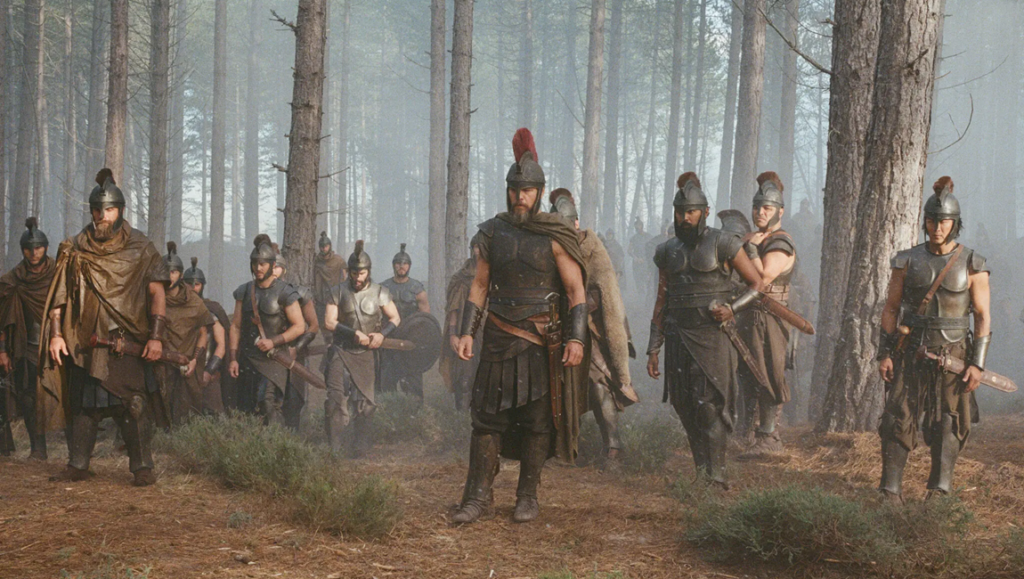
As this well-known fable demonstrates, one can never be certain of the contents of a large wooden horse. But it is as much a fable for daily, practical reference as it is a fable for Christopher Nolan, whose film about the large wooden horse is itself that very thing. Nolan, the inveterate puzzle-master, the trickster and gamester, has produced a Trojan Horse masquerading as a film about a Trojan Horse, inside which is another, different Trojan horse. The first layer in that algorithm is the film as advertised. Nolan has adapted the Odyssey, using as totem the image of the Trojan Horse (which does, despite the counter-claim by many well-paid film critics, feature in Homer’s Odyssey). It is a Grecian epic, in which the Odyssean story is recounted with a vaguely accurate approximation of location and action; a man does journey home by a very inconvenient route, he does seem to encounter gods and monsters, and he does wreak his vengeance on the impolite suitors who have splayed themselves across his various couches and dining tables. It is in some respects, as in the poem, a story about hubris, and a story about kleos, and it is in other respects, as in the poem, a story about nostos, and a story about xenia. (More on that later.) In this mode, the film is also in its way compromised: it alters the character of Odysseus (and many of his encounters), and it appears to exchange the text and subtext of the poem. Where the wiles and homecoming of Odysseus are the engine of Homer’s poem, with a kind of brooding, subcutaneous sadness, Nolan’s version instead fronts the sad Odysseus, the war-weary Odysseus, whose cleverness is as much a crutch as it is a flagellating rod. There is almost none of the humor, none of the eroticism, and little of the chest-thumping achievement that Homer threads through his epic; Nolan reconstructs his Odyssey as one of those typically modern, typically revisionist reinterpretations of the heroic figure.
But it would be an err to suggest that there is none of this in the epic poetry. Odysseus is a veteran of the Trojan War who, upon returning home, seems to restage the conflict in his backyard. Another citadel, another stolen bride, another siege, another massacre. He is only prevented from vaporizing the entire male patrimony of Ithaca — the many suitors and their fathers — by direct intervention of Zeus’ lightning bolt. In the Iliad, the destruction of Troy seems prefigured by the destruction of Achilles’ mind: in which it is not heroic conquest, but instead an intense, despairing pitch of loss that motivates Achilles into his final, Hector-vanquishing slaughter. Virgil’s Aeneid — also a source for Nolan’s film — skilfully interweaves the two (as Virgil’s Aeneid does in almost every line); here we have Aeneas, a Trojan survivor, who odysseys to Latium to found a successor state: the foetal Rome. In order to do so, he must defeat the native Italians in battle, and instead of becoming a new Hector — the great defender of Troy — he becomes a new Achilles, the rage-spun destroyer of the city. The poem ends, suddenly and abruptly, with his merciless slaughter of the humbled Turnus. The Trojan War is not waged once, but constantly across and beyond the Aegean Sea. The Trojan War exists in the minds of those who fought in it.
But this psychology is not the primary interest of Nolan, and rather is the arrow that points inward, into the belly of the horse. This lavishly mounted spectacle is rather the lure, the equine trolly we gladly tow into our cranial palaces. This Homeric nag would complement the cerebellum, we think mutually; it is good to see the Greek man come home, for within his homecoming is the cultural nexus of all Western Thought. But why are they all speaking American? This is the signal question, perhaps the first that would be asked by the beautifully ignorant holy man who — never having seen a film before — imagines he is seeing a beam of reconstituted reality. He would then wonder about the remarkably diverse makeup of Mycenaean Achaea, and the unusual quality of the gowns: at this point we would be forced to describe to this man the art of filmmaking. In relating the short history of that estimable form, we would explain to him various conventions in the making of epic, historical drama. In the olden days of Hollywood, all actors would speak in a ginned-up Transatlantic accent, which glanced closer to the farther or hither shore depending on the actor. A film might be set in ancient Sinai, or in revolutionary France, or in a Hungarian cornershop: all actors capable of this universal accent would adopt it. Those incapable — we look to Marlene Dietrich’s implacable Denglish — would maintain whatever voice they could manage.
Later, three possibilities occur in large-scale English-language historical filmmaking, in lieu of speaking whatever language the setting demands. The first is the adoption of appropriate accents, perhaps interspersed with native interjections. The Northman is one such example, with a bevy of Norse accents, from a filmmaker who stretches the nativistic linguistic principle of mainstream American cinema as far as it can go. The second, evident in almost all American historical films, for instance Troy, is for all actors to adopt posh English accents. This tendency, which appears totally bizarre outside of its cultural context, is to provide an old-fashioned setting with a breed of antiquity or archaism not thought to exist in the “hypermodern” American drawls. British English, representing a cultural ancestor of the American variant, is steeped in a certain past. It becomes a particular register of English, a supposedly formal, archaic mode, even when it is rarely either of these things in practice. It even belongs to the fantastically historical: could we imagine Legolas with a New York patter? Oliver Stone twists this scenario in his Alexander, giving Athenians English accents and Macedonians Irish accents, an attempt to mirror relative cultural attitudes by means of specifically British geopolitics. The third, the lackadaisical and theatrically inclined, forgets accent work altogether. In Amadeus, for example, each principal actor speaks with his native voice, be it American or British. Forman complicates this hands-off approach by inserting certain smaller characters who speak in a comical German or Italian cant: it is not uncommon for a particular character to be given an absurd accent even in a scope where accents in general are being ignored (consider Liam Neeson’s native Irish against the many attempted Portuguese accents in Silence). These three options, we explain to the holy man, dominate the span of contemporary historical drama. He buffets and sways: we have not accounted for The Odyssey!
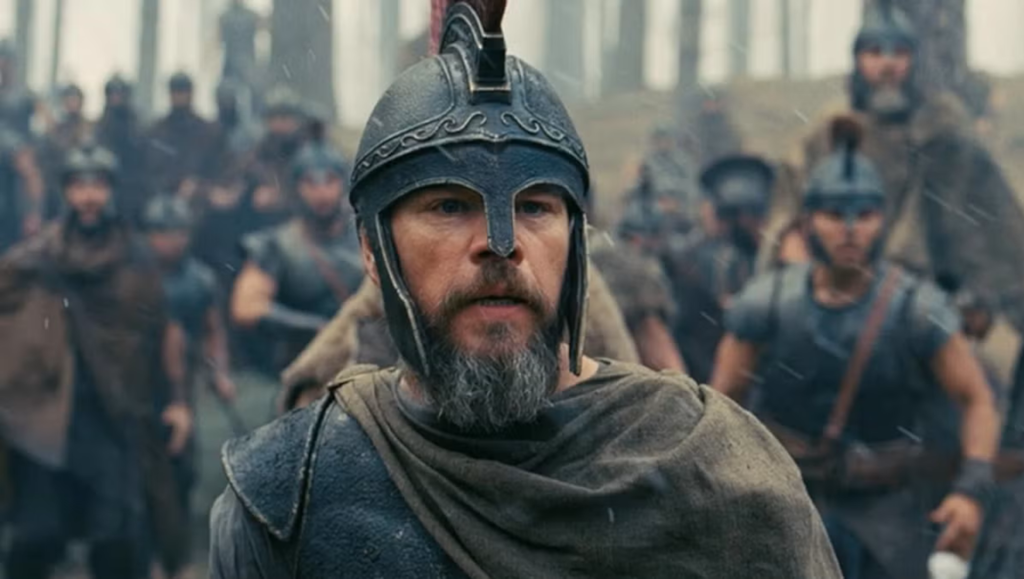
Perhaps uniquely in a modern, large-budget historical picture, Nolan has not merely opted to permit the American accents (à la Amadeus), but in fact to require them. A wide array of English actors — Tom Holland, Robert Pattinson, Himesh Patel, Samantha Morton (and Lupita Nyong’o, who identifies as Kenyan-Mexican) — are tasked with maintaining the metropolitan heave of vocalized modernity. Why on earth would Nolan demand this, if not to intentionally sabotage the laurelled anciency of distant Homer? Just as unusual is his dialogue. Much has been made of the English Pattinson mocking the English Holland with a profoundly American squib about his “daddy.” Throughout the film, this lower, demotic tone is taken. Odysseus does not stalk the Ithacan heights to appreciate the lay of the land, but rather he’s there to assess the situation. He does not seek victuals on the searoads, but on a known provisions route. He does not ask that his crew flee the damnèd halls of Hades, but instead barks a simple “Let’s Go!”
The justification for this approach is, in one respect, one of relative distancing. Nolan took some inspiration from Emily Wilson’s translation (equal parts acclaimed and controversial), which employs a clear, direct, often condensed style of poetry. The high fustian and multisyllabic grandeur one associates with the epic poem is laid aside; Wilson argues that an ancient Greek reading the Odyssey would not have been overawed by extravagant or rare language, and that the insertion of such serves only to obfuscate the contents of the poem from an English-reading audience. This is also the reason she adopts iambic pentameter (rather than the original dactylic hexameter), an English poetic meter associated with native-language epics. In translation, there are vying principles of “domestication” and “foreignization,” by which one either conveys the language by means that are intimately familiar with the reader (replicating its original fluency), or those that make the reader feel in an utterly different place or time. Wilson combines the two: by representing the Homeric poems in plain, lucid speech, certain of its archaic features are made more evident: the preponderance of slavery, for instance, or the startling quality of its violence. In The Odyssey, Eumaeus is referred to as a servant by the heroes, and a slave by the villains — an intriguing sleight of hand. But Nolan’s domesticating impulse is more profound: not only does he strip the language of any lofty (archaic) or otherwise foreign (Greek) mood, but he transfigures his entire production on a similar basis. Costuming, art design, and soundtrack are all composed of a strange medley of competing influences. Nolan’s Odyssey is putatively set in the Bronze Age Mediterranean (as the dialogue reminds us), but is in fact rendered as a timeless crosshatch of “mythic” or “historical” signifiers. There was no time that looked like this, or sounded like this. It is a notion of the past that exists only in the cultural conscious: a foundation myth projected backwards. In this sense, it is not Greece patterned for an American audience, but America patterned backwards into Greece.
This is the other, perhaps more pressing motivation for an entirely American-speaking cast. The Odyssey is not a film that concedes its Grecian antecedent for a pin-brained American audience, but rather it is a transformation of the myth into one decidedly about the modern America; therefore, it is a film for which genuine “historical accuracy” would be its own form of obfuscation — it is a film with almost nothing to do with history, and a film for which Homer is not the end but the vehicle through which to deliver its payload. This is the Trojan Horse, wheeled now into our cerebral courtyard. We can identify it most obviously by the feature it possesses that is otherwise totally absent in Homer: guilt. There is a sadness in Homer’s Odyssey, there is a subtext of mental or spiritual distress, and there is remorse for failure, but there is no point at which Odysseus (or any of his crew) repents or regrets a supposed evil in their past. Homer’s Odysseus is a man of many ways, a complicated man, but he is utterly without shame. And yet in Nolan’s film this is the primary, overweening designation for Odysseus. He is guilty for leaving home and sailing for Troy; he is guilty for partaking in the war; he is guilty for ending it; he is guilty for coming home and guilty for not coming home; perhaps he is even guilty for killing the suitors and rectifying his house. Odysseus’ nostos — his homecoming — is defined by the temporal impossibility of reversal. One cannot undo what has been done; this is a film that exists in the strain of that reality, in the permanence of all decision, in the single-strip of time which — however much Nolan meddles with chronology in its telling — can spool only one way.
Much of what Nolan has to say about the gods (more on whom later) is conveyed in the sense of the implacable and unchangeable: a deterministic universe in which abstract quantities designate a future, or more pungently a past, that cannot be in any way changed; Odysseus’ journey becomes one such, a return home that, no matter his long digressions and divergences, must occur. There is no possible alternative for the blood-soaked hero — he is not the master of his destiny. Here we encounter the inverse of Tenet’s optimistic compatibilism. That film conceived of a materialistic, deterministic universe in which the inevitability of the future is a sublime comfort: it is a confirmation, an article of complete faith, in the continual existence of the cosmos. Reality must go on, because reality goes on. The Odyssey instead produces a man who constantly heaves against the angle of time, who wishes to in some way use his future to undo, or to outrun, or to forget his past. But he is defined by linearity, much as Nolan’s film is defined against linearity: we see the object of Odysseus’ guilt bloom in all directions, spattering simultaneously across the whole matter of the film — but it all distends from one centrifugal source. This is the sorrow of the Sirens’ song. Odysseus must confront the total inaccessibility of a prelapsarian past: he must account for a past he cannot touch, and a future consequent of that past he cannot bear. He is strung to the mast of his destiny, howling.
This description of The Odyssey tends toward another of Nolan’s films: the billion-dollar biopic Oppenheimer, a duple-narrative that portrays the execution and consequence of J. Robert Oppenheimer’s Manhattan Project. The film orbits its central set piece: the Trinity test, the birth of nuclear weaponry, a reality on which human civilization would teeter for the next half-century (and beyond). Nolan splices the before-and-after of this sudden revelation. The excitement, the hubris of invention cut against the unimaginable destructive capability, and the realization that there is no possibility of undoing what has been done; one cannot uninvent the atom bomb. Nolan is perhaps less interested in the geopolitical realities born by that fact than he is the psychology of the Great Man upon whose shoulders the decision seems to rest. To have ushered in the apocalypse: how could any man consciously, with such great and profound effort, build the end of the world? And what happens to that man, after realizing it? Nolan relies upon the same principle that drives Tenet and The Odyssey: on linear causality, on a chain reaction. In physical reality, every effect is caused, and each effect becomes a cause in turn; it is impossible to break the chain having first produced it. We cannot negotiate with what appear to be the natural, chemical consequences of a particular action. Therein the metaphor: it is an unstoppable chemical reaction that causes a nuclear detonation, once triggered. Nolan identifies in Oppenheimer a transformative moment in civilization, by which the continuation of human life — up until then resilient to even the greatest atrocity — had suddenly been thrown into the balance. It seems almost necessary that Oppenheimer’s collaboration with Armageddon must result in a world-ending conflagration — and it is as much a sin of Oppenheimer’s as of the United States. It was an American project, intended to produce American victory against the un-American world. The narrative of guilt becomes increasingly ecumenical: Oppenheimer’s shame must distend outward, into the context that demanded his contribution.
The guilt of Odysseus becomes a crucial, primeval iteration of this same crisis of conscious. Nolan supposes that we envision the Bronze Age Mediterranean as a prelapsarian civilization — once again, it is important we shed both historical and mythological precepts from our minds. It is a society governed by an inviolable notion — Zeus’ Law, as the characters call it — an adaptation of the Greek concept of xenia, which we can understand as a form of hospitality. A mutual responsibility, from host to guest and from guest to host, to ensure amicable relations between strangers. While this practice had a religious significance — one of Zeus’ many appellations is Xenios — one can conceive of it as a practical morality which enabled travel, trade, and diplomacy among Greek (and neighboring) states. If one offers all guests an appropriate degree of hospitality, and is certain of a reciprocal degree of hospitality when he ventures afar, then a certain stability and security is implied between people who are otherwise unknown to one another. As mentioned in the film, it was thought that gods sometimes walked as men and women in the world — another motivation to treat travellers with circumspect care.
The natural consequence of this important moral baseline was its inversion: the breach of xenia constituted one of the great sins in Greek civilization. Indeed, the Trojan War — typically depicted as the great cataclysm of the mythological Bronze Age — represents the ultimate breach of xenia. The Trojan Paris kidnaps (or absconds with) Helen of Sparta, thereby breaching his responsibility as a guest in that land; whether or not Helen willingly leaves (on which ancient accounts are varied) makes little difference to a cultural frame that interprets women as private property. The Greek war against Troy is therefore not merely for the sake of a beautiful woman, as it is often portrayed, but rather it is an existential struggle to reassert this foundational value of Mediterranean civilization — while the Trojans are not Greek, they share “common gods” as stated in the film; common virtues. But Nolan does not take this notion precisely from the Greek practice (on which more later), nor does he interpret the Trojan War in the same way. His Trojan War perhaps better resembles the Iraq War (or the 2005 movie Troy) than it does the Epic Cycle. Helen is a manufactured casus belli similar to the alleged WMDs stockpiled in Saddam’s palaces; the war waged a cynical exercise in economic supremacy rather than a restitution of global justice. In one especially flimsy throwaway, Nolan’s Odysseus mentions that Agamemnon intended to “break Troy’s control of the trade routes”; meanwhile, the retrieved Helen — scarred by her victorious husband — disavows herself completely from the war effort. But if we are to suppose that Nolan has engineered xenia into a prelapsarian value, and if we are to suppose that the Trojan War was not the Original Sin that breached that inviolable standard, then we must reevaluate where exactly the Fall took place.
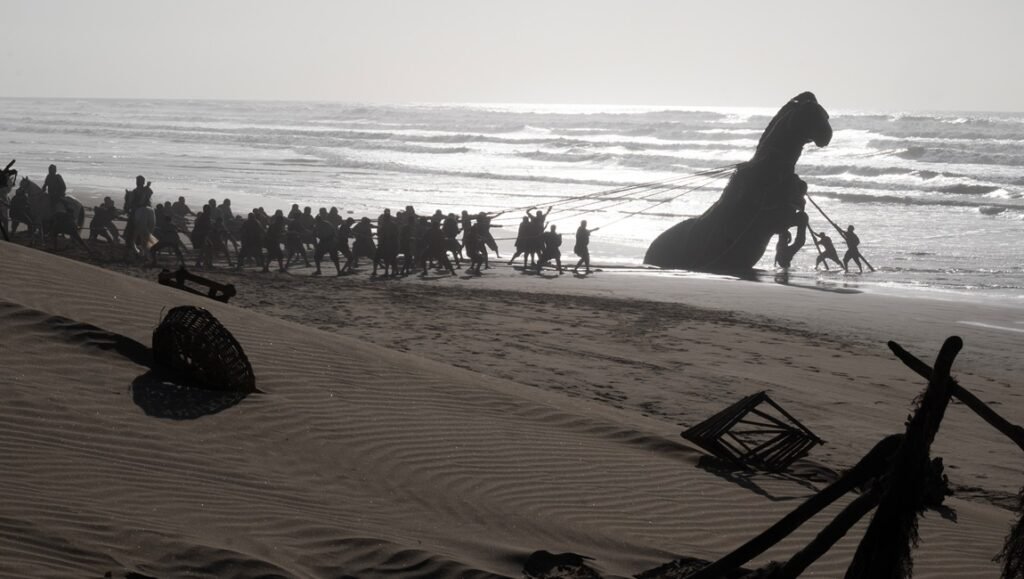
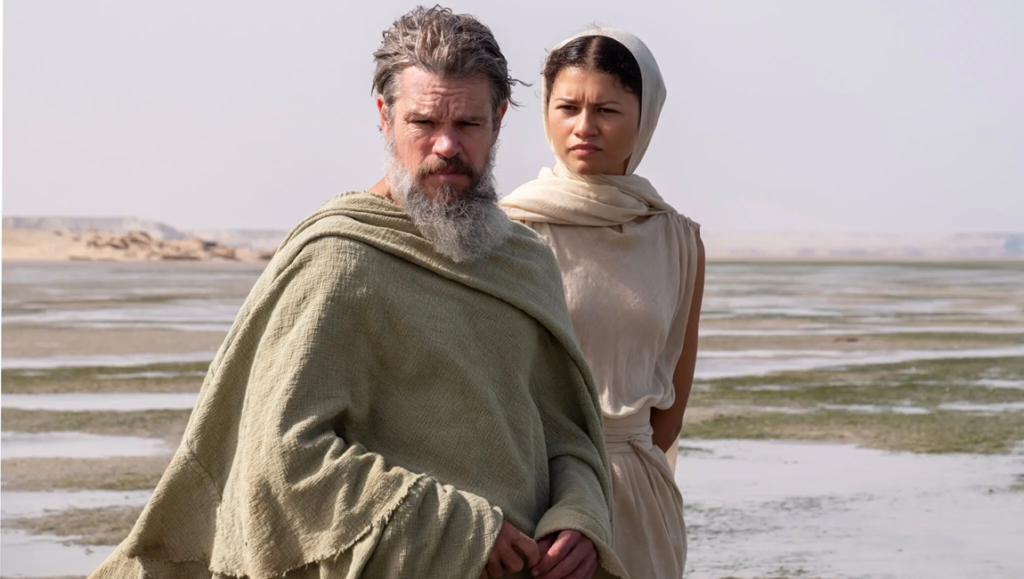
Finding in him an archaic Oppenheimer, Nolan places the albatross upon the neck of Odysseus. In his revision of the ancient account, Nolan does not see the absconding of Helen as the breach of Zeus’ Law (being that Nolan interprets Helen as an agent rather than as property); nor does it seem that even the Trojan War itself is a fundamental breach, being that war and warriors clearly pre-existed this siege, for various reasons — some presumably justifiable. Rather, it is the ingenuity of Odysseus — it is the Trojan Horse — that breaks the sacred bond. The Trojan Horse is not conventional warfare (and we think to the nuclear comparison), but rather a trick predicated on existing forms of mutual belief. A peace offering; an offering for Athena; a respect of the gods that is shared between Greeks and Trojans both. Even Sinon (a character yoinked not from the Odyssey but Virgil’s Aeneid, though mostly transformed), the Greek soldier who explains the horse’s provenance to the Trojans, believes it is a legitimate offering. Inspired by the accounts in both the Odyssey and Aeneid, Nolan will deliver the drama of the Trojan Horse and the sack of Troy in several broken orations. Our first sight of the horse has it half-buried on the Troad beach, like the forgotten statue of Ozymandias, the symbol of a bygone realm. Later, we see it dragged into the city, and then the egress of Greek soldiers who silently execute the Trojan guard and crank open the unusually sophisticated locking mechanism on the Scaean Gates.
But the mood of this nocturnal mission is essential. We do not lament Odysseus’ infiltration of the Trojan city. In fact, we are excited by it; we fear they might be found out; we are impressed by its cleverness. When the horse’s womb bursts open and the Greek heroes make meat of the Trojans, we hope they will heroically defy their enemies. Odysseus whittles down the Trojan defenders with bow and arrow, and Göransson’s score thuds with thrumming drums, and rising choral shouting. This is the thrill of the ancient story. Herein is kleos, honor, fame, glory. And as soon as the gates fling open, and Agamemnon’s absurd frame enters, the oration is again cut short. It is only later that Nolan completes the scene: he follows the breach of Troy to its natural consequence, a massacre of the men of the city, a savage butchery — a decade of rage (and we might think of mēnis, cosmic wrath) unleashed upon an unsuspecting foe. Sexual violence is entirely stripped away — and this pattern of denying sexual violence softens this scene and its later descendant — but women are murdered just the same as the men. The scene — the film — climaxes with the murder of a priestess of Athena, whose summary execution is made simultaneous to the beheading of a cultic statue of the goddess. Herein the ultimate contravention of Zeus’ Law. If it is true that gods walk among us, why might she not have been a god? More importantly: does it make a difference if she is or is not? The principle is not designed to protect gods; rather, it is to protect those who might accidentally violate them. Therefore it is a principle designed to protect humanity.
One may rightly question if the sacking of any town or city in the Bronze Age Mediterranean much differed from this one. Historically and mythologically, the practice of total devastation was the norm: to execute every man and child, while forcing the women into sexual slavery. Nolan plants a distinction early in the film, between a fight and a hunt. Odysseus says a hunt is just a fight with stealth. Later, this neat definition is not so satisfying: one is a combat, the other a slaughter. In Troy, it is a hunt. Perhaps the important idea is not that the Trojan brutality was unprecedented (though even in ancient accounts, its scale was unique), but rather that Odysseus has suddenly, somehow, become aware of it. In both the Iliad and the Aeneid there is a scene in which the gods will open the eyes of a hero to the true shape of the world. Diomedes and Aeneas, respectively, are permitted to see the invisible gods on the battlefield, wreaking their havoc; in being granted this vision, it is then implicit that their sight before this fact — and the sight of all other warriors — had been false. The battle was not as it seemed. This is the threshold reached by Odysseus in the Trojan slaughter (in which he nonetheless partakes); it is as though the atrocity is so dissonant as to untune the moral fabric of reality. There had been breaches of Zeus’ Law before (or else the law is redundant), but none so total as this; here, a Rubicon had been crossed; it is a contravention that seems to demolish the law itself.
The remainder of Odysseus’ journeys — all of which depicted before this revelation — seem to be in evidence of this. That notion of xenia is tested in each, and in each it fails. In the first of these adventures, Odysseus visits the cave of the cyclops Polyphemus, and while there anticipates the hospitality of his unseen host. But it is a hospitality presumed by armed soldiers: this is another breach of xenia, the responsibility of guests not to threaten or exploit their host. Polyphemus matches their implicit hostility. This episode is repeated on the island of the Laestrygonians, in which the armed host terrifies an unusually large child, who then summons his scimitar-swinging patrimony to fend off the Greek warriors. Here, even the trees are inhospitable, caging Greeks with moving trunks. Later, the men arrive on the island of Circe, who has met with various armed soldiers before: she perverts Zeus’ Law by making the means of hospitality — the offering of food — the lever of destruction. But in Circe we see legitimate cause: she is granted insight — she sees “truths” — she punishes these men for the crimes they have already committed (but we have not yet seen), and frees them knowing their doom. This is a vision of a world in which no such law exists: in which all travel is dogged by peril; in which men murder, even eat one another on sight; in which men are made into beasts, of the mind or body.
Odysseus seems instantly to suffer the universal consequence of his action; either he is roaming beyond the limitation of the presumed ethical code, or the outcome of the Trojan War (whose mythological account includes a decade of pillaging and eradicating neighboring Anatolian cities) has already corrupted the scape of the Mediterranean. Odysseus’ journey to the underworld (or its edge) makes this connection explicit: we hear of Agamemnon’s own homecoming, at which he is almost immediately murdered by his wife Clytemnestra, who has taken a lover. Before the Trojan War, Agamemnon had sacrificed his own daughter to calm contrary winds and enable his journey to Troy — the sins of that war include its preliminary phases — and on returning vengeance is wreaked upon him. In the parallel Telemachus narrative, we learn that Clytemnestra is herself murdered by Orestes — her son with Agamemnon. Telemachus is frightened to hear of sons killing their mothers, as we are of fathers killing their daughters; he is shocked to hear of a world whose hinges have disintegrated. Perhaps he thinks to his own mother, who might herself take a lover, and with whom he has been at odds. Otherwise, Odysseus meets Sinon in the underworld — the solider who enabled his equine deceit at Troy. Odysseus lied to Sinon to enable his scheme; Sinon cannot forgive this. The “necessary” outcome cannot justify the required means. Again we are looking into the eyes of Oppenheimer, who won the war at the cost of the world.
During Odysseus’ absence, Nolan seems to stir the expository pot back at Ithaca. He produces a mythic-historical catalyst for the drama — the Sea Peoples, a mysterious tribe whose raids may have precipitated the historical Bronze Age collapse, are rumored to be sacking cities across the Aegean. It is therefore necessary, if Odysseus fails to return, that Penelope marry. The noble blood of Ithaca and her surrounding islands must not remain in this suiting purgatory; if a defense is to be staged, then it requires strong and singular leadership. This seems initially to be a rather lame motivating device — a ticking time bomb to give Penelope’s unusual dilemma some modern propulsion. We are reminded of it again in the court of Menelaus, who seems more intimately aware of Sea People raids — more than rumors. The “gappiness” of Homer’s poetry is naturally discomfiting for such a structurally invested filmmaker as Nolan; he does not like to spring an image or idea at an audience without ample support or justification. We will see Odysseus string and shoot his bow long before the final challenge; we will see Argos as a little puppy, then an old dog, long before the final wag; each associative shot — most obviously the beheaded statue of Athena — will later be explained in the curve of the drama. So we must anticipate some payoff to the Sea Peoples angle; we might not anticipate this payoff to be the closing of the central dramatic loop. It will be in his climactic speech, in which the disguised Odysseus confesses the atrocities at Troy (here in the prelude to his aristeia, his massacre of the suitors). It becomes apparent that Odysseus and his men, that the Greek force in general, are themselves the Sea People. Such is the indirect nature of premodern communication that the rumor of marauding, seaborne raiders has travelled back to the Greek homelands having lost their precise identity.
But seen in the abstract, rather than the protagonistic role, it is obvious: these men — at the very least the men of Odysseus and Menelaus, though it is implied that the list is longer — have spent years at sea pillaging coastal civilization; rumors speed ahead of them; Telemachus hopes his father arrives home so as to stop his father from arriving home. It is not a misidentification: Odysseus has become the destabilizing threat, and the antonym of Zeus’ Law. He then fulfils the prophecy. The following day he slaughters the suitors (a justifiable reassertion of Zeus’ Law which itself breaches Zeus’ Law). He massacres the majority of the noble young men in Ithaca in savage revery. This is exactly the threat of the Sea Peoples. During his frenzy — initially against unarmed opponents — the score repeats the music that had accompanied Odysseus’ victorious Trojan gambit. We understand that this violent outburst is not the redemption of Troy, but a repetition; that the war rages on in Odysseus’ mind. He has slain the young men of Troy and now he slays the young men of Ithaca. Violence abroad has finally climaxed in an equivalent violence at home, following a long, bloody voyage between the two.
The Odyssey is not just a film for America, but it is a film about America. Consider the first atrocity we see prosecuted by Odysseus’ crew. Soon after leaving Troy, his men raid a village in a parallel to the poem’s ravaging of the Cicones. Here a group of foreignized innocents are put to the blade. A survivor is interrogated in the only instance of a character in The Odyssey speaking another language (unless we count the mumbling of Polyphemus). This unnamed role represents the film’s only Greek actor, and the language he is speaking — through an interpreter (into American English) — is modern Greek. We encounter the bizarre moment in which the English Himesh Patel says, in American Engish, that he is a Greek from Ithaca, to an actual Greek who he cannot comprehend. The most politically neutral read of this remarkable aside is that Nolan is paying heed to translation as a formal device. But it seems more pressingly a statement as implied above: that this is a film about an imperial power which has adventured into the distant East, and pillaged these far-off people; a chain-reaction of roving violence thereafter; a people who, returning home, find their moral compass melted, weapons of war blazing in casinos, schools, stadiums. The United States is not a country populated by Greeks, but rather it is a multi-ethnic melange; it is a country in which people speak with American accents; it is a European off-shoot that is here reflected in the warped mirror of a foundational European text projected backward and forward. Homer’s Odyssey has transcended its Greek scope to become a universal story; Nolan’s The Odyssey parachutes this story into the eternal now.
 iii. Tho’ much is taken, much abides
 iii. Tho’ much is taken, much abides
Nolan’s is not the only revisionist Odyssey adaptation of recent times. Umberto Pasolini’s uneven The Return throws its hat into a similar arena, a film whose many mediocrities are suddenly justified by a thunderstorm finale. There, the war-weary Odysseus — whose return in disguise belies a reluctance to engage in combat, a fear that his old bones will comfortably slide back into ultraviolence — does all that he can to delay the inevitable recompense. Much of the Odyssey, in Homer and beyond, has to do with delay. But a disappointed wife and a rage-filled son spur him into action. The trial of the bow is arranged; the suitors are locked in the palace. Pasolini shoots the scene not as an action-filled set piece, but as a de-dramatized execution of a pathetic, unarmed host. These suitors — who have been played so far as cartoonishly evil villains — suddenly evoke pity. Our hero, vanquishing those who deserve vanquishing, suddenly seems a murderer. The audience are in their way complicit, having willed on this ending for all the film’s circuitous wanderings. Yet in having it we are suddenly horrified. The jaded Telemachus takes part in the battle, junior to his father, bloodthirsty in his own way. At last the scene climaxes with Antinous, leader of the suitors, pleading for mercy. Penelope, shocked by the brutality (that nonetheless she encouraged), begs her son to spare him. Telemachus cuts off his head. A moment of signal brutality. Misery pervades. We never see the Trojan War in The Return; this is its spectre. The film ends with Telemachus going into exile. There is no future for him among the bloodied corpses of his homeland. Odysseus and Penelope remain, hoping of reconciliation.
Nolan’s version of the same scene differs considerably. His is not the plainly shot massacre, but an increasingly pumped action set piece; the suitors are swiftly armed and able to put up some kind of a fight; Telemachus finds himself in a deadly scuffle with the goatherd Melanthius, his loss of innocence cut against Odysseus’ spree. In this intercutting we understand that the violence of Odysseus has crept into his son — an outcome he specifically aims to avoid (more on which soon) — but the editing nonetheless exists so as to supercharge these battle scenes, and to will the father and son on to victory. Toward the climax it seems almost as though Odysseus will be defeated — we hope for his triumph, we hope he wreaks vengeance on Antinous. He does triumph; he does wreak vengeance. Here the tone finally seems to equal the poem: this is a battle for kleos, for fame and honor. Unlike The Return (and the poem), the massacre is not total: some suitors submit and their submission is accepted. Unlike The Return, no one protests the execution of snivelling Antinous who refused to fight. Zeus thunders his approval. Indeed, throughout the film there is a persistent mockery of Antinous’ cowardice: his decision not to go to Troy (the sight of Original Sin and utter moral depredation) seems almost as bad as — or worse than! — the fate of those who went to fight. As soldiers are drawn by lot, he switches his with the younger Sinon (the only direct allusion in the film to the Iliad, in which recruitment-by-lot is briefly mentioned); Odysseus shows him mercy and is punished for it. Do not forgive cowards.
Completing his partial massacre, Odysseus — porcupined with spears and arrows — determines that he will go into exile. He is joined by Penelope, and together they sail lovingly into the sunset — and something feels drastically wrong. How did this recapitulation of Trojan atrocity suddenly morph into a romantic send-off? How did this film about the apocalypse shudder into one of redemption? It seems, at the last, that there is an incoherence at the heart of Nolan’s Odyssey. This is the exact criticism levelled so fiercely at the film in Emily Wilson’s scathing critique for the London Review of Books: that it is an exercise in self-contradiction, whose stark ethical claims — whose representations of ancient Greek morality — suddenly tumble into all-American Hollywood romanticism. But inside the Trojan Horse there is another Trojan horse.
Nolan is a filmmaker known for a mode of cold rationalism; a world of cogs and spokes. In his film about magic, it is trickery and experimental science that explain the unexplainable; in his films about Batman and other such ghouls, he makes a serious attempt to ground them in reality; his film about dreaming is populated almost entirely by men in suits shooting guns at one another. There is a certain mechanical, even mathematical, precision to his filmmaking that belies wild fancy and real poetry. Even Interstellar, whose central thesis depends on the objective, material significance of the Power of Love, is swamped in calculations and technicalities. He therefore seems a rather unusual figure to adapt the Odyssey; how he would deal with the mythological creatures of the poem (let alone shoot them with his practical-oriented production methodology) was the meat of speculation for a long while. Perhaps, like Troy or Exodus: Gods and Kings, Nolan would produce a “truth behind the legend” account, in which the obviously impossible is excised for some alternative possibility.
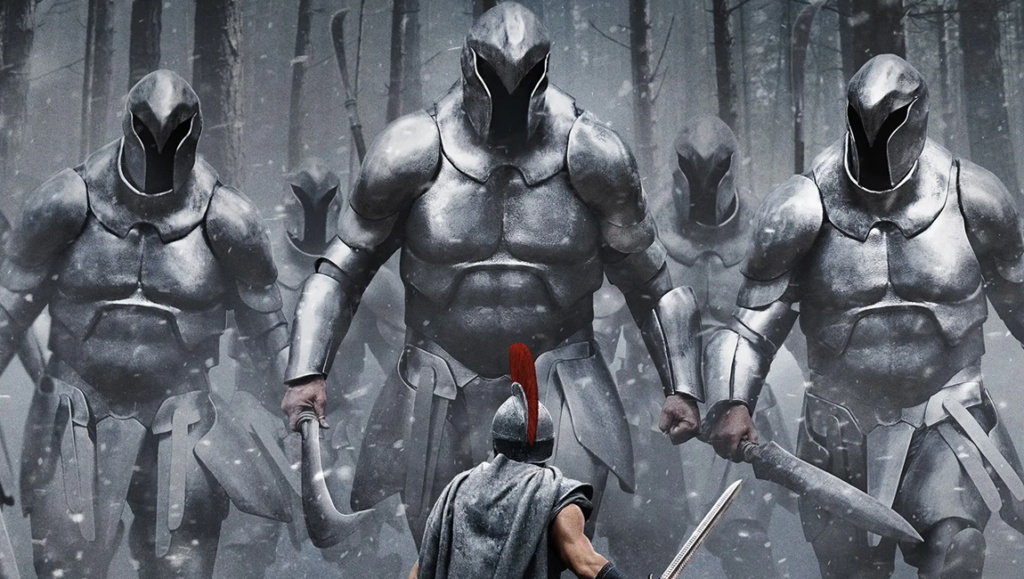
There is ancient precedent for this, with various antique authors proposing “naturalistic” explanations for mythological phenomena. Scylla, the part-woman, part-dog, part-serpent fiend that brutalizes Odysseus’ crew, is explained by Palaephatus as the name of a vessel that plundered the coasts of Sicily; Heraclitus Paradoxographus explains the same story differently, suggesting Scylla was an alluring courtesan, waited upon by dangerous “dog-like” followers who would slaughter those who visited her. Nolan might have made a similar attempt to rationalize the Greek myth, and produce a historically plausible account of Odysseus’ voyage. But it was not to be: though he may have ameliorated some of the holy magic in Homer’s text, we nonetheless still encounter 60-foot cyclopes, and Laestrygonian giants, and pig-molding witches, and crooning sirens. His Scylla is perhaps the most fantastical of all: a perplexing network of stone-grey mouths that issue from the cliffside, hoisting up unlucky sailors. But those characters less in evidence are the gods. If frequently mentioned, there is no long-bearded Zeus and no tridential Poseidon; we do not see Apollo or Hermes; and while Calypso and Circe survive the adaptation, they are nowhere clearly identified as gods. Only Athena is given a central, on-screen role, advising — or criticizing — Odysseus. She is not his champion, as she so often is in the poem. Even her reality is ambiguated. She shares a face with the priestess Odysseus saw slaughtered in Troy, and it is heavily implied that the Athena he sees is not a personification of the goddess but rather a psychological projection. She is guilt given human face divine.
Perhaps Nolan’s frame imagines a world of material strangeness — in that we encounter fleshy transformation and bizarre monsters — but not one of any metaphysics or religion. This is suggested by the opening title, designating a world of “apparent magic.” This is to suggest that what appears to be magic is, in fact, not; because magic does not exist. Odysseus himself appears to be something of a skeptic: early in the film he is dismissive of burial rituals, and will say things like “we can’t live by omens and sacrifices.” At one point he rebukes his crewmate by saying “your gods” gave Circe her power; the implication being that they are not his. In the Underworld, at which point the supernatural is overwhelmingly present, Odysseus begrudgingly acknowledges the gods with a promise to defy them.
But we must not be so hasty as to apply this early skepticism to the film’s own ethos. Consider Odysseus’ two conversations with Athena, before we discover she is (or might be) a figment. In both, Odysseus asks “why can’t gods speak in ways we understand?” In the first, Athena replies: “Who doesn’t understand thunder? Fire? A child’s smile? A good harvest?” We may see in her response certain attributes of the interventionist gods — Zeus’ thunder, Hephaestus’ fire — for which we would later develop firm, materialist explanations. Fire is a process of rapid oxidation, requiring fuel, oxygen, and heat. There is no room for limping gods in this triangle. But this explanation misses entirely the spine of Athena’s argument. It is not that the gods show us signs contrary to reality — that they will strike the sinning man with an unseasonable bolt from the blue — but that the signs of the gods are reality. We encounter a theism closer to Spinoza’s: God is not active in nature, nor can we say that God is, in a material sense, the “universe,” so much as we can suppose that God and Nature are synonymous: that the entirety of reality, all of its physical postulates, its mathematical certainties, its psychological attitudes, are attributes or expressions of single divinity. Therefore, the intelligibility of the world is wholly bound up with its holiness: by feeling, and comprehending, and understanding, we are reading the signs of God; all thought, all reason, all perception is proceeding from and entering into this single binding mystery. If we understand anything, we are responding to the “sign” of reality.
And so, the entire psychodrama of Odysseus, including the “projection” of Athena, is from the gods, insofar as the mind that produced it is bound up in the same cosmic continuity. In ancient Greek drama, there is the concept of “double motivation,” by which the will of the gods makes a character do something they would have done anyway; the god and the man are in perfect consonance. To defy the gods is to defy oneself; this is the overwhelming sense of The Odyssey. If we see Athena, it is perhaps not the cultic goddess represented by a particular bend of white marble; but it is absolutely a vision that corresponds with a kind of truth — the guilt of Odysseus is an expression of something holy. Zeus is the lighting; Poseidon is the waves; and Hephaestus the fire. Twice we hear thunder in the great hall of Ithaca; the first time it is handwaved as a lucky chance; not so the last. The great breakthrough in Odysseus’ character, after spending seven years in guilt-ridden, drug-infused stupor with Calypso, is to cease resisting: to accept the gods’ punishment, and the reality of the world. Doing so is an act of faith.
In this frame we begin to understand this second Trojan horse who we have been violently vivisecting for at least two paragraphs. May it whinny in another world. There is a spiritual essence, of sorts, brushing up against the depressive, deterministic Fallen world inherited by the descendants of Odysseus. And it is this essential quality that justifies various of the unusual or dissatisfactory features of the film as according to the previous thesis: that it is an account of the apocalypse. Why, for instance, does Nolan spare Odysseus from the most gruesome Trojan crimes? We do not see him engage in femicide; we do not see him mad with bloodlust; we do not see him — as reported in several ancient dramas — throw the child-prince of Troy from the battlements. Nolan also removes the sexual violence in Troy entirely: the Greeks murder women, and that is all we know; a single line of dialogue claims rape. Odysseus is complicit, but he is also remote from total damnation. Nolan also mutes the business in Ithaca. In the poem, several of the female slaves in the palace shack up (willingly or no, it is not exactly clear) with the invading suitors. This is represented by the disloyal Melantho in the film, who dallies with Antinous. After the bloodletting in the hall, Odysseus orders Telemachus to execute these women by the sword; Telemachus instead prefers to hang them, believing it a more suitably horrible death. This is a digression so brutal that even The Return opts not to depict it. But it marks an obvious parallel with the Trojan aftermath: the women are not spared; their fate is utterly abject. It is no different afar or at home. Old habits.
In Nolan’s finale, on the other hand, it is merely implied that Melantho is killed in the melee (and sentenced to death by Penelope, in what feels like a sympathetic portrayal of feminine revenge — far from Penelope’s shrieking horror in The Return), in a bloodbath that ultimately stops short of total devastation. We might be disturbed, but we are not utterly appalled. We might suppose, if Nolan is to argue that the breach of Zeus’ Law has loosed the arms of civilization, that the ending should therefore not pull the punch; that despite the self-awareness, and the haunting guilt that followed Odysseus home, there is no form of violent massacre that fails to denote the savagery at Troy. That is the real sadness of it: to be aware, like Oppenheimer, of the sin, and nonetheless find oneself powerless to prevent its continued expression. To be the man you hate that you have become, despite guilt, despite homecoming. But this is not the film Nolan has made. And if we suppose that the world is not composed of neutral particles, jostling together in looping violence, perhaps we can make sense of that. Perhaps we can find a redemptive pattern at the foot of Nolan’s Odyssey.
The key is then to return to Zeus’ Law, which previously in this writing was roughly equated to the Greek concept of xenia. This is an approximation, but it is not particularly accurate. Xenia is a social phenomenon that applies specifically to the zone of hospitality; it is also a virtue that respects and maintains hierarchy. A prince is owed better hospitality than a beggar, even if the latter is to be in some degree tolerated. It is a social structure designed to maintain the system of Greek city-states as they existed in and after the Bronze Age, not to radically overturn networks of power, and much less to outlaw any practice of war. As mentioned earlier, it is the kidnapping of Helen, and not the Trojan Horse, that demarks the great breach of xenia in the ancient texts. Indeed, the Trojan Horse does not in fact represent a breach of xenia whatsoever, even if it is a strategy of deceit — an approach much admired by the ancient Greeks.
Zeus’ Law as it appears in Nolan’s Odyssey appears far wider-reaching, and far more ecumenical. It is, in its essence, a repackaging not of a Greek social virtue, but of a Christian Great Commandment. To quote Penelope’s definition in the film: “to treat others as you would be treated.” It is a universal, levelling principle that must necessarily obliterate the Greek kleos — fame and glory. The Homeric tendency to burn down cities and exterminate their populace, depicted either in neutral or even celebratory terms when not referring to survivors from these places, must be transfigured into a breed of fundamental sin; Odysseus becomes aware perhaps less of the peculiar religious error of the sack of Troy so much as the equality of the victor and the victim. He is given an insight into a religious philosophy far into the future: in which strength does not connote honor; in which there is some virtue in the meek. In Homer, the weak are also unworthy: in the Odyssey, Odysseus disguises himself as a noble vagrant, and meets Irus in the palace, a physically imposing but weak and cowardly beggar (he features in the film, but does not appear to be a beggar). Homer shows no sympathy to this man, much as he shows no sympathy to Thersites, the ugly malcontent in the Iliad, beaten viciously by Odysseus. Even his supposedly humble characters may hide secret glory: Eumaeus is the swineherd, but he expands in detail on his noble blood, so clearly evidenced by his noble character.
Nolan repudiates these ideas — he does not make his noble Eumaeus an unlucky aristocrat — and it is little surprise, given this Christian appreciation for meekness is so totally integrated into secular society, that it has become the default in moral speech. But in doing so he also grants to his Odysseus something that his Homeric equivalent neither wants nor deserves: an opportunity for redemption. Nolan has spared Odysseus from the deepest evil, so we are willing to forgive him. When Odysseus’ ship is finally destroyed in a Zeus-wrought thunderstorm, Eurylochus says to his captain (his final words): “Pray to Poseidon! Pray for forgiveness!” It is an intriguing couplet, most of all because no ancient Greek prayed to a god for forgiveness. Gods were prayed to so as to propitiate them, to sate their anger with sacrifice; they would not clear any moral blotting paper. But Nolan’s Odyssey does not concern itself with the reciprocity of those antic gods; this call for forgiveness defines the film’s middlemost heart.
The crucible of this idea is in the final showdown in Ithaca, which is posed a little differently than in the poem. In the film, Telemachus has been held off from violent reprisal (whether or not he could manage such a feat) because any king who has slain the principle menfolk of Ithaca would surely be driven off in exile for an almighty fracture of Zeus’ Law (still held as such despite its obvious debasement). This might be a reference to the poem, in which the victorious Odysseus is almost immediately set upon by the fathers of the suitors after his slaughter: he is ready enough to kill them as well, and be king of nobody. In the film, Odysseus agrees that the man who massacres the suitors could not be king and must be exiled. He therefore determines that he, and not Telemachus, will do the killing, and therefore take upon his shoulders all the sin and leave Telemachus blameless. One is here reminded of Leviticus, in which is written of the scapegoat. During Yom Kippur, a goat (one of two) is selected by lot, and the High Priest will symbolically transfer the guilt of the community into this goat, who is thereby banished into the wilderness. The scapegoat, not necessarily guilty of anything, therefore redeems a people by his sacrifice. Christian apologists have made the analogy with Christ for as long as Christian apologia has existed: that one man may take on the sins of all, therefore cleansing the world with his death. It would be perhaps too profound a stretch to equate Nolan’s Odysseus with Christ, but one can equate him well-enough with a goat.
It also recalls Odysseus’ second conversation with Athena. He again complains that “Gods don’t speak in ways we understand.” She replies: “Who doesn’t understand pain? Or blood? Or death?” She goes on: “When you watch your men die, do you see chance or do you see consequence?” Odysseus sees consequence. “What if their deaths are not your failure but theirs?” Odysseus led them; it must be his responsibility. Athena continues: “And who led you? Why do you put yourself above the gods? Why do you claim responsibility?” This series of questions is fascinating. We see, in fragment, a counter-argument to the Great Man: that there is some material, or causal, reality that absolves Odysseus from his universal guilt. He played his part, but he cannot bear the sin of all his men (who have damned themselves by eating the Sun god’s cattle, and much else besides). He cannot save them, because their souls are not his jurisdiction.
But this is the very innovation of the Christian doctrine: the notion that a man might wear the sins of another; wear the sins of all. If the punishment for sin cannot be outrun, cannot be outthought, cannot be evaded or forgotten, then it can be taken in lieu. Here is the sense that the Fallen Man can gather into himself all the evil of society, and then leave it: vanish from the known world. That while his slaughter is a recapitulation of the evils of Troy, it is also a destruction of that evil by the same means; it is a great irony by which the virus is permitted to destroy itself, with efforts taken to inoculate Telemachus from its obviously polluting quality. This is an unusual meld of the Christian and the pre-Christian: an unforgiving, pagan slaughter so as to remove pagan slaughter from the world. Even Antinous contains some element of this notion: that he represents the sin of the suitors, and with his death the survivors might be absolved. Odysseus’ efforts are not entirely successful: Telemachus ends up fighting Melanthius the goatherd (another of those snivelling, ignoble characters in Homer), though he is kept away from the center of battle. And certainly he does not behead Antinous (as in The Return), and certainly he does not suggest hanging the female slaves by their necks (as in the poem). There is, in that, a turning over: a sense that the Old World has been destroyed — Odysseus will self-consciously predict the end of their “Age of Bronze” and the obliteration of the written word — but that the redemption of the father is passed onto the son. It is one of those great ironies in Christian theology: that while Original Sin opens the gates of evil, it takes another, perhaps greater sin — the betrayal of Christ by Judas — to redeem the damned. Goodness operates through evil; salvation requires a blood sacrifice.
Much is made of the atheistic Nolan’s Catholic upbringing: that he is a filmmaker obsessed with apocalypse, and sacrifice, and salvation. Tenet is a statement of optimism in the construction of the universe: the future is assured by the continuing existence of the present. We must keep faith in the persistence of reality. Oppenheimer saw the apocalypse, and did not find a way out: the crisis of Oppenheimer remains contemporary. We do not know its outcome. But The Odyssey collides the two. It anticipates a successful apocalypse; the end of the world is assured. But it also anticipates rebirth and reconstitution. The Bronze Age will end and another will succeed it. Odysseus is granted his afterlife, sailing into the unknown West. There, he has promised, he will make some abstract amends for the men he has left behind. It is a journey of self-abasement and expiation. Odysseus’ atonement is not complete, but rather this is its commencing; we know he will never return home. An ending, a beginning. It seems, at the last, despite it all, that Odysseus is smiling, like Christ on the cross in The Last Temptation. The past is unchangeable, and consequence is absolute. But there is redemption. It is a Socratic principle: paying the penalty is a relief from the greatest evil, wickedness. It is a Christian principle, that the penitent will be forgiven. The Trojan horse that lives in the Trojan Horse believes in God.
Comments are closed.