
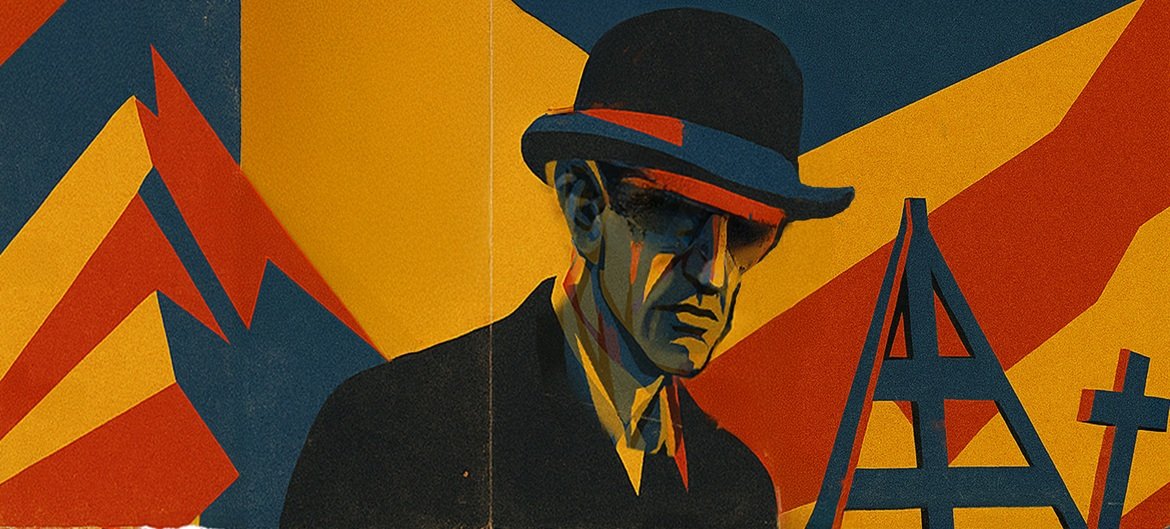
Punk iconoclast Alex Cox isn’t going away quietly; in fact, he might not be going away at all — but let’s not get in the way of a good story. After more than 40 years of moviemaking, Cox’s latest, Dead Souls, is being billed as his “final” film. We’ll get to why that’s misleading at best, but if we play his game, it’s about as perfect a finale as one could ask for.
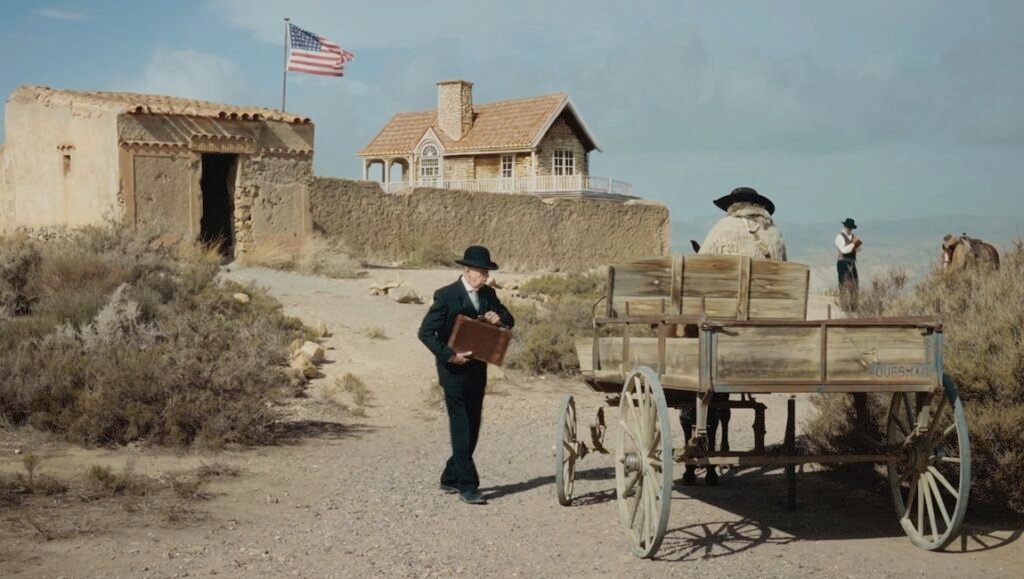
Based on Nikolai Gogol’s novel of the same name, Dead Souls stars Cox as Strindler, a mysterious drifter in black who arrives in a dusty Arizona town in 1890 seeking to collect the names of dead Mexican laborers. The reason is a mystery, but in casting himself as the grifting, amoral hucker Strindler, Cox, whose work interrogates the commodification of bodies, has performed a stroke of genius. Even as his liar-in-black slinks into bars and outruns death, it’s impossible to ignore the sense of pure joy that permeates the film. My colleague Chris, in his excellent review, argued that it feels like Cox and co. are getting away with something. There’s a real sense of friends playing in the giant sandbox that is the Old West, furthered by a lack of narrative thrust, each scene feeling like a moment of Strindler’s life bouncing into the next.
This isn’t to say there’s no purpose or that Cox doesn’t have something to say. As Strindler inhabits a new disguise or tells yet another tall tale in pursuit of the names of the dead, Cox underscores how easily lives can be lost to the whims of those who write history, and how stories, particularly those of the Old West, are often shaped by those with a vested interest in whitewashing how it was “won.” As such, Dead Souls makes for one of the most revitalizing American Independent films in recent memory. Cox pays tribute to his favorite genre as much as he tears it down and, in doing so, skewers the myth of the American Dream.
Shot in Almería, home to countless Spaghetti Westerns, including Cox’s own satire, Straight to Hell, and co-written by Italian stalwart Gianni Garko, Dead Souls doubles as an excellent capper to Cox’s career, as well as maybe the final statement on the genre. But again, this is all conjecture, because if you ask Cox, he’ll bristle at the idea of calling this his final film. Sure, it’s in the press notes, but he says it just made for good copy. Perhaps that’s apt, too. There’s always been a bit of a screwy, “up yours” ethos to Alex Cox, and if he wants to continue to crowdfund esoteric and deeply strange odysseys for another 20 years, who are we to stop him?
As it stands, Dead Souls is an excellent return for the filmmaker and easily slots in among his very best work. In the midst of a national tour, including screenings at the Roxy here in New York over the last week, I caught up with Cox for a wide-ranging discussion about the film, capitalism, and making movies despite it all. We may even have broken news about the long-gestating Repo Man 2.
Brandon Streussnig: I recently read an interview where you were asked several questions in a row about the themes and throughlines in your work, and you kept saying, “That’s for the critics to decide. I just make them.” It made me think about the interview process and how we’re always asking filmmakers to explain things that are already there in the image and text. Does being asked to expand on your work ruin some of the mystique for you?
Alex Cox: Well, no, it’s just that it’s a waste of time because a filmmaker really can’t answer those questions. I mean, if you went to Francis Ford Coppola and said to him, “What is the meaning of the body of your work?” How could he answer? He doesn’t know. If he can answer, then he’s a fraud and a pompous individual who thinks too much about the meaning of his great creations because things get made in different circumstances. Sometimes films are made because the filmmaker really wants to make them. Sometimes they’re made because the filmmaker is broke and really needs money. It’s very hard for the filmmaker not to be so distant from the whole thing.
BS: Let’s talk about the circumstances under which this film was made. It was crowdfunded, which is something you’ve done before. Making a film can be so hard, especially when it comes to financing it. Do you find that not having to answer to specific masters through crowdfunding gives you a degree of freedom compared with some of your earlier work?
AC: Let me go back to what you just said, because you said making a film is hard. Why do you think that? Making a film isn’t hard. It’s a pleasure! It’s an entire exercise in pleasure and fun and creativity, unless something goes badly wrong. So in that sense, I don’t think making film is hard at all. I mean, it’s just a whole bunch of elements that you have to get in line and do right and do the very best you can. But funding? Funding is hard.
The great thing about crowdfunding is that the people who are funding the film are actually people who like your work. They have no reason to crowdfund a project if they don’t like your work. I would never crowdfund a project I wasn’t interested in. I wouldn’t give them a dollar. But if I liked the project, I might sign up for a disc, a poster, or to go to the premiere.
So the difference is that, in the commercial world of filmmaking, the reasons films get made are obscure and largely tied to how much money someone makes. Say, in the case of a studio film where the studio takes a 20% overhead, the studio executive is thinking, “How can I expand the budget and make this film as expensive as possible?” Because don’t forget, the studio is going to be clawing back 20- 25% of that as overhead. The managers and the agents are thinking, “How can I push the price of my client up to the max, both because my client is in competition with other movie stars to earn as much money as possible, but also because I’m getting 10 or 15% of everything my guy makes.” So the rationale of a conventional film with conventional film finance is profane and perverse. Whereas crowdfunding, the people who are funding the film actually want to see it.
BS: My partner is a filmmaker, and I’ve watched her deal with all of those things. You’re right: funding is profane because you’re essentially begging for money just to not make any in the long run. It’s incredibly frustrating.
AC: It’s rarely being done for altruistic reasons. It’s normally being done for some completely odd reason, some really weird reason. A certain amount of money has to be spent. Who knows? But the reasons aren’t rational or artistic.
BS: What I’ve always found fascinating is the punk-rock sensibility you’ve incorporated into so much of your work. It feels like it’s part of who you are in everything you do. I imagine that has to be difficult in such a capitalist industry.
AC: Well, I think it’s impossible in our culture to exist outside of capitalism, isn’t it? I mean, there aren’t any benign communists who are going to come along and give me a load of money. That did happen one time to Kurosawa, but when the Russians showed up after he’d attempted suicide. His career was finished, and the Russians showed up and said, “Let us give you some money.” Then he went and made Dersu Uzala and revitalized his career. That’s the only instance that I can think of where that occurred. Pretty much every country in the world has adopted a capitalistic model, and films are supposed to make money. If they don’t make money, then they’re said to have failed irrespective of their innate quality. I don’t think we can exist outside of capitalism.
BS: How, then, have you been able to maintain your own sensibility in your work?
AC: I was taking an airport bus from Indianapolis down to Albuquerque to meet the Circle Jerks a couple of days ago. There was a lady on the bus who was going for a job interview at the University of Bloomington in Indiana. She said that she thought of all the musical movements that she had known and loved during her lifetime, punk was the most community-oriented. I think that’s true. I think that within punk, definitely within the punk world and within the kind of film world where I’ve worked, there is a sort of community, and we share common values. So when I go to somebody like Del Zamora or Zander Schloss, Lorenzo O’Brien or Cecilia Montiel, or the people I’ve worked with in the past, it’s sort of like, okay, let’s go. There’s already an understanding, a shared culture, and a shared sense of politics and desire, which sustain us all. It makes me feel that if I want to go and make a film, I’m not going to be alone. I know I can reach out and people will help me.
BS: One of those longtime collaborators is Dan Wool, who’s done the score on Dead Souls. I love the score. It evokes some of the Spaghetti Western tradition while still sounding like its own thing. What were you hoping for in terms of the sound of the film?
AC: Oh, I never know anything. It’s funny because although I love music, I don’t know anything about it. So I defer entirely to the composer or the person who’s writing the song. In the case of Dan, he had already done Italian Western music for a couple of films, Straight to Hell and Searchers 2.0. So when we did Tombstone-Rashomon, he wanted to get away from the Spaghetti Western sound, the Morricone sound, and do something different. But on this one, he got dragged back in a little bit to the Spaghetti aesthetic, the Morricone aesthetic, I think, because we were shooting in Spain. My co-author was Gianni Garko, a major Italian Western actor in those days.
BS: The film is based on the Gogol story Dead Souls. If I’m not mistaken, he never got to finish that work. Was it ever in your mind while making the film that this might be your interpretation of how he might have ended it?
AC: Yeah, I think his intention, as far as I’m aware from reading his biography and doing my due diligence, his intention was to have a three-volume work called Dead Souls, of which we have Book One and some fragments of Book Two. Book One was supposed to be about bad people, Book Two was supposed to be about good people, and Book Three was supposed to be set in heaven. He wrote Book Two twice, but destroyed it both times, and all that’s left of it are some fragments. Book Three he never even started. Obviously, he wrote very slowly, and he was going through life-changing experiences, which he wrote about. At the same time, it’s much easier and more fun to write about bad people than to write about good people.
In terms of writing about paradise, I can’t even imagine how boring that would be. Dante only wrote about the Inferno. Someone will correct me, he probably wrote about heaven too. I don’t know that much. I’m just making that up. But I do think that writing about villains, creating villains and wicked people, is far more fun for the author, and reading about them is far more fun for the reader. Moby Dick is about Ahab. It’s not about Queequeg.
So that was where he ran into trouble, I think. The first book of Dead Souls is very popular, and it ends with its protagonist racing through the night. He doesn’t know where he is going. He’s had to leave town in a hurry because people are after him. He’s just racing through the night. His coachman is whipping the horses, and the two of them are just totally exhilarated and laughing, and they’ve got no idea where they’re going or what’s going to happen next. That’s the end. That’s pretty good. So it was hard to follow that, but I tried.
BS: Was this always conceived with you playing the lead?
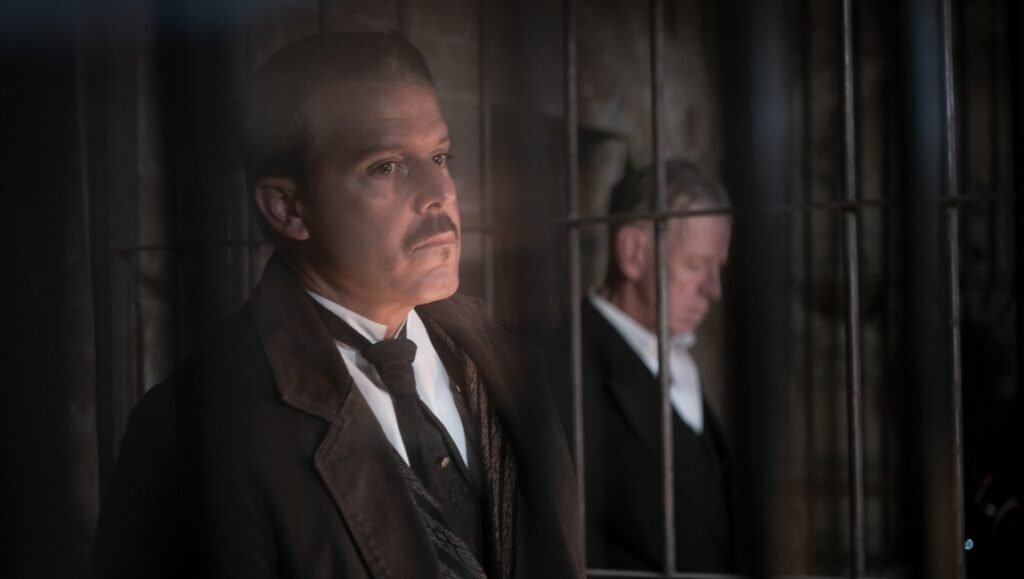
AC: No, I was going to do it with Gianni. He played Sartana back in the 1960s and ’70s; he was my choice to play Strindler.
BS: The Angel of Death.
AC: Yeah! Yeah, Sartana, Angel of Death. I know him fairly well, and he’s a great-looking guy. He looks my age. He looks about 65 or 70, but he’s 91. We worked on the script a lot. He was the most attentive actor I’ve ever known. That’s how he came up being credited as my co-author, because he brought so many ideas to the table and put so much into the script. He wrote whole scenes he thought might be good and just sent them to me. But when the time came to do it, we obviously didn’t have a very big budget, and we were going to have to shoot very quickly in two countries. Gianni said, “Look, this schedule is too fast for me. I’m not going to be getting up and down off that wagon 20 times a day. That’s physical acting.” That was a perfectly reasonable response. If we had come up with five or six million, I could have done it with Gianni.
But of course, then it was my excuse to step in because I love acting as well, and it was my excuse. When the director does that, they always say, “Oh, well, it’s to save money because we don’t have to pay the guy or pay for a hotel room.” Then all the crew is going, “Oh God, pay the guy. Get a hotel room because don’t play the part yourself.” [Laughs]
BS: It’s not your first time appearing in front of the camera. You’ve been in your own movies quite a bit, but never in the lead. What was it like taking on that role?
AC: Oh but wait, even better! I also play the head of the CIA in Mexico City in the 1960s and 1970s, Winston Scott, a real character in a Mexican Netflix series called An Unknown Enemy. It’s really great. I’m pretty good in the series. I’m the principal villain. The funny thing is, if you look at the Wikipedia page for that series, they list all the characters except me because they cut me out entirely. They don’t mention me at all because, after the hero, I’m the most interesting character in the series. I’m the one who’s causing all the damage and causing the massacre at Tlatelolco in 1968 and constantly trying to introduce American troops into Mexico to look for drugs while I’m organizing the drug trade. So it’s a tremendous part, really good character. It’s not physical acting. I’m always sitting in a restaurant with a suit and tie, having lunch, or sitting with the president, being a pill in his presidential palace. So it was tremendous fun and more difficult than Strindler because it was a more complicated part, and it was in Spanish.
BS: That’s certainly of a piece with your work. What’s always brought you back to the way America has mistreated Latin America?
AC: Oh, well, I mean, I don’t know really. Again, it’s just that they’re interesting stories, aren’t they? I mean, think about Peter Watkins. He made a wonderful film called Culloden about how the English mistreated the Scots. Or think about Steve McQueen, the English Steve McQueen’s film, Hunger, a fantastic film about how the English abused the Irish. There’s lots of abuse in the world, but I was always drawn to the Western. That was always my favorite film form because I loved American Westerns, Italian Westerns, and the desert. So it was just really the choice of location that dictated the injustice that was going to be illustrated.
BS: There is something about the way those old Budd Boetticher movies look. Sometimes there’s nothing better than just a landscape like that on screen. They’re beautiful.
AC: Oh, yeah. And they were all made in a place not far away from where I live. They were all made on Highway 395, like Lone Pine, the long highway that runs north and south through California and through Oregon. Yeah, beautiful, beautiful locations.
BS: Speaking of location, Almería is somewhere you’re deeply familiar with. You lived there for a time.
AC: I did. I lived there for about 20 years.
BS: What do you love about it? Returning there for Dead Souls is certainly fitting if this is to be your final film, but I know you’ve been pushing back on that.
AC: Well, it’s like The Who. The Who had farewell tours every year. So it’s a bit like that, I hope.
BS: Well, at least from the location, it would be fitting if it did end up being your final film.
AC: Shut up! Who said that? [Laughs]
BS: I don’t want it to be! I’d love to see many more.
AC: Good! [Laughs]
BS: What do you love about Almería beyond its deep history with the Spaghetti Western?
AC: I just love the desert. Almería has one of the most beautiful, dry deserts that I’ve ever been able to see. Obviously there are more in the American Southwest and in Northern Mexico, and in Peru and everywhere in the world and in North Africa, all over the place. But Almería is the one that I became most familiar with. So it was an excuse. This time, when we shot in Almería, we were on the location built in 1965 by Giancarlo Simi for A Few Dollars More. In that film, it plays the city of El Paso. So, in our film too, the trajectory is Strindler’s journey to El Paso. It was quite fitting that in the 50th anniversary year of that location, we went back and revisited it not just as an anonymous Western town, but as the place it was built for.
BS: As much as I love your work and your films, something I love even more is your passion for cinema in general. There’s Moviedrome, you’ve written books on The Prisoner, and you’ve made documentaries about Emmanuelle and Kurosawa. You’ve taught screenwriting at Colorado University. Even during this conversation, you’re dropping title after title. Where does that passion come from?
AC: I just like films. I mean, I always loved going to the pictures. When I was a boy, I would just go to the pictures. When my friends from school would go to a football match, I would go to the pictures. I would go to the cinema in Birkenhead or Liverpool once or twice a week. In those days, there were double bills. So you’d see two films. You’d see Django Kill and something else. You’d see Illustrious Corpses and something else as well. It was great. I was just very enthused about the cinema and remained so. I mean, I’m not necessarily greatly enthused by $250 billion Hollywood blockbusters, but I am enthused by film in general and by the cinema. Narrative film. I wasn’t an experimentalist. I never got into the experimental thing, but I love narrative films and documentaries.
BS: I’m sure there are people in the UK who grew up watching Moviedrome and saw films you recommended that they would never have encountered otherwise. Did you have any guiding hands in your journey?
AC: In those days, there wasn’t anything like the amount of media about media [we have now], because obviously, first and foremost, there was no internet; but there were books, and there were newspapers, but newspapers didn’t take films particularly seriously unless it was a film by Stanley Kubrick or Lindsay Anderson. Films were kind of like, “Yeah, we’re going to have a little film review and stuff,” but it wasn’t a very important thing. There were, obviously, magazines about cinema in Britain. There was the Monthly Film Bulletin, which was very useful because it was supposed to list every film released in Britain, along with all the credits and a brief review. So that was an enormously valuable resource if you were interested in looking more deeply into film.
BS: I have to ask about the stop-motion segment. Was that always something that was in the script, or how did it come about?
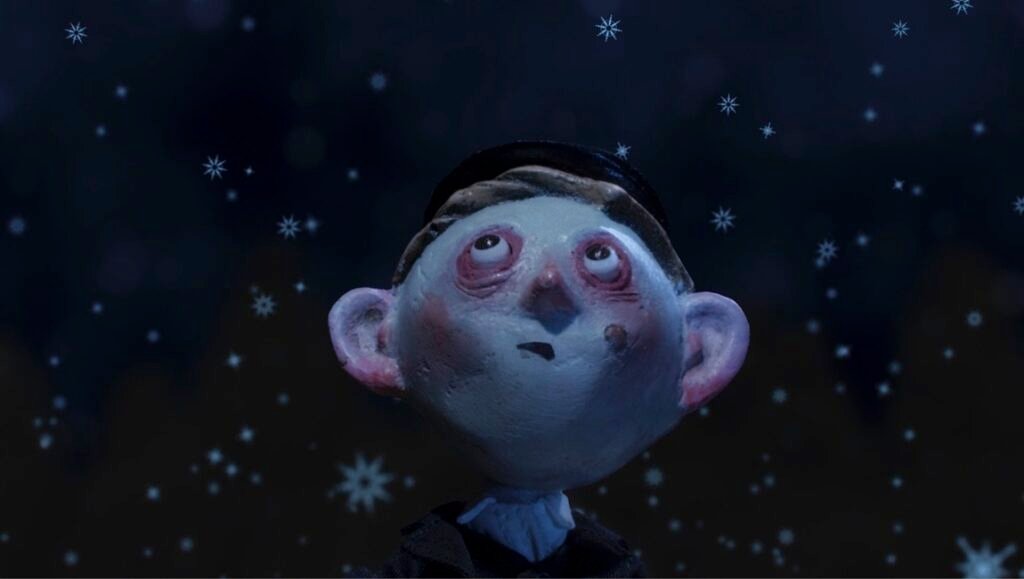
AC: Well, it was always in the script and not as a puppet scene. The very first thing we shot was Ed Tudor-Pole playing Strindler’s Father. We shot that against a green screen in Almeria. So then we needed an environment for Strindler’s father. I never thought about that as being naturalistic. I always thought that that would be an artificial tabletop environment. So then the producer in Spain, Guillermo Olivera, he said to me, “Well, why don’t I get you a kid? I’ll get you a kid from Tiburnis to play the little boy offscreen.” I go, “No, don’t worry. I’ll do the kid’s voice. I’ll play the kid for Ed. It’ll be more fun because Ed and I are old friends and I’ll play his son offscreen.”
Well, we’d recorded my voice going, “Oh, papa,” and so then, of course, it was easy for me to say, “You’re not going to find a kid who looks like me anyway. Let’s get a puppet made.” Luckily, the guys at Tippett Studio were very enthusiastic. Tom Gibbons, who then worked at Tippett Studio, also known as Gibby, worked for eight months on that scene with three others, all working on stop-motion animation, backgrounds, and the reindeer. The reindeer pulling the sleigh isn’t stop-motion animation. It’s a little robot whose legs work.
BS: We started this conversation with the idea that a filmmaker can’t always see, while they’re inside something, the connections and themes running through their work. I do, however, think that even from Sleep is for Sissies all the way through to now, there’s a throughline of commodification. Of bodies, art, and everything in between. I have to imagine there was a time when you were younger, making these films, hoping things would get better in that regard. Where are you now with all of this?
AC: Oh, I think many things have gotten worse. We can say almost everything has gotten worse. One thing, in the sense of commodification within the arts, that’s really terrible that has arisen is the idea that actors, and probably directors and crew people as well, but poor actors in particular, are expected to have a social media presence and followers. I have heard that wicked casting directors actually pay attention to an actor’s number of social media followers. That’s cruel and horrible because social media is insidious, and people should avoid it at all costs. The idea that actors are obliged to have a Facebook page or an Instagram page and promote themselves endlessly with photographs of themselves and their food and selfies and on holiday and doing cool things with famous people — I mean, it’s sickening. People should be judged on their own merits. Well, obviously, what a thing to say. Of course they should! But yes, it’s gotten worse. Much worse.
BS: Well, I just want to reiterate, as we wrap up, that I do, in fact, hope that this isn’t the last.
AC: We’ve been on the road with The Circle Jerks. We do a show, Repo Man, they do a show, and we do a Q&A in the middle. At the end of the Q&A, Zander, who’s the bass player in The Circle Jerks, as well as the actor who plays Borracho in our film, says to the audience, “Would anybody here like to see a sequel to Repo Man?” Of course, there are 800 people there and every hand goes up, and there’s a cheer. So, in October, I’m going to launch a Kickstarter to make Repo Man 2.
Comments are closed.