
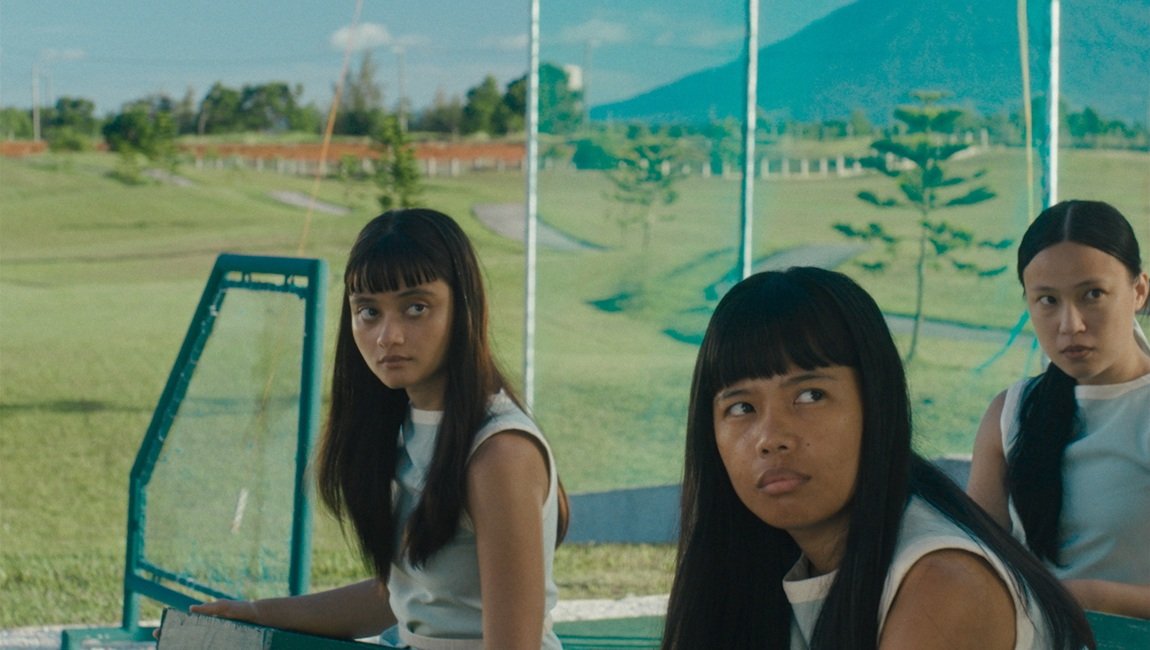
Rafael Manuel’s debut feature Filipiñana should go down as one of this decade’s great sweaty films. The humidity of its Philippines setting is touched with the sickly sweetness of rotting mangoes, a noxious and intoxicating overwhelm for the senses. The luxury resort outside Manila where the story unfurls is a languid oasis amidst the city’s bustling chaos. Here, characters live at the mercy of time, money, and class divides which run wide and burrow stubbornly; there is humidity in the air and of the mind, a breeding ground for anger and national guilt; and, on this film’s particular day, 17 year-old Isabel (Jorybell Agoto), a tee-girl who assists golfers on the driving range, glides through the resort’s immaculately manicured grounds like her country’s long-held secrets come to life.
Isabel is a walking contradiction. In her job, she must be seen and unseen, alert but not intrusive. Her presence is an essential signpost of luxury because she frees guests of even the slightest inconvenience. She’s as valuable a fixture in the resort as its towering, imported pine trees — though just as disposable. Born and raised, like former dictator Ferdinand Marcos, in the Northern Ilocano region of the Philippines, Isabel’s presence is the result of violent capture. She was essentially imported from far away to work as any number of the anonymous cogs in the resort’s machine of leisure: caddies, concierges, and caregivers dot the landscape yet hardly make a noise. We don’t know Isabel’s backstory when we first meet her; in fact, like the other tee-girls, she is not meant to have a story at all. She is a marker of the present moment, in service of rich tourists who are there to purge, like anyone on vacation, all thoughts of the past and the future.
A nagging drought is killing the resort’s giant pine trees one by one, each ready to be replaced by another at a moment’s notice, but no one is willing to acknowledge that they’re not meant to be there in the first place. Isabel, too, doesn’t belong. Like the scores of employees at the resort, every sun-scorched surface is snapped to attention but on the brink of exhaustion. Manuel maintains this delicate balance across a single day full of banquets, karaoke, dancing, and golf, during which Isabel bristles against bosses, commiserates with colleagues, and gradually obsesses over the resort’s overlord, Dr. Palanca, in whom she recognizes a piece of home.
Manuel’s precise compositions belie a languidity of feeling, detached like Michael Haneke but deep like Jia Zhengke (who was a significant mentor to Manuel and serves here as an Executive Producer). Like Jia’s The World (2004), Filipiñana means to portray an escape that somehow accommodates a totality of existence. But where the former envisions one where a symbolic simulacrum of the whole world is at a person’s fingertips and the alienation borne of living in it, Manuel’s film offers an escape to home, where Chinese tourists can enjoy familiar comforts, down to the spoken language, without compromise. This is a film about belonging, and Manuel understands that in a pot such as this, someone is bound not to melt.
Befitting its Marcos-era construction, the resort at which the film was made is a palatial monument to evil. It’s easy, and perhaps the point, to get lost marveling at the pristine green of the golf course or the elegant curve of its grand staircase as tourists dressed in gowns trot up like wannabe Cinderellas. What makes Filipiñana so captivating is the way Agoto and Manuel devise a natural way for Isabel to be physically dwarfed by the grounds, but never minimized. Look off to the side of that staircase, once the high-heeled footsteps have died down, and you’ll find Isabel scanning the visitor map to find the pool and Dr. Palanca, to whom she’s been tasked to return a stray golf club. Agoto’s performance is bound up within her placid face and dulcet voice, but she hides a latent rage. Early inconveniences like a belittling boss simmer underneath the blazing heat until they boil over in the face of deeper, more insidious injustices. When she learns a grave truth about her past, she sets her sights on revenge. Suddenly, her invisibility becomes a weapon, her unassuming presence an asset.
Manuel is not shy of a metaphor. The dying pine trees represent one direct, occasionally blunt, pathway to the film’s ideas about displacement and extractive violence. But where the trees hit like a mis-swung golf club into the earth, another comes later, emerges more subtly, as sharp as a knife, and suggests with more force a flipside argument about belonging. Lost amongst the resort grounds is a little girl, a guest at the resort, whom we meet at the same time we meet Isabel. Their encounter is innocent: the girl licks an ice pop and stands over Isabel as she dozes (against protocol) on the empty greens. The girl is the daughter of a wealthy tourist, clearly mischievous, having slipped out of her resort-appointed caregiver’s sight. By the time it’s clear that the girl has gone missing, Isabel is already on her own mission (whose mystery is worth preserving). The girl’s discovery and the conclusion of Isabel’s mission are at once inevitable and spontaneous, poised against violence and chance. Manuel converges two points about class divides, and the spaces they share by choice and by force, in a confluence of careful narrative construction. It’s Filipiñana‘s greatest strength, and singles out Manuel and his film among an increasingly crowded crop of films dealing with similar themes.
DIRECTOR: Rafael Manuel; CAST: Jorrybell Agoto, Angeli Bayani, Carmen Castellanos, Teroy Guzman, Carlos Siguion-Reyna; DISTRIBUTOR: Kino Lorber; IN THEATERS: August 28; RUNTIME: 1 hr. 40 min.
Comments are closed.