
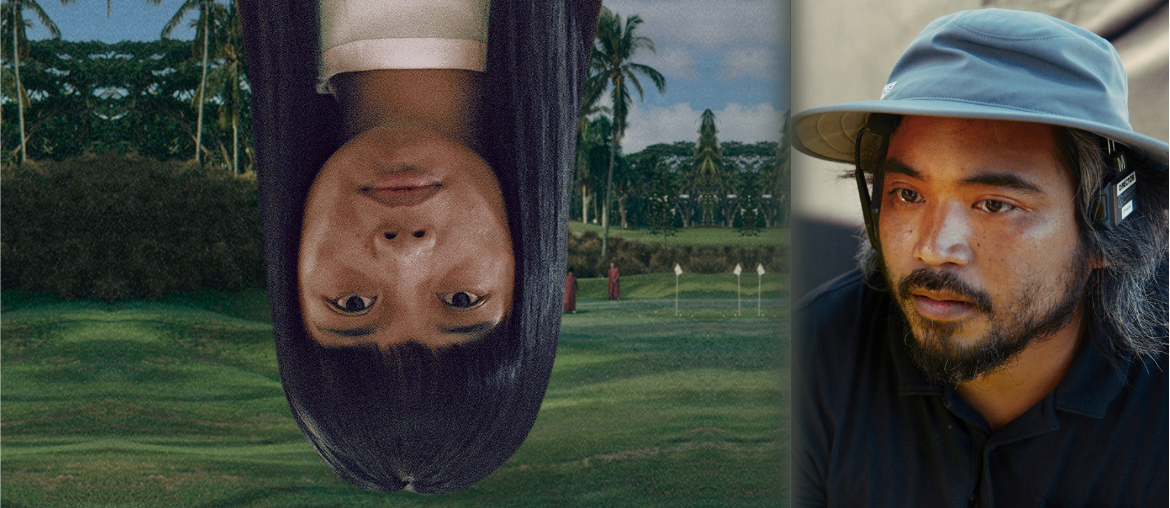
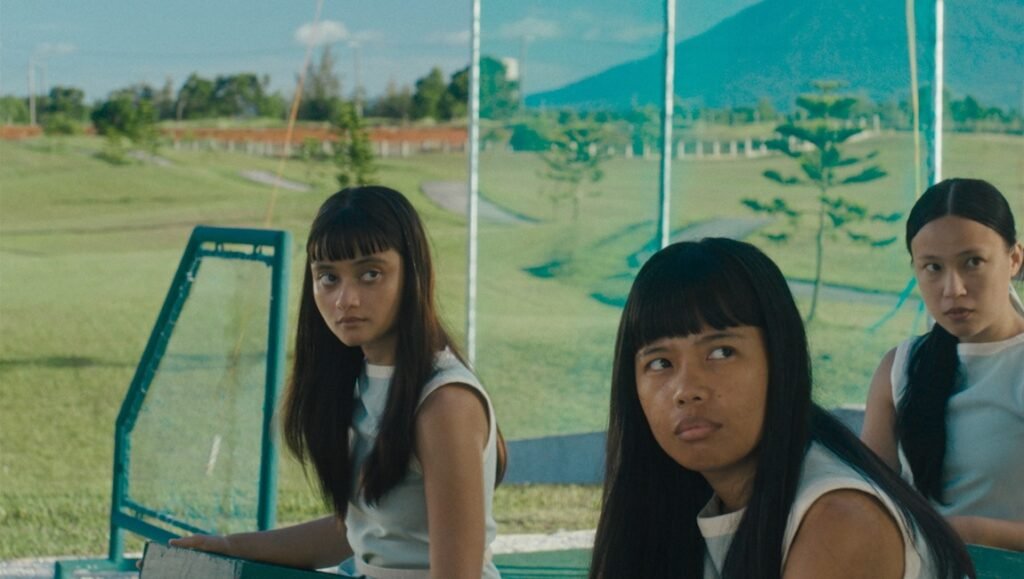
The verdant hills of a resort’s private golf course serve as the backdrop for Rafael Manuel’s debut feature, Filipiñana; a strikingly picturesque setting that is just as serene to its visitors as it is hostile to those who tend to its grounds. Adapted from the director’s Silver Bear-winning 2020 short of the same name, the film zeroes in on the vastly different experiences of two young women — one a teenager from the rural north working as a “tee girl” for the resort’s wealthy clientele, the other an expatriate struggling to come to terms with the social norms of her homeland — as the stifling heat and an inescapable drought excavates the darker secrets hiding underneath the club’s pristine surfaces.
These secrets and the conditions that maintain them reflect many of the interests Manuel exhibits in his larger body of work — namely, how the spectral ghost of colonialism infiltrates the lives of those generations removed from its initial wrath — a perspective that has no doubt been colored by his own worldly experiences as a diasporic Asian filmmaker. Filipiñana languidly unspools itself across meticulous static compositions, inside of which personal histories inevitably collide with the capitalist systems of the present, to crack its cotton-candy facade. Rafael’s approach brings to mind the cinema of legendary Chinese auteur Jia Zhangke, who previously served as Manuel’s mentor and is credited as an executive producer here.
Ahead of the film’s theatrical release, I spoke with Manuel about art’s relationship with colonial oppression, how his life in the West has informed his creative ethos, and the most important lessons he learned from Jia all those years ago.
Kevin Bui: Although your film is primarily set on a golf course in the Philippines, a lot of its imagery around themes of colonization and violence feel very universal. I’d love to hear more about how you chose to incorporate these aspects into the film.
Rafael Manuel: For me, there are so many things about a golf course that makes it a really effective microcosm to explore colonization. The first golf courses in the Philippines were on U.S. military bases, and then when the Americans left, the local elite just kind of took over these spaces. When you think about the form of the film, there are a lot of these wide landscape shots. Throughout history, these kinds of images have always been a colonizing tool. Landscape paintings, for example, are an expression of man’s dominion over nature. If you go through the photography archives from the 1900s in the Philippines, one thing you’ll keep seeing is landscape photography with faceless and nondescript Filipino workers, because the only people with access to cameras back then were Westerners.
Simon Schama, who’s an English academic, writes about how “landscapes are culture before they are nature” in Landscapes and Memory. The question that naturally arises is, whose imagination is being projected? In On Photography, Susan Sontag also talks a lot about how the American West was colonized through photography. It’s a way of documenting and imposing a record on things. A golf course is nothing more than a gentrification of land. You’re taking a piece of the Earth that was wild, and you’re making it safe and pristine for man’s usage.
KB: I felt the use of English in the film was particularly pointed, too — who gets to speak it and when to do so. Could you tell me about the inclusion of this dynamic and how you came to weave in the native Iloko dialect so heavily within the film?
RM: English as a class marker is a very real thing in the Philippines, and it’s something I definitely wanted to represent in the film. The contrast between it and the Iloko dialect came about when I cast Jorybelle Agoto — who’s Ilocano — seven years ago for the short film. When directing, I try to build around existing things that my actors already know so they can “pretend” as little as possible, because that’s how I feel you get the best performances. It ended up being perfect, because Ilocos is very historically relevant to modern-day Filipino politics. The Marcos family, who are a political dynasty back in power again after being exiled 40 years ago, are actually Ilocano. So its inclusion kind of gives the film this political charge that I feel is so necessary when making the kind of movies that I want to make.
KB: At times, it seems like the film is set in an alternate fantasy world with how playful and anachronistic the imagery is. Why did you decide on this approach?
RM: It’s a very important aspect of the film, this timelessness. I feel like post-colonialism is a term that gets thrown around a lot lately, but for me, I really don’t like that phrase because we’re still living in it. With my production designer Tatjana [Fanny Honegger] and cinematographer Xenia [Patricia], I intentionally tried to develop a visual language that could have happened 50 years ago, 50 years from now, or today. For me, it speaks to this timelessness of colonialism.
KB: You mentioned your crew, which consists of artists hailing from a wide range of cultural and ethnic backgrounds. How important was it for you to get a variety of perspectives on set?
RM: When I was living in the Philippines, I worked in advertising; I was a creative director. But my background was in writing television scripts and things like that. The people I went to film school with abroad are the ones that I really kind of grew up with in my cinematic journey, which is why a lot of them ended up being my heads of departments. It’s important to have very diverse perspectives when creating a piece of art — especially in film where there are so many different craftspeople that work on it with you — and obviously as a man telling a story with two female protagonists, to have these checks and balances and the inputs of the women in my crew was crucial. I feel like the visual and audial language of the film is very much a product of our collaboration, and not just of my own imagination.
KB: You were born in Manila but have lived and worked in Amsterdam and London. I felt that the character of Clara was a really effective surrogate for Asian people who have left their home country and return to find things are so different from what they’re used to. How have your own experiences informed the film?
RM: That’s a good question. I mean, Clara is very much me. Her uncle Renato’s company, Golf Depot, is actually based on my parents’ own business. So she’s very much a direct representation of myself. I always have these conversations whenever I meet other Filipinos living abroad, that we feel this sense of guilt being able to pursue our dreams abroad while so many others in our country suffer. I don’t know about your background, but for me it’s funny because you talk about going back home and seeing how things are different, but at the same time, many things are still very much the same.
KB: I guess this is something that I’m also quite conscious of too. I have family in Indonesia, so I go back quite often.
RM: You can admire all the “progress” in the Western countries we live in, but really, the power dynamic that exists is the same that it was 150 years ago, when America had the Philippines and the Dutch had Indonesia. Right now, every story I write is still about the Philippines, but I haven’t lived there in 10 years. Sometimes I wonder, “Oh, when will I start to want to make a white film? Should I feel guilty for wanting to make one?” Another observation I had is that with white artists, when they make a piece of work, it tends to feel like they are speaking for the rest of mankind. For many brown artists I know, we often only feel a responsibility to engage with our own audiences.
KB: You’re an alumni of a few prestigious incubator programs, such as Berlinale Talents and the Locarno Filmmakers Academy. How did European labs like these affect your filmmaking process?
RM: There are both pros and cons to it. Going to film school, your experience is very much at the mercy of who you are going through it with. I was very lucky that I got along well with my cohort, and we saw eye to eye a lot artistically. It’s like starting a band. If you don’t jive with the other person, you’re never gonna make music that you’re happy with. The same thing goes with these labs.
KB: I guess it almost speaks to this other form of colonialism, which is this cultural version of it.
RM: I think there’s this belief that it’s important to have these Western stamps on your Southeast Asian project because that’s how you get financing. There’s lot of European logos at the beginning of my film, for example. It made me think about this one Flemish painting I saw. I forgot who painted it, but it’s a painting of this huge living room in Amsterdam from the 1600s. On the walls, there are pieces of art from all over the world, from Africa, Asia, everywhere. It made me think about how little has changed 400 years later, where the gatekeepers are still these Western countries. What art gets to be made and who gets to consume it? I don’t want to seem ungrateful because I did get a lot of opportunities by going into these labs, but I feel it’s also my duty to be critical of the way that things are structured. It doesn’t come from a place of hate. It’s just that the overall structure is a bit unbalanced.
KB: On the other hand, tell me a little bit more about your mentorship with Jia Zhangke as part of the Rolex Arts Initiative.
RM: What separated the Rolex program from the others for me was time. Other labs lasted for only a week or a few months at most. I think the longest one I did before this was the Cinéfondation Residence at Cannes, which was about four and a half months. Because of the limited time with your mentors, you feel pressured to only ask them craft-related questions about cinema. The Rolex program lasted over two years, and I lived in Beijing for six months. Director Jia and I constantly saw each other. I really got to have a more holistic connection with him, and I feel like I could ask him about how he lives his life and why he lives it that way. That for me was just as important as getting to ask the craft questions, because that’s ultimately what I want to make art about.
KB: What was his involvement with your film like? Is there a key lesson you learned from him?
RM: For Filipiñana, he came over for the first week of production. The day before we started shooting, I asked him to give me one piece of advice. I was driving him, because he couldn’t smoke in the car that was rented out for him. He told me that in the first couple days of the shoot, it’s okay if nothing works. The most important thing for you is to bridge the gap between the perfect version of the film in your head and the reality of what the film is going to be. It really makes a lot of sense that he would give that piece of advice, because what I’ve come to admire the most about him is his pragmatism. I think especially when making the films that he does, in the setting that he does in China where there’s so much bureaucracy and so much censorship, to be able to do all that at almost 60 years old and still keeping your independence is amazing. I can only hope to be like that at his age.
Comments are closed.