
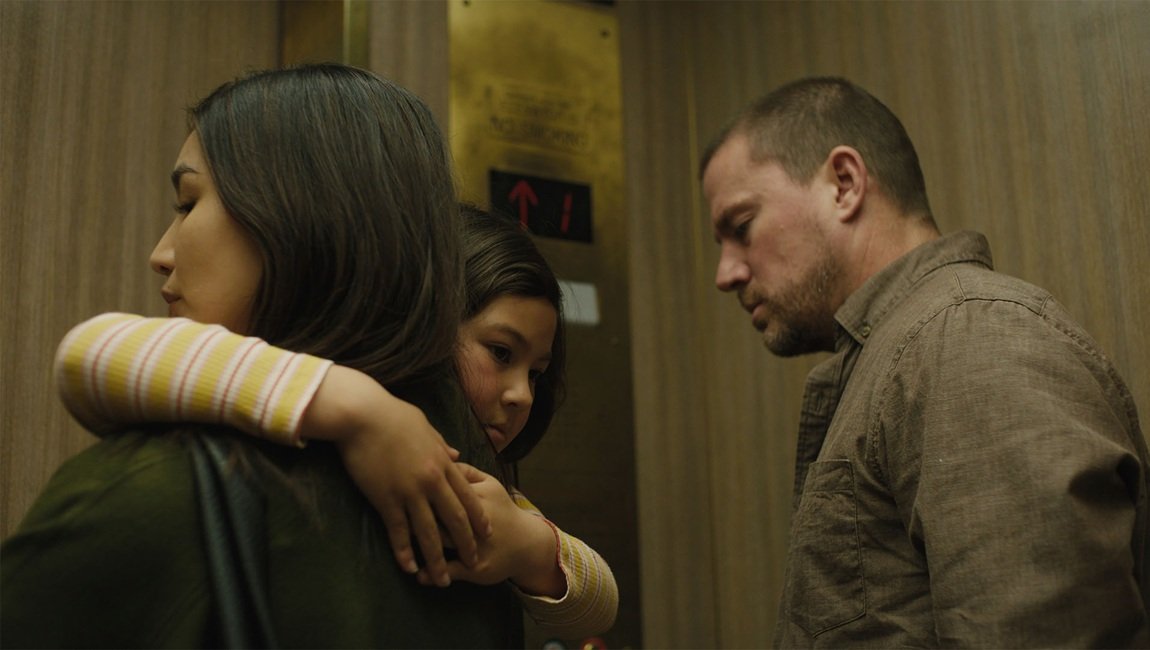
In the backseat of her parents’ car, an eight-year-old girl (Mason Reeves) searches the word “rape” on her mother’s phone. We only see her face as she scrolls through the results, but we know what’s happening: her world is rapidly widening in unspeakably terrible ways as she seeks to understand the assault she witnessed the day before. The effects of this earth-shattering event on both the girl and her parents are the subject of Josephine, the new film by Beth de Araújo, and the winner of this year’s Sundance Grand Jury and Audience prizes.
Separated from her father (Channing Tatum) on their Sunday morning run, Josephine witnesses a man follow a jogger into a park bathroom and then assault her in the clearing beside it. The scene is arguably graphic to the point of excess, but it is important to our efforts at understanding Josephine’s mental state afterward that we see exactly what she does. It may even free us of the assumption that we, experienced adults, are so better equipped to handle an event than a child. If seeing this shakes us, imagine what is happening to Josephine.
In the ensuing days, Josephine’s behavior grows erratic, sometimes violent, and she, educated by what she can glean from a computer, closes herself off from the terrors of the world and starts to become suspicious of all men, even male dogs. Meanwhile, her parents’ lives are thrown into disarray and their ideologies into conflict. Her father, Damien, is motivated by fear, anger, and a sense of justice. He wants to enroll Josephine in self-defense classes and make her testify to put the rapist behind bars. When he catches up to Josephine in the park, he sprints after the fleeing assailant, paying little attention to the victim on the ground. If it appears that Tatum is playing himself, it’s only a testament to how naturally he is able to embody the casually frail masculinity of a concerned girl dad. Her mother, Claire (Gemma Chan), meanwhile, wants Josephine to see a psychologist and fears that appearing in court would place undue responsibility on the shoulders of a child, only setting her up for more disappointing encounters with harsh reality if conviction proves elusive. Where Damian’s fears are borne out of imagination and papa-bear protectiveness, Claire operates from the knowing place of womanhood, the pain of the woman in the park being one she knows intimately.
Unrelenting shallow-focus and the occasional POV shot lock the film tightly into Josephine’s perspective, only straying from her emotional reality in brief moments where de Araújo needs a bit of context from the girl’s parents. When a detective visits their family to discuss the possibility of Josephine testifying, the camera repeatedly rotates 360 degrees in a dizzying, headache-inducing long take — because more than any of the dialogue’s actual participants, we are with Josephine, running around the table in the background and playing a game of duck-duck-goose. In the seat beside her father sits the rapist from the park, a ghost only Josephine can see; he appears this way throughout the film, most often when she is otherwise alone in her bedroom.
Though these techniques are effective at grounding Josephine in its subject’s interiority and generating empathy through shared experience, going so far as to make an audience feel trapped in the fracturing mind of an eight year old — her eventual subjection to cross-examination in court is appropriately painful — they also betray the filmmakers’ limited aesthetic range and point toward a frustrating strategy of sick-making agitation. Stress is currently something of a cinematic buzzword with filmmakers like the Safdies and their associates making careers out of not panning away from their own Travis Bickles’ most uncomfortable moments. In that micro-movement, discomfort becomes a propulsion engine; to be stressed out is to be thrilled. De Araújo, whose previous film put viewers inside the maelstrom of a hate crime, uses anxiety to different ends, as neither excitement nor humor is in her film’s purview, but it’s worth questioning this tendency toward distress when it becomes excessive.
Anyone with severe trauma, including and especially children, can be liable to extreme behavior, but there is a difference between sensitively portraying this and rubbing one’s nose in it. In this regard, Josephine too often overshoots. When a boy at school, embarrassed at losing a game of arm wrestling to a girl, pushes her to the ground, Josephine responds by grabbing a nearby shopping bag and throwing it over the boy’s head, pulling it back like an assassin in a movie. Did she learn this in her karate class? Would simply whaling on the kid be too passé? The scene demands an overreaction, but this is so unbelievable. Further, incidents like this one and a similar outburst later in the film are some of the few times that Josephine puts distance between us and its titular character, rupturing the empathetic project in the name of shock. And a few, blessedly rare stabs at poetry — who can say what a face pressed into the flesh of an apple rotting in timelapse is meant to evoke, really? — likewise provide embarrassing flourishes of another flavor. These and other misjudged moments accumulate throughout, steering Josephine away from its observational strengths and toward the unfortunate, familiar schema of cloying Sundance fare.
Published as part of TIFF 2026 — Dispatch 1.
Comments are closed.