
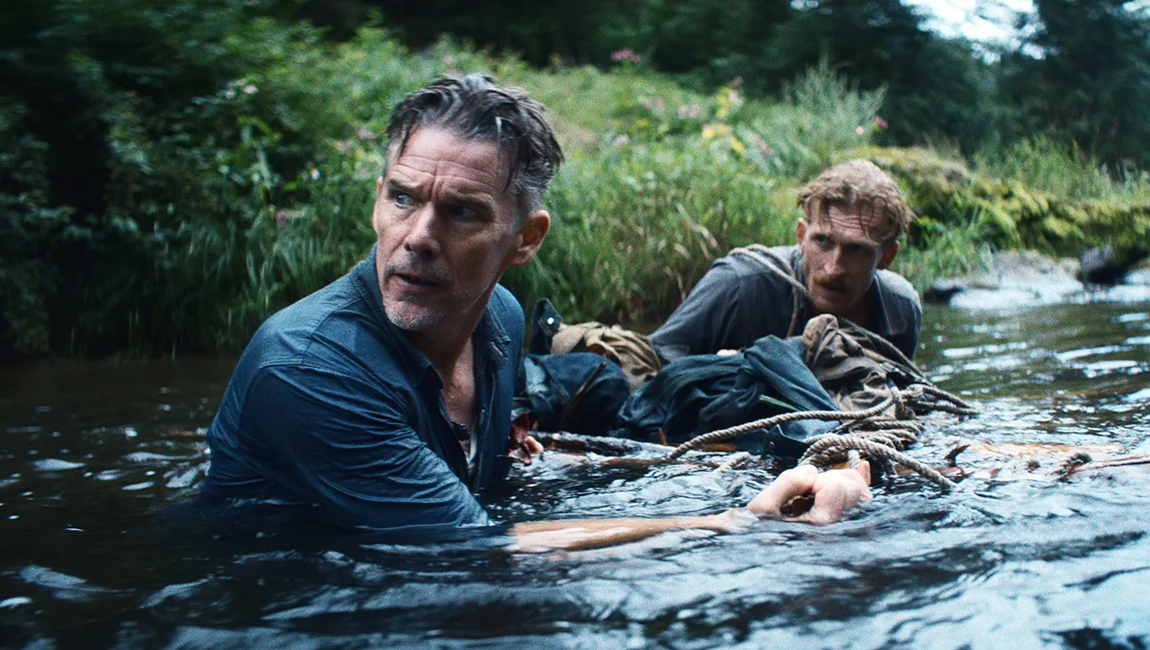
There’s a certain irony to Padraic McKinley’s new film being called The Weight. Set during the Great Depression and starring Ethan Hawke as one of four convicts compelled to undertake a dangerous, off-the-books job to try to earn his freedom from prison, the “weight” of the film’s title refers to the physical burden of carrying a dozen bricks of the U.S. government’s gold in a knapsack and presumably the exhaustion that results from said carrying. And yet, despite the extremity of the task they’ve undertaken, requiring the men to travel 50 miles on foot across unsteady terrain and under the noses of equally desperate men who would happily kill them for what they’re carrying, there’s a curious lack of ballast to the film. Even though this belongs to a long, proud tradition of films about men tempted by lucre — either literal riches or simply a shortcut to a better circumstance — to risk their lives, the film flouts dramatic conventions as well as common sense and puts a hopeful face on a genre that’s almost exclusively a bummer. No cautionary tale about greed nor men being driven mad by temptation (there’s no Fred C. Dobbs amongst our cohort), the film instead plays like a straight-down-the-middle, men-on-a-mission film that argues for working together, coalescing around a common enemy, and emerging triumphant against incredible odds.
It’s a subversion of expectations, to be sure, but it cuts The Weight off at the knees, leaving the film at odds with its true self. The film represents a collision between two modes that aren’t necessarily complementary: white-knuckle tension over a scenario with zero margin for error and an aspirational fantasy where collectivism is rewarded, competing factions put their differences aside, and the little guy stands tall against the crushing boot of both capitalism writ large and the carceral system. The Weight is torn between artful pitilessness and “dadcore,” with the latter ultimately winning out. It’s the sort of film that concludes with a Lynyrd Skynyrd song on the soundtrack — despite being set in the 1930s — and shots of our cast preening and laughing it up in between takes under the end credits, as though it were something like Predator.
Hawke stars as Murphy, a widower and single father, solely responsible for the care of his adorable young daughter, Penny (Avy-Berry Worrall). Murphy is what you would describe as a jack-of-all-trades: he boasts that he can frame a house, make planes fly, rebuild a car’s engine, and mend a sock. However, it being the Depression, he can’t find work or afford the rent, leading to him and Penny being thrown out onto the street. After accidentally assaulting a plainclothes police officer, Murphy is sentenced to a year in a labor camp, with Penny being made a ward of the state; there’s even a ticking clock where she’ll be put up for adoption after a short period of time. Murphy is sent to a labor camp in central Oregon where he breaks rocks in the hot sun all day under the watchful gaze of a folksy taskmaster, Warden Clancy (Russell Crowe). Clancy takes an immediate shine to Murphy, who has a knack for problem-solving and is good with his hands (he even repairs the warden’s Ford Model 18, just to be a gracious guest). But even with Murphy working off his jail stint in a quarry and keeping his nose clean, his sentence won’t be up for months, not in time to prevent Penny’s adoption. And so, over swigs of whiskey, the warden presents an opportunity that would serve both their purposes.
Clancy arranges for Murphy and three of his fellow convicts to travel several hours downstate to the Black Hawk Gold Mine, where the four men connect with the mine’s chief of security, Taggert (Alec Newman). Taggert explains that Roosevelt is recalling all the gold being kept at various government-controlled mines around the country to fortify the U.S. economy, which has, in turn, led to a string of armed robberies where bandits have made off with Uncle Sam’s gold. The plan is for the four men, accompanied by two armed supervisors, to backpack through the wilderness for five days until they arrive at a rendezvous point, at which point the gold will be taken into possession by the government and the convicts’ sentences commuted to time served. It’s a scheme that plainly doesn’t pass the smell test, but none of the men are in any position to say no. Setting off under cover of darkness, the six men are immediately intercepted by Anna (Julia Jones), a Native American woman who works at the mine and who demands that she accompany them or she’ll betray their secret mission. Over the course of a week, our travelers alternate between fraught impediments to their success — both of the natural and human-centric variety — and gradually grow closer with each other as they share their stories and are compelled to work together.
Films like The Weight typically fall into a much-beloved subgenre where maverick directors will spend a small fortune and walk right up to the brink of madness to depict the eternal conflict between man and the elements; the sorts of films where filmmakers like Boorman, Coppola, Herzog, and Friedkin bolstered their legend (there’s a sly homage to Sorcerer in the film involving a mid-film sequence set on an especially rickety rope bridge). Yet The Weight is a comparatively modest film, both in its ambitions and budget, and despite its best efforts, you can see where it’s cutting corners. McKinley primarily works in television as an editor-producer (he previously collaborated with both Hawke and Crowe on the miniseries The Good Lord Bird and The Loudest Voice, respectively), and the filmmaking reflects an artist possibly uncomfortable staging action sequences for the big screen. McKinley employs a lot of shallow focus, shaky handheld camerawork, and medium close-ups, which tend to minimize the enormity of the locations — with rural Germany standing in for the Pacific Northwest — while undermining the tension of some of the film’s set pieces. The director also favors cutaways, jerky and chaotic action, and utilizing offscreen space, and after a while it becomes clear that this is because he simply doesn’t have the footage to convey the grandeur that the film demands. Even more detrimental, The Weight is primarily shot with wide-angle lenses and milky lighting, which causes visual distortion around the edges of the frame and even more limited depth of field (if you recall the way The Revenant or Malick’s A Hidden Life looked, it’s similar but only with less production value). This too feels like another trick meant to obscure the limitations and seams, with the side effect of making it feel as though you’re watching the film through an astigmatism.
Despite the zero-sum nature of the endeavor — the men are told at the outset that if even a single gold bar goes missing, the deal is off and they’re in line for a world of hurt — and being chaperoned by a couple of gun-packing brutes who don’t seem terribly invested in the convicts’ long-term well-being, The Weight is oddly devoid of suspense. There’s almost no cause-and-effect to the film’s plotting. At one point, one of the convicts (played by Hit Man’s Austin Amelio) tries to kill Hawke’s character — after the latter saved his life only seconds earlier and in disregard of how it would harm the mission — for seemingly no reason at all, which the film then brushes past with no lingering fallout or bad blood. When Hawke’s character breaks his dominant hand, there’s no actual consequence to it, save the extraordinary measures undertaken to pry his wedding band from his swollen finger. Further, the film is so insistent on making Murphy a faultless vessel — proficient in literally everything, unwavering in his decency, and never wrong in his decision-making — that it makes for a very dull protagonist, humoring others until he’s ultimately validated. And then there’s the character of Anna, who seemingly has no agenda of any kind, to the point that one questions why she would even traipse across the forest with a bunch of convicts and a couple of rapey guards (the implication is that she’s an employee of the mine; it’s unclear what’s preventing her from just leaving through the front door). Ultimately, the character is little more than a chaste potential love interest for Murphy while also giving voice to the inhumanity of the foster system, as if Hawke’s character couldn’t assume as much and lacked sufficient motivation.
Watching The Weight, it feels like the film is stuck in “easy mode,” with the characters rarely pushed to their limits or forced to make sacrifices that might leave a lasting impact on them or the viewer. The film rides along in an agreeable groove where it’s never in any danger of becoming too ambitious or drawing blood from any of its sharp edges. The film’s best scenes are the early ones shared between Murphy and Clancy, which benefit from the familiarity of two old pros enjoying one another’s company while coasting on relaxed movie star charisma (Hawke is taciturn and deferential while Crowe gets to play avuncular with a perceptible rascally streak). One anticipates that the film is building toward a big confrontation between the two actors, after it’s placed all its cards on the table, but instead The Weight settles for a more anticlimactic note of pragmatism that perhaps feels closer to real life but only affirms the belief that the film lacks real fireworks. Time and again, McKinley’s film appears to be settling — for what’s convenient or expedient or simply amiable. One goes into a film like this expecting a crucible, and what we instead get amounts to a walk in the park. The Weight is like low-sodium potato chips or AA baseball: it’s just good enough to make you wish it was better.
DIRECTOR: Padraic McKinley; CAST: Ethan Hawke, Russell Crowe, Julia Jones, Austin Amelio, Avi Nash; DISTRIBUTOR: Vertical; IN THEATERS: September 18; RUNTIME: 1 hr. 55 min.
Comments are closed.