
A stunning bird’s-eye view of the Pacific Northwest’s sprawling vistas appears several times over in The Weight, Padraic McKinley’s tense, atmospheric Depression-era thriller; it’s the sheer arduousness of the ensuing trek across them that brings the film right back down to Earth.
Desperate to shorten his sentence and reunite with his young daughter (Avy Berry) before she becomes a ward of the state, resourceful prison camp inmate Samuel Murphy (Ethan Hawke) accepts a deal from his warden, Clancy (Russell Crowe): transport backpacks of gold bars across the Oregon forests on foot in exchange for an early release. Murphy enlists his prison buddies Akers (Peter Lewys Preston), Rankin (Austin Amelio), and Singh (Avi Nash) for the job, which they’re aware is effectively a death sentence — should the men lose a single gold bar, they will be killed. And even if they make it through the grueling five-day journey, there’s a strong likelihood that all the witnesses to this covert operation will be eliminated anyway. Armed guards make their escape impossible.
McKinley not only builds tension through harrowing set pieces — one set atop a rickety rope bridge at a dizzying height, another in a suffocating underwater trap — but also through his framing of the trek. Rather than the title cards stating “Day 1,” “Day 2,” they instead read “Five Days Out,” “Four Days Out,” etc., a countdown to the promised freedom that’s just within grasp and a constant reminder of the mission’s stakes. Desperation, however, breeds violence, with the men gradually proving just as dangerous and unpredictable as the terrain.
Ahead of the film’s release, I spoke with McKinley — who also co-edited The Weight — about developing the script with Hawke, the dangers of filming in a river, and the throughline of masculinity in his work.
Gayle Sequeira: You’ve spoken about the film drawing on your love of 1960s and ’70s action movies, such as Cool Hand Luke and Jeremiah Johnson. There are also echoes of Deliverance, Sorcerer, and Rituals here. What were you influenced by, in terms of both their craft and their themes, and was there something you were looking to subvert?
Padraic McKinley: Those films came naturally to Ethan Hawke and I when we were developing the script. We started talking about the kind of movie we could make set in the 1930s Great Depression era. Ethan was working on a Paul Newman documentary at the time [2022’s The Last Movie Stars], and he talked about the kind of character that the actor often played — a good and honest man who stuck to his moral code even during tough times. So we started not only building the script from a character point of view, but we also really started paying attention to the aesthetic of ’70s films. We looked at Sorcerer, Cool Hand Luke, and Jeremiah Johnson. We also looked at The Verdict and Hud, and got inspired by the idea of trying to make something that looked like it belonged to that time period.
A lot of themes we deal with in the film — the corrupting nature of power, the haves and the have-nots, the prison system where, in order to just get people off the streets, they were put away for a really long time even for committing small crimes — were inherent to the Great Depression, but things have not changed drastically since. We’re in a downtick in America right now. Thematically, it’s a little too close to home.
GS: Could you talk about developing the script with Ethan and how it evolved from the original? I read that it was you who came up with the idea of having the men be incarcerated.
PM: In the original draft, the men weren’t incarcerated, which changed their dynamic. Murphy’s daughter Penny was in a home — we didn’t get to know her too well — and he had to pay a certain sum within a deadline to prove that he could get her out. Clancy was actually one of his friends, a fixer who lived in Eugene, Oregon, and he had sent Murphy off to a gold mine. The original draft was a bit more of a period action film than an adventure film. So there was a bit more shooting and bodies were dropping a little harder, and there was a big climax — ours has Ethan Hawke and Russell Crowe just talking. So it had a different tone. But this world and the idea of a reverse heist set during this time period and the character of a man doing it for his daughter — that was all in the original script.
GS: What made you decide to end not with a firefight but with a conversation between Clancy, the incarcerated men, and Anna [a stowaway on the trip] instead? It did seem like you were priming the audience for loose ends to be tied up, but this was a change of pace.
PM: I love car chase sequences in movies, and I knew I wanted to have one here. It would be fun to have one featuring a 1930s car — a slowish, underpowered vehicle. We had that, and then we felt like we’d come to the end of the road. When [co-writer] Shelby [Gaines], Ethan, and I were outlining it, we kept thinking, “Okay, this is the part where the shootout happens; this is it.” But it just felt wrong. It would’ve been a different film. Shelby wrote this amazing scene about The Bonus March, which took place in Washington, D.C., in 1932 [in which veterans hit by the Great Depression demanded their bonuses immediately rather than having to wait till 1945 to cash their certificates]. It was a great, great speech. But we realized it had Murphy talking too much. The story’s told through his eyes, and we knew that he would’ve instead done something pragmatic instead because he’d made a deal with Clancy.
This whole movie is about deals — Clancy makes a deal to free the prisoners if they get his gold out, and he breaks his promise, but Murphy still holds up his end of it because he’s a man of integrity. But at the same time, this payment ensures that he never has to cross paths with Clancy again. So the car chase sequence works as an ending, and then you can start saying goodbye to the characters — Clancy, for example, exits when everything’s squared away. And then at the end, you come all the way back to the beginning and meet Penny once again. You see her and Murphy drive down the road in the same way they did in the beginning.
GS: I wanted to touch upon these ideas of masculinity that run through your work. In the antebellum era-set series The Good Lord Bird — a previous collaboration with Ethan Hawke that you executive produced and edited — an enslaved young boy spends almost the entire series in a dress. He’s able to survive this violent landscape because of the fragility that’s projected onto him. With The Weight, also set in treacherous terrain, the threat is as much from the men as the elements. But you have Anna seeing right through them by saying, “I think men who talk big usually ain’t big.”
PM: What a great question, Gayle. I’d never even thought of the survivalist aspect to Onion in The Good Lord Bird until now. That’s such a cool question. He did whatever it took to survive, including working at a whorehouse, which goes back to the amazing novel [by James McBride] that we based the show on. Masculinity is funny. It’s unfortunate nowadays. Our culture is at the hot-water mark of toxic masculinity and the kind of masculinity that’s not good for people or for your brain, and definitely not for those who don’t subscribe to this “Alpha Male” dynamic. You see a lot of street violence and violence on the internet, and part of it comes from politics. Part of it comes from our society and the rise of things like Ultimate Fighting Championship and Joe Rogan. I’m not saying these are bad things, but times have changed, and there’s now a lot of posturing in the world.
Back then, masculinity meant something else. Murphy is just trying to make ends meet. There’s no room for posturing with him. There’s no showboating. He doesn’t have the outlet to do that. So he’s just trying to get by, and he finds himself incarcerated with men who, at first, seem questionable and whose masculinity is quite full-on, particularly Rankin. There’s this big guard, Letender (George Burgess), who’s overbearing. But hopefully what comes out in the film is that integrity is an important part of masculinity. I do worry sometimes that integrity is being eroded nowadays. Part of the fun of doing a period film is that you can see characters who possess it. At the end of the day, Murphy gives the money back to Clancy because he made a deal and he fulfills his end of it.
GS: The film’s nighttime sequences, in which the men are lit by firelight, are beautifully shot. There’s also a murder that takes place in the dark, which you only see brief flashes each time lightning strikes. What conversations did you have with your cinematographer about shooting these scenes?
PM: They were great conversations. This is a great question because the nighttime stuff was something [cinematographer] Matteo Cocco and I spoke about early on. I wanted the men to just be lit by the fire. I didn’t want there to be lights in the background or for the presence of the crew and their lighting equipment to be felt. That naturalism was important to us. But what did that look like? It didn’t mean just lighting a fire and hoping for the best. Matteo was out there with his small gear — he’s a master and a talent and just beginning to get his due. The murder was in the script, but the idea of doing it in flashes came to us at the end. It was really fun, and the biggest thing we were able to do on the shoot. We brought in the rain and lightning. Then, in the cutting room, it was really fun to have a character commit a crime in two or three frames at a time.
GS: It couldn’t have been an easy shoot. You were outdoors, there’s pouring rain, there’s a sequence in which the camera is underwater in a river. Where did you shoot? And how did you navigate the elements?
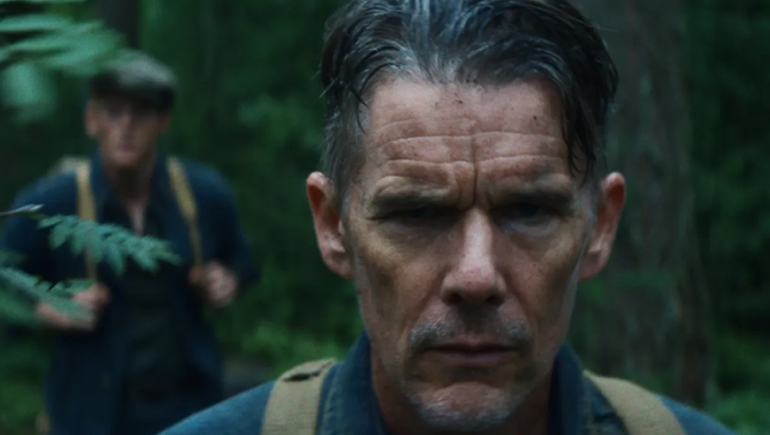
PM: It was easier for me because I spent a lot of time in jackets and with nice hot tea. [Laughs] I had it easier than the people carrying the gear, the actors getting in the water, and the cameraman on the bridge getting bumps and bruises. We shot in Bavaria, Germany. It was important to me that we shot in places that seemed untouched, where there weren’t paths, and it didn’t seem like people had walked through. Even deer paths felt wrong for the visuals we were trying to achieve with those men with heavy backpacks. It was a good thing, though, because these locations really inspired the crew and the actors when they got there. They were like, “Oh, this is beautiful, but it’s going to be hard.” If you can get up a rock face with a pack on, you don’t have to act much because you will already be sweaty and out of breath. We did lose a lot of our shoot time because we wanted to drive to some places and then walk out to others that were hard to get to. But at the end of the day, it was probably worth it in terms of even just the inspiration gained — we could point the camera anywhere and see something inspiring.
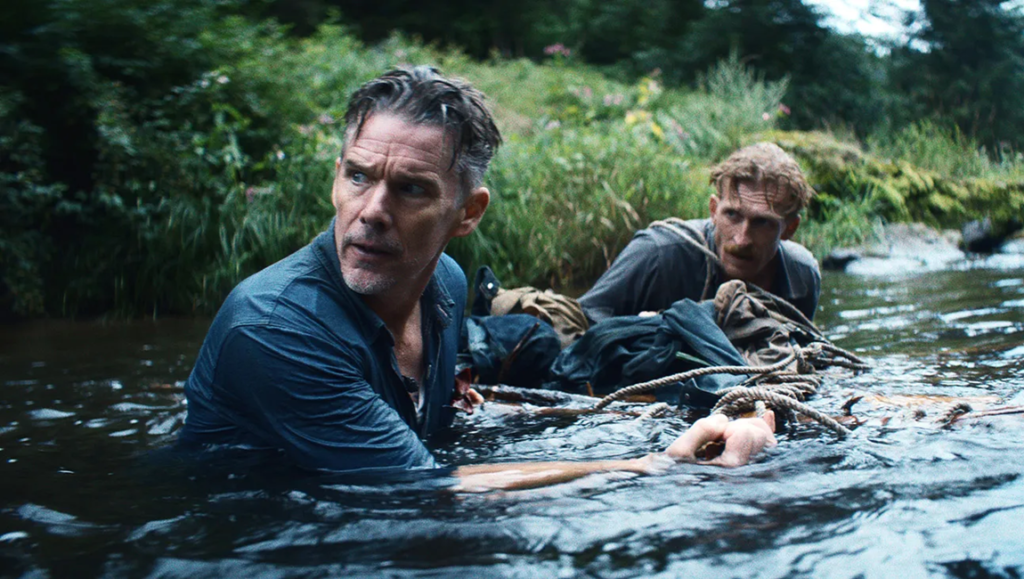
For the river sequence, we had to find the location first. That was funny because when we first scouted it, we tried to find a river that would be chest-deep. We got all geared up, put on our helmets to go river rafting, and then the water turned out to be an inch deep. So we got dragged along the rocks for most of it. We looked like the biggest dingalings you’ve ever seen in your life. We found a river, eventually, and knew that it would rise, but we didn’t know when. But once we had our location sorted, we had to manufacture the scene in terms of, “okay, there’s a crossing section, a pulled-downriver section, and then a drowning section.” And then we just did the math on what we needed to tell that story with its three distinct sequences. It’s like just anything else in movies — if you think about it in its large form or in terms of the whole story, it’s incredibly daunting. You have to think, “They’re crossing a river. They have to cross from one side to another. So let’s get the shots of them crossing. Okay, now the next step…” It was really hard and really cold. I’ve never met a human being who was colder than Austin Amelio in my entire life. But they suffered for their art, and I had a lot of tea. [Laughs]
Comments are closed.