
Two depressed guys, a remote location, and loads of shit hitting the fan. Martin McDonagh doesn’t need much more to make sophisticated black comedies that handsomely straddle the line between populist banger and purist art film. Ever since the Irish playwright turned to cinema as his primary artistic avenue with 2008’s masterful debut In Bruges, his adherence to that formula has been a reliable gauge of the quality of an oeuvre that still amounts to only five features. With the middling Tarantino-esque mosaic satire of Seven Psychopaths (2012), he bit off more than he could chew. And while the follow-up, Three Billboards Outside Ebbing, Missouri (2017), fared much better at the box office, and at the Academy Awards where it was in the running for seven statuettes, its blunt engagement bait around the political hot topics of the day made the dour Frances McDormand saga age like milk.
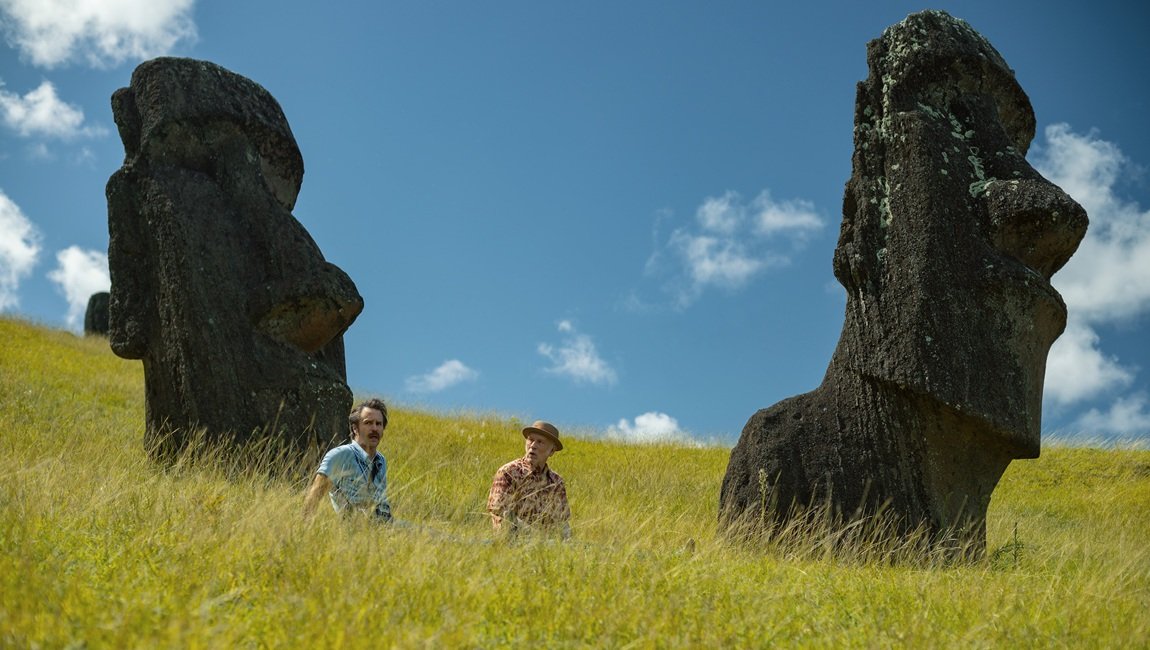
That’s a fate hardly imaginable for Wild Horse Nine, a back-to-basics star vehicle that landed John Malkovich the Volpi Cup for Best Actor in Venice just before its Canadian premiere at TIFF. The 1970s CIA caper, primarily set on Rapa Nui, better known as the mythically charged Easter Island of Chile, is arguably McDonagh’s best film to date, and most certainly an award-worthy career high for Malkovich. With remarkable comedic dexterity and emotional profundity, he crawls into the skin of Chris, an aging CIA agent on the verge of retirement, if not for late-stage cancer getting there first. Keen to die on his own terms, he drags his espionage protégé Lee (Sam Rockwell) to the island of the “big heads” for a somewhat somber, somewhat sweet suicide pact. As far removed as possible from any politics the Americans might interfere with, this is the place where Chris wants his skull obliterated by his most trusted CIA buddy.
McDonagh sets up a perfect serve here for a series of smashes: the most incredible jokes of his comedic oeuvre, mostly at the expense of the myriad political victims of America’s relentless interventionist politics. For instance: Chris wants a shot to the head just as much as he likes joking about that fateful 1963 day in Dallas, Texas, on which someone turned JFK’s skull into a bloody pulp. The sardonic agent also loves to riff about the impending coup d’état that is soon to oust Chile’s socialist president Salvador Allende and install the regime of General Augusto Pinochet. Patrice Lumumba catches some strays too in McDonagh’s prickly screenplay, all while the less lethal gags strike with equal impact. The objectively evil man is so infectious a jokester that accredited guests at Venice proudly donned merch bearing one of the film’s many quotable lines: “good luck with democracy and all that.”
The hardest-hitting joke, though, is emblematic of how much comedy gold McDonagh can mine from even the most banal back and forth. Chris posits the hard-to-refute thesis that the quality of cheese in a country is directly related to its acceptance of gays. The Netherlands, with all its queer pride, offers your Goudas and Leerdammers, while the icy uniformity of Russia has no such delectable cheeses to speak of. Like Colin Farrell and Brendan Gleeson’s miserable hitmen killing time in the sleepy Belgian town of Bruges, or the same pair falling out on the Irish island of The Banshees of Inisherin (2022), Malkovich and Rockwell gleefully chew the scenery of Rapa Nui, turning a place where nothing ever really happens into an arena of exciting cerebral sparring, and ultimately into a metaphorical site where America’s evil foreign policies come to die.
Never pretending to be a great visual cineaste, McDonagh and his trusted cinematographer Ben Davis do know how to extend their edgy comedy onto a visual plane. The title takes its name from the wild horses roaming the island, elegantly caught as impartial bystanders while Chris wrestles with his conscience and tries to put his insane career into a revealing memoir that the CIA would rather never see the light of day. The best visual joke is another JFK throwback, with a passing airplane lined up so that it seems to pierce one of the stupid big heads — as Chris so fondly calls them, much to the ire of Rapa Nui’s inhabitants. This mastery of the visual register also stays in place when the shit really hits the fan, and Steve Buscemi arrives as the strung-out head of the CIA’s Chile station. As if lifted directly from the Coen brothers’ best films, he delivers a couple of pitch-perfect lines of his own, all while escalating the plot to a dizzying degree.
But even as a geopolitical storm is brewing, McDonagh never lets the emotional core of his modest masterpiece out of sight. He is the master of the depressive male bromance for a reason, and Malkovich’s late-turn reckoning with all the ills he has inflicted on this planet is the most poignant crystallization of themes that have concerned the Irish director all the way back to his very first film. Rarely do you see a work that so gleefully bursts through political bubbles, only to finger-paint with the bloody remains scattered across the floor.
Published as part of TIFF 2026 — Dispatch 3.
Comments are closed.