
Over drinks at a lounge in Hollywood, Chris Rock tells Rosalind Eleazar that if you go anywhere in America, there’s a chance that at some point in history, Black people weren’t allowed there. This scene is a key moment in Misty Green, a jagged, convoluted, and compelling star vehicle about many things, too many things. But this idea — of conditional access and opportunity for Black creatives in the entertainment industry — is always lurking in the background.
Misty Green is just Rock’s fourth movie in 23 years, a filmmaking career that began with the pre-Obama Black President hypothetical comedy Head of State in 2003. As a director, and even an actor, much of the brilliant, generationally important comedian’s work on screen could be characterized as good ideas on paper that suffer in execution. He co-wrote and starred in a Heaven Can Wait remake. He made a buddy cop terrorism thriller with Anthony Hopkins. He’s directed an Éric Rohmer adaptation about marital ennui. He starred in a Longest Yard remake with his SNL buddy Adam Sandler at the peak of his powers. He’s submitted himself as the Ethan Hawke to Julie Delpy’s own take on Before Sunset. He’s put himself in the center of an installment of the Saw franchise. And he made an auto-fiction Annie Hall with dashes of Spike Lee sermonizing and, literally, Tracy Morgan.
With the exception of that last film, 2014’s excellent Top Five (still his best), Rock’s fans have experienced a now familiar cycle of being intrigued by the potential of these can’t-miss elevator pitches, then invariably underwhelmed at the cinema. He’s a director and actor who feels like he is in a constant state of tension torn between his highbrow personal taste, his political concerns, his projection of his audience and what they may want from a Chris Rock film, and his studio.
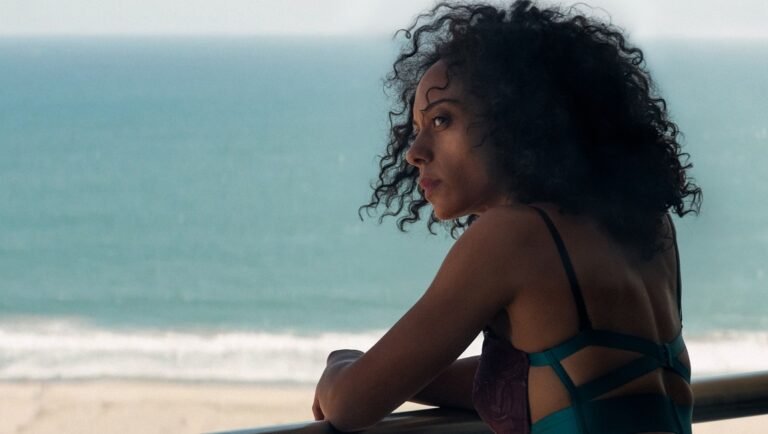
Misty Green has some of this DNA. It’s another great idea: a messy Cassavetes riff about a beguiling, former Emmy-winning diva who incites a reaction wherever she goes because she’s gorgeous, because she can act and sing, but she can’t get out of her own way. The film opens with Misty nearly out of chances and bridges to burn, with a week left to crash at the cushy beachfront apartment she’s been squatting in as a kept woman after her rich and powerful Hollywood producer lover died. The demand for housing incites a desperate pursuit of a job that can sustain her financially and jumpstart her career. You can imagine a version of the film that updates Hollywood Shuffle, a series of broad Chris Rock Show sketches sending up the contemporary industry as an oblivious racist and misogynist nightmare factory. And the film doesn’t shy away from this critique, but its strength lies in holding Misty accountable for her hubris, poor social skills, lack of discipline, and bad decision-making.
This is because Rock found his Gena Rowlands/Llewyn Davis in Eleazar, a 38-year old “discovery” best known to American audiences for a supporting role in Apple TV’s spy serial Slow Horses, but who made a name for herself on stage in London’s West End. Even Slow Horses fans will be unprepared for this performance. As the pilates-ripped, rage-coiled, eye-ringed, and smile-lined Misty Green she is no longer an ingénue, but remains defiant to the expectations placed on a Black starlet at this perilous moment in her career. Misty refuses to settle down as a powerful man’s arm candy wife, play Hollywood’s game to make it conventionally by taking on shitty, uninteresting parts, or sell out to nefarious concerns on the margins of the industry to exploit her fame in the interest of safety and comfort. Eleazar is objectively a superstar here. Rock knows it, and in the first of his films that he isn’t at the center of, the director capitalizes on finding an actor in the zone with multiple audition scenes, karaoke performances, and tense confrontations that make Eleazar what should be an immediate, chiseled-in-stone, no-brainer Oscar nominee.
Rock has long had a preoccupation with Black celebrity, Black power, and the responsibility of Black influence within the context of white-led industries and spaces going back to his first film — about a DC community liaison/alderman who becomes president — and running through his last film — about a Black celebrity with a lot of fellow ‘90s Black comedy star Martin Lawrence’s career in its construction. He is drawn to stories about Black people pushed to satisfy corporate and/or institutional (white) interests, who must wrestle with the compromise of self wrapped in monetary and status based rewards. Misty Green is his most interesting protagonist to date to wade into this struggle. She is her own worst enemy, but Rock goes to lengths to show the routine indignities she’s subjected to as a Black woman who won’t take shit, relegated to chattel in this industry, and why her relationship to the stardom she ostensibly wants and the roles on stage and off it would require her to embrace is so fraught and complicated; why she subconsciously may be doing everything in her power to torpedo her own success.
Unfortunately, Eleazar has to be as good as she is because the film is in constant danger of flying off the rails of that idea without her grounding it. The supporting performances are near uniformly excellent — particularly Adam Driver, having a fucking blast as mephistophelian “director”/Epsteinish sex=-trafficking drug dealer — but as a director Rock loves to let the camera roll regardless of the budget (a shoestring $5 million here), and as is historically the case in his films, the edit is rough, the seams are visible, and there are multiple plot threads he would’ve been wise to jettison. Chief among them is a B-story with Daniel Kaluyaa as Misty’s brother who suffers from schizophrenia. Kaluyaa is asked to play an American, with an accent he occasionally commits to, but more notably plays a mostly normal, charismatic, regular guy, which he struggles with, until he’s not normal, where he excels. Rock clearly had a message to express and a story he wanted to tell about Black mental health, the non-existent social safety net supporting that community, and the unsympathetic police state constantly endangering it, but it’s also fair to ask why he felt the need to splice that movie into what would otherwise be a small, thorny, and wonderful character sketch built around an exceptional woman on the verge of collapse. But perhaps that’s the point.
Speaking of fair questions, let’s return to the aforementioned lounge and drinks. In this scene, you watch Rock’s palpable chemistry here with Eleazar and wonder why can’t that just be the movie? Why haven’t we gotten one of those per year from a writer and performer as entertaining, inventive, and capable as Rock in the dozen years since Top Five? Maybe it’s because he can’t find the greenlights; or like Misty, he refuses to make it easy. He has other things he wants to say, and after 12 years in the wilderness begging for this meager budget, is concerned he may never get another chance to say them.
At the end of Top Five, Rock runs into DMX in jail, who repeats the refrain that has defined a career played out across multiple creative mediums: “One thing I really respect about you, why I fuck with you for real son, is you won’t let the industry box you in.” Then he barks Charlie Chaplin’s “Smile” through prison bars. It’s now unfortunately the second best musical performance in Chris Rock’s filmography. The best is officially Rosalind Eleazar in Misty Green singing “One Night Only” from Dreamgirls, auditioning for the role that may finally get her the stardom she’s been fighting for on her terms. She throws her soul into it, and it is a heart-stopping moment delivered by a breakout star in a film full of them. What’s unfortunate, then, to fold Rock’s preoccupations here into the discourse of Oscar forecasting: if Eleazar does end up getting nominated for this vital performance, she will likely still lose to a white woman.
Published as part of NYFF 2026 — Dispatch 2.
Comments are closed.