
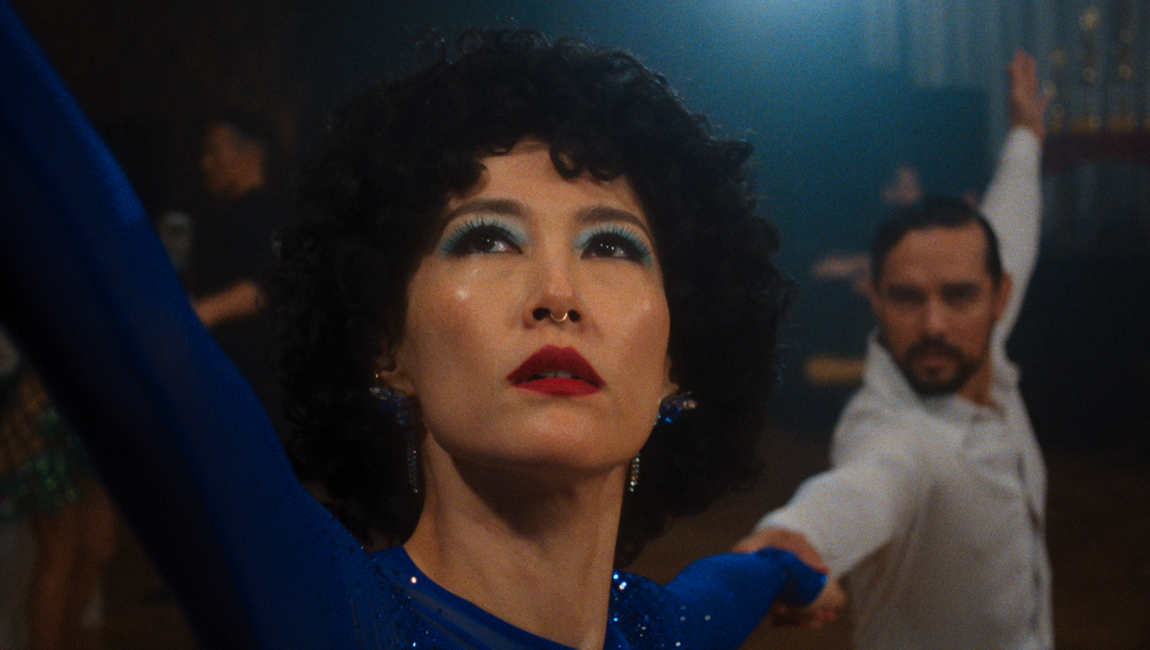
In Ha-Chan, Shake Your Booty!, grief bums around like a third wheel. It is needy, morose, fickle; the sort of guest that says they’re not hungry and then becomes sullen when everyone else’s food arrives. That’s inconvenient for the formerly jubilant Haru (Rinko Kikuchi), a Japanese salsa dancer who only stops moving when her husband, Luis (Alejandro Edda), passes tragically from a heart attack. But Ha-Chan is as averse to drudgery as its title suggests. Director Josef Kubota Wladyka answers the call to grief with psychedelically dilated eyes, finding as many punchlines, pratfalls, and pockets of rhythm in death as he might in life.
We first meet Haru as dawn floods her modern and immaculately curated home. She chews her breakfast with mischief curling at her lips; she grooves past posters of Punch-Drunk Love and All That Jazz toward her record player like a mountain lion on a lazy day. When she finds her prey in the backyard — her sweet Luis — he answers the call with a playful shake of his own hips. It’s the sort of near-silent, masterfully economical introduction that bares two full lives within a few script pages. They finish breakfast while they review footage of their own dancing, trading compliments and loving barbs in English, Spanish, and Japanese. If there was ever friction between Haru and Luis, it’s long since smoothed; if they’re sweating their upcoming competition, they’re not showing it today.
Ha-Chan operates with a vivacious cadence that merely shudders, not stalls, when it approaches its central tragedy. A (literally) ascendant performance at the Tokyo Dance Classic ends in literal heartbreak, and Luis spends his final moments alive clutching his chest on the dance floor. But grief is not a sullen affair in Wladyka’s purview. Haru’s sisters, the conservative Yuki (Yoh Yoshida) and the wild-eyed New York transplant Hiromi (YOU), swoop in to shepherd Haru through her sadness and stretch the cartoonish poles of sisterly affection and agita. If their Tom-and-Jerry cabaret weren’t enough to lighten the mood, Haru’s grief is quickly personified: a giant, chibi-style raven manifests in her home, as adorable as it is foreboding.
It’s an unsubtle metaphor that fits snugly within Ha-Chan’s portrait of broad strokes and primary colors. The movie is divided into six chapters, each with winking titles (“Oh Fuck, Fedir,” reads the fourth installment), each repeated twice in bright neon: first in English’s Roman characters, again with Japanese Kanji, both shouted in alternating baritones and shrieks. Wladyka’s palate is uncut indulgence. Ha-Chan’s score makes room for two needle-drops from The Cranberries; characters crunch and slurp and smack their food in ecstasy. Even the film’s most harrowing moment is an in-joke: home alone for the first time since Luis’ death, Haru waltzes with his framed picture in an unmistakable allusion to the drunken grief of Leland Palmer. It might be exhausting if it wasn’t so successfully funny.
On the page, Wladyka’s allergy to subtext is a riskier gambit. His players are operatic in their mission to tell before they can show, and the film cha-cha’s its way past every opportunity for nuance. But that inclination toward bold, brash text is deliberate. Ha-Chan militaristically pursues the less familiar fringes of grief, in which it can transcend its onus of woe to exist as an entity of vitality, of excitement, even of love — qualities that demand to be shouted. Eventually, Hiromi and Yuki convince Haru to draw back her curtains and dance again. She starts taking classes under the comically hunky Fedir (Alberto Guerra), a former Dancing with the Stars contestant with a notoriously open marriage — and, like Luis, a Mexican immigrant cutting a life as a dancer in Tokyo. Haru’s grief keeps her tethered to the ghost of Luis’ love, but Fedir’s bohemia poses an interesting question: what if that grief could open their relationship to a third?
Ha-Chan is a dance movie, one that marries its rhythms and cadences to the popping hips and sliding shoes of a waxed parquet. In a stroke of bitter irony, though, the movie’s dance sequences slip into its least successful moments. Cinematographer Daniel Satinoff’s lush, gauzy frames never seem to step in sync with Haru as she glides and snaps with her partners. Perhaps it’s a consequence of comparison. Ha-Chan performs characteristically explicit homage to the pillars of the genre — Dirty Dancing, Grease, Footloose — but never quite captures the art with the same panache. It’s an unfortunate failure made all the more tragic for the movie’s otherwise stalwart adherence to the bliss of the dance floor’s absolution.
Josef Kubota Wladyka is the son of a Japanese mother and a Polish father, and Ha-Chan is dedicated to the former, who remains an active ballroom dancer into her 80s today. For all its insistence on abandoning subtlety, Ha-Chan is most successfully nuanced and mature in its position as a by-product of multiculturalism. Wladyka is no stranger to the unexpected rifts that emerge through wedded cultures — say, the proper way to bury a lost son, a lost husband — and even through his dogmatic frivolity, he remains tonally nimble enough to pay these moments their due respect.
As Haru, Kikuchi earns equal esteem as an international star. No stranger to global productions herself (Kikuchi is one of only two Japanese actresses to be nominated for an Oscar), she shimmies seamlessly through Ha-Chan’s trilingual script and commands dexterous control over the movie’s maniacally giddy reckoning with grief. Like Ha-Chan itself, Haru exhibits little distinction between the passions of puppy love and the bowel-gripping panic of fresh grief. They are both deliriously painful, brutally ecstatic reminders of what it’s like to be alive, gushing from a vein with a rhythm good enough to get your feet moving.
DIRECTOR: Josef Kubota Wladyka; CAST: Rinko Kikuchi, Alberto Guerra, Alejandro Edda, YOU, Yoh Yoshida, Damián Alcázar; DISTRIBUTOR: Sony Pictures Classics; IN THEATERS: September 25; RUNTIME: 2 hr. 2 min.
Originally published as part of TIFF 2026 — Dispatch 3.
Comments are closed.