
Guy Moshe is an Israeli-American filmmaker. This, under normal circumstances, is not information pertinent to a review, but regarding his latest, The Fix, it’s tough to think of another place to start. Moshe is a former IDF special operative, serving under the particularly brutal authority leading up to the Oslo Accords. He remembers the day well when “we… basically handed the keys back to what was at the time the Palestinian Authority,” the new rule under Yasser Arafat. He likens the event to the United States’ 2021 retreat from Afghanistan, the precipitating event of The Fix: “I remember that I felt confused: ‘What have we been doing here? Why have we been fighting? Why did I bury friends of mine, people got shot, what are we doing here?’” In the film, spec ops agent Tucker (Zachary Levi) and his supervisor Larry (Liam Neeson) find that the retreat has left many undercover assets and American sympathizers in jeopardy. Traumatized by this fiasco, Tucker embarks on an extraction mission in Tehran in order to save an anti-regime activist and recover a large pot of money rumored to exist in a place called the Hotel Tehran.
Suffice to say, Moshe’s analogy is specious, if not nefarious. For starters, the IDF did not “hand over the keys” to the Arafat regime. Israeli soldiers were ordered to leave Gaza (though evidence proclaims many did not), but the strip was not rendered an independent body. Israeli Settlements continued to encroach further over the borderline, massacres continued to take place during and after the Oslo Accords, and Arafat would be harshly criticized as a U.S.-Israeli impostor, far more interested in puppet dictatorship than Palestinian independence. The Biden-led withdrawal from Afghanistan, though certainly not a humanitarian victory, was a genuine admission of U.S. defeat in the region. American intelligence no longer found Afghanistan a worthwhile place to be. Personnel loss, paired with the surrender of key points to the Taliban, rendered the war untenable, a financial venture gone sour. There are legitimate concerns about the safety of civilians after any kind of military withdrawal, especially in a two-decade-long conflict, but The Fix cannot be concerned with those lives in danger.
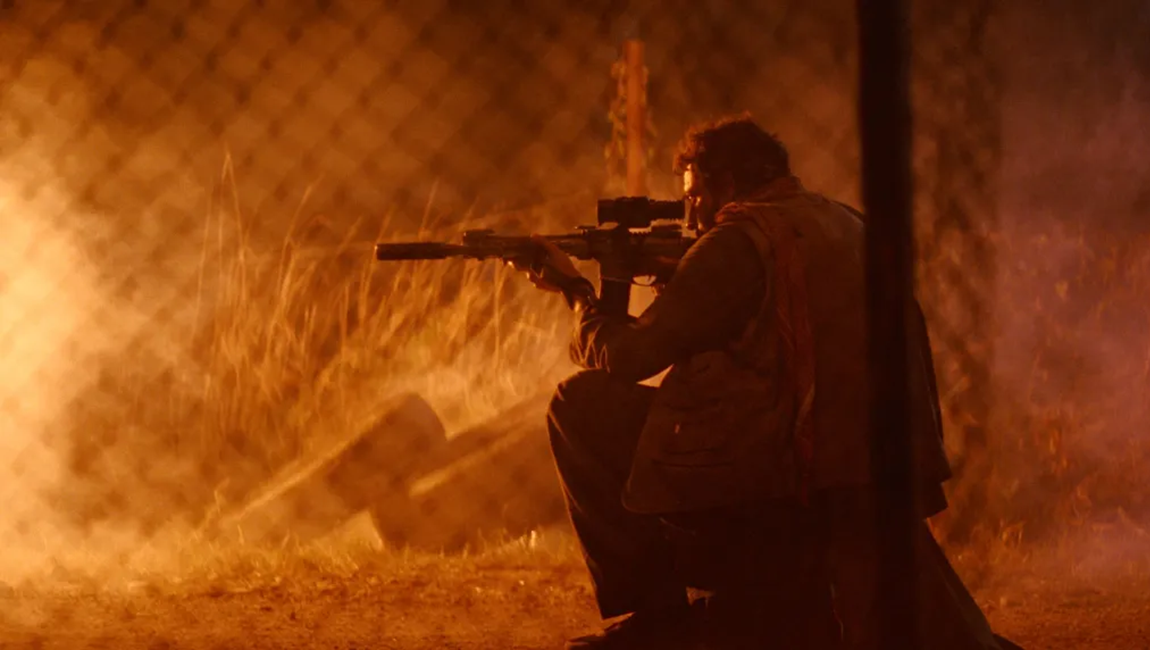
The real tragedy, according to Moshe, is the CIA assets left stranded in the country. The film opens in Kabul, where Tucker and his team are forced to encroach behind enemy lines one last time, in order to save one such asset. The fight, mostly a long-range, saloon-style shootout, plays almost entirely in shaky-cam portraits of blurry figures and flashing lights. The action inspires no more excitement than the doldrums of a bad Call of Duty campaign, while women and children stream from houses as insignificant wraiths. When the mission spins out of control, Tucker is forced to slay the asset himself in order to save him from torture at the hands of the Taliban. Their mission, which is later revealed as unauthorized, earns most of them a dishonorable discharge, the disgrace of which somehow results in swanky loft apartments and cushy family farms back stateside.
For all his faults, Levi accurately represents the CIA self-image. Rugged, quiet, and fierce, often called “cowboy” if only so Moshe may compose his umpteenth Peckinpah reference, he walks with a quiet pain and trauma that nevertheless spurs him to action. Most of his performance is set in his cheekbones, which, to his credit, are well-defined. Tucker considers himself independent from the acronyms, and yet acts in the exact same way that they do. The CIA and IDF both understand themselves the same way; that is, when they are not torturing innocent civilians or filming TikTok dances on mass graves. The many former IDF and active CIA agents who act as consultants or producers will all likely find a distant familiarity and glee in Tucker, an emotional role model that may absolve their atrocities and lack of a guilty conscience.
After this opening chapter in Afghanistan, Moshe draws another dubious historical line to Iran. Tucker and co. are tasked with an off-the-books mission in Tehran, in order to rescue a women’s rights activist currently held by the regime. Also, there is a large pot of mythical money waiting at the “Hotel Tehran,” promising to right the wrongs of their unceremonious exit from the CIA. Keeping with Hollywood’s standards, Tehran is shot as an intensely regressive society, a small and backward urban area where no one speaks, and civilians rarely exist. Tucker disguises himself as a Kiwi Persian rug dealer trying to corner the Middle Eastern market, but the mission goes awry, of course, in an onslaught of obvious betrayals. Though nominally a “heist” film, much of the two hours we spend in Tehran is spent with Tucker’s team discussing how dangerous and impossible such a heist would be and the questionable ethics of stealing from the Iranian regime. The climax is comparatively quick, comprised of the same slow, droning wides as an army recruitment commercial.
The inclusion of this Iranian detour is an obvious CIA talking point, made more troubling by the overwhelming number of active CIA officers listed in the credits. Moshe takes great care in painting Iran as a dictatorial hellscape fit for armageddon. If the past year of U.S. assaults on the country can teach us anything, these images have their uses. One can hear the slobbering warmongers cheer as the film’s insufferable drama tarries on, delighting in the murder of civilians.
Perhaps the only interesting section of the film, then, is also the most honest. Tucker sits down with a group of IDF spec ops undercover in Tehran. He needs their help in order to get inside the hotel. At first, the Israelis object, but Tucker explains, “If we fail, we’re just a bunch of stupid Americans.” He implies that if they succeed, the Iranian government will be weakened, allowing them an opportunity to strike. This international cooperation is now common knowledge, but to hear it admitted aloud is striking. If Moshe’s film is worth seeing, it is for this unceremonious portrait of the “state of things,” where one can see the ravenous id and ridiculous ego of the intelligence community in shocking clarity. The hatred of the film’s players abounds without circumstance, and the shadowy military apparatus that stalks all corners of the globe appears assured, unapologetic in its illegality. Of course, to reap any of this knowledge, you have to wind your way through a relentlessly boring two-and-a-half hours, mostly spent contemplating Levi’s cheap Kurt Russell impression. Everyone has their own endurance levels.
DIRECTOR: Guy Moshe; CAST: Zachary Levi, Liam Neeson, Quincy Isaiah, Wes Chatham, Jake Choi; DISTRIBUTOR: Inaugural Entertainment; IN THEATERS: September 11; RUNTIME: 2 hr. 22 min.
Comments are closed.