
In his rather humbly titled “Autobiographical Notes” that appeared in the New Yorker in 1970, Jorge Luis Borges recounts the day in 1935 when, from her deathbed, his paternal grandmother Frances Haslam — “a respectable English lady” from the West Midlands — told her “Georgie” and the gathered family: “‘I am only an old woman dying very, very slowly. There is nothing remarkable or interesting about this.’” Grandma “Fanny,” Borges notes, then went on apologizing “for taking so long to die.” This may be as good an entry point as any into the life of Argentine writer Jorge Francisco Isidoro Luis Borges, and, one hopes, even more so into the Life of Jorge Luis Borges, the experimental documentary by El Pampero Cine co-founder and filmmaker Mariano Llinás, who prepends his exhaustingly inexhaustive portrait with a line from Jean de La Fontaine: Défendez-vous par la grandeur — “Defend yourself with grandeur.” What in itself may read as a Flaubertian imperative turns, within the logic of the fable “Death and the Dying Man,” into its near opposite, La Fontaine’s memento mori: La mort ravit tout sans pudeur — “death seizes everyone without shame.”
It — or “she,” as the French dubs the Grim Reaper — does indeed. And it is death that allows people to look at another person’s life and tell it how they see it. If one understands the biographizing practice thus, there is no issue with the terse international title of Llinás’ biography of Borges: Life of Jorge Luis Borges, for every life exists solely as a story and, as such, begs questions about its narrator. And if there is one charge to which Llinás, throughout the film’s more than five-hour-long runtime, never lays himself open, it is the obfuscation of his own narrative subjectivity. Far from it, his skittish and mischief-infused voiceover remains dominant throughout, the chaotic zeal of its performance perceptible even to non-hispanophone ears. It is a kind of filmmaking that follows traces, sometimes mere intuitions; a filmmaking that turns things upside down. Toward the very end, we see Llinás’ hand write down the same sentences that his voice uttered only moments before, thus turning the screenplay — that element that is typically expelled from the mise-en-scène — into a play of the screen, not for it.
Before, about midway through the film, Llinás had already met us sitting at his office desk, interrupting our full-screen experience of car-riding through La Pampa, the image of which suddenly reduced to a small window on his editing monitor. If there was any sense of liveness to the previous scene, it quickly dissipates once it reveals itself as footage shot who-knows-how-far-prior to this moment. Similarly, Llinás at one point reports about a message he just received, but as we see him taking quite some time to scroll up the WhatsApp chat, we realize the unreliability of his assemblage. In yet another instance, when replaying one of his voice memos, he kicks it up to double speed. So much do temporality and locality get juggled around in Llinás’ narration that we inevitably lose track of — well, the tracks.
But see, speaking of “tracks” may already hint at a misunderstanding, for Llinás’ project, not unlike that of the narrator named “Borges” in Borges’ famous short story “The Aleph,” strives for the experience of simultaneity where earthly constraints, the limits of language, enforce sequentiality. The fictional Borges of that tale, much to his chagrin, must come to accept that one of his most annoying adversaries is not the madman he took him for; that so-called “Alephs,” worlds at large that can be experienced in impossible limitless lucidity, do exist. Yet, the problems they naturally pose to a man of letters are those of representation: “What my eyes beheld was simultaneous, but what I shall now write down will be successive, because language is successive.” It is a problem well-known to Llinás, though he, with every fiber of his being, seems set on resisting the formal rules of narrative cinema, i.e., of ac-counting and re-counting.
In 2024, not so long after the Institute for Studies on Latin American Art in New York had commissioned Llinás to make a film project about the vast collection the Institute had recently acquired, Senses of Cinema published an excerpt of a still unpublished book by the film scholar Hernán Sassi under the headline “Mariano Llinás in the Footsteps of Borges.” In this excerpt, Sassi argues that Borges’ literary legacy lives on much more in the films of the New Argentine Cinema than in the national literature of the nascent 21st century. Who better than Llinás then, one may ask, to attempt the impossible and compress the infinite worlds of Borges into one — if particularly long — motion picture.
As is to be expected when giving artists quasi-free rein, the project, initially to be centered on the world’s largest private Borges collection, quickly outgrew its premise. Somewhere in between travelogue, reenactment, investigative journalism, and essay, between YouTube and Venice’s Sala Casinò, where it premiered out of competition, this “biography” remains to the end unidentifiable. And those few scenes that do approximate the conventional are offhandedly mocked by the filmmaker himself, who in one scene laments the necessity of including one particularly boring episode of the journey. As if to make up for it, Llinás, in other moments, squeezes in a sequence here and there for its mere unusualness. A random place he happens upon is captured solely for the reason that it otherwise would be “unlikely ever to appear in cinema.”
On this journey, Llinás is regularly accompanied by Ernesto Montequín, director of the UNESCO-Villa Ocampo Documentation Centre outside of Buenos Aires and the film’s Borges expertise incarnate. Montequín, with his solemn airs, makes for a most natural target of Llinás’ trolling, yet nevertheless proves one of the emotional pillars of the story; a necessary protagonist — “the star when no one ever asked him” — who quickly ascends to MVP status. He is the Sherlock to his — Llinás’ — Watson, the filmmaker quips. And indeed, Montequín, in the role of the skillful investigator, right away appears to solve an enduring mystery that leads the film into explorative terrains: the infantile yet somewhat precocious tiger drawings that, for decades, had been misattributed to feline admirer Borges. Signed none too subtly in the name of Adolfo Bioy Casares, the writer of The Invention of Morel and Borges’ lifelong friend — who, mind you, had not yet been born in Borges’ boyhood — these drawings make one wonder why, throughout several decades and numerous editions, they were recurrently reproduced under Borges’ name. Though no later revelation equals that one in magnitude, the diario de Montequín, as Llinás dubs it, becomes one of the film’s intermittent segments. In one of its particularly poignant entries, we encounter a notebook dated to the 1950s, whose handwriting, midway through, changes hands. It marks the point at which Borges, by then blind, began dictating—to his mother and to other collaborators along the way.
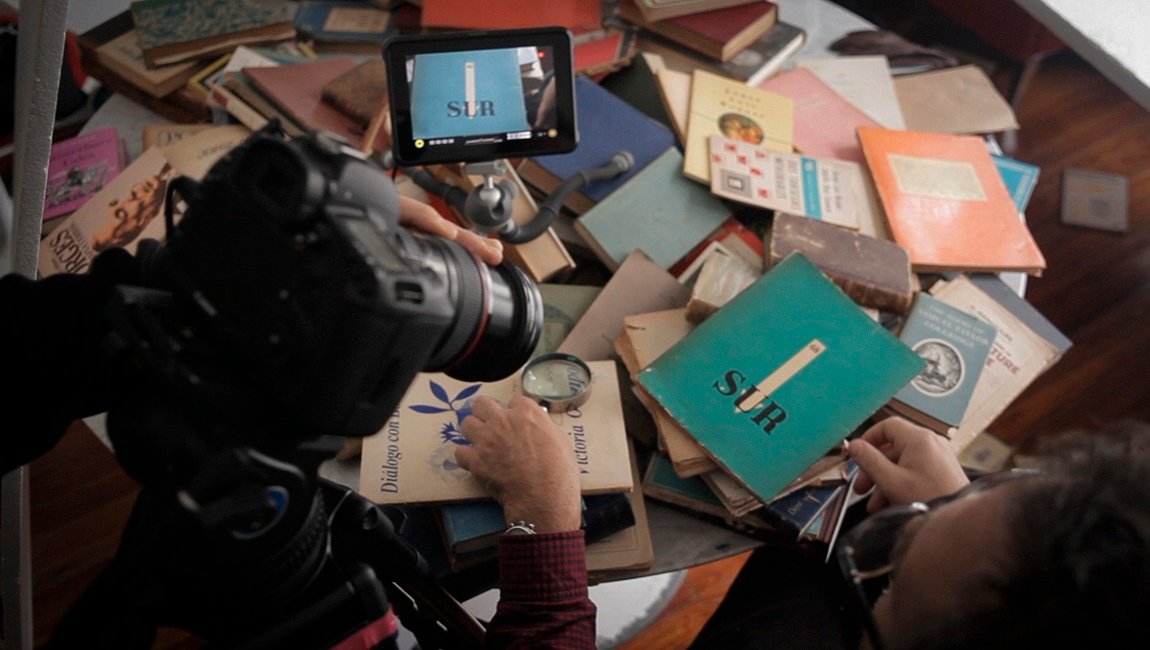
If Montequín is the implied hero of the story, Norman Thomas di Giovanni — one of Borges’ English translators, and likely the most significant, who passed in 2017 — becomes the villain of Llinás’ narrative; albeit, for the most part, a villain in absentia. Ever and anon, meanwhile, the audience is reminded of the ongoing production process: at one point, we see the director play the very tones on a xylophone that underscore the scene. Going even further, Llinás and his DP Agustín Mendilaharzu — known for his work on Trenque Lauquen and the monumental La Flor, to mention just the household names — spend an extended scene resisting their own camera that cannot seem to get right the jade-green color tone of the cover page of the 68th issue of Sur, the magazine that first published Borges’ canonical story “Tlön, Uqbar, Orbis Tertius” in 1940. The function of this scene — its refreshing playfulness aside — is clear: reminding us that whatever we see is rendered through a lens, and sometimes a quite literal one.
It is in this sense that one should understand Llinás’ imposition of the villain role upon di Giovanni, with whom Borges between 1967 and 1972 went on an innovative and rather ingenious spree to carry over many of his hitherto untranslated stories into English. Publicly, Borges would later come to call these English variants better than his originals, though in private — at least according to Bioy Casares and his 1600-page biography Borges — the famed writer was much less enthused by di Giovanni and their co-authored translations. It is not so much a complaint as an observation that this episode, among so many other side trails, did not find entry into Llinás’ film. At any rate, it appears obvious that di Giovanni, like no one else, got under Llinás’ skin. In omitting this chapter of Borges’ life, which, granted, is of much more interest to the anglophone world, Llinás makes use of the biographer’s perhaps most powerful device and nearly erases di Giovanni’s presence, save for the latter’s misogynist dig at Borges’ first wife Elsa Astete Millán.
The other reason why this dispute does not feature in greater detail is, of course, that to find a fiend in a biographical tale of Borges, one need look no further than Borges, the man of mirrors himself. As an attempt at “a biography, not a homage,” Llinás initially describes the coordinates of his endeavors. Consequently, he does not spare us the many interviews toward the end of his life that see his reactionary turn that outright demolishes his cultural legacy. Interviews featuring racist slurs and denigrations of Indigenous people are well documented, as is his public siding with Augusto Pinochet after the Chilean’s coup d’état in 1973. The latter episode, Llinás suggests, likely cost Borges the Nobel Prize — a matter that is perhaps belabored a touch too long, and too strongly. All the more powerful is the manner in which Llinás effects a transition toward Borges’ political regression. Together with El Pampero Cine stalwart Laura Paredes, Llinás reenacts a legendary interview in which poor Borges was asked to opine on tennis star and multiple Grand Slam champion Guillermo Vilas. The verve with which Llinás imitates the assertive journalist and Paredes returns Borges’ irritated dictum is deeply infectious. And yet, it is the script’s change for another, more politically centered interview — in the course of which Paredes’ Borges posits his revolting worldviews — that reveals the subversive potential of the reenactment format and its mechanics of identification and differentiation.
Decades before, in February 1921, Borges and his coevals Jacobo Sureda, Fortunio Bonanova, and Juan Alomar had published the Manifiesto Ultraísta in the Mallorquin magazine Baleares. Central to their postulation was the fundamental distinction between the “passive aesthetic of mirrors and the active aesthetic of prisms.” Given the millennia-old concepts of mimesis and poiesis, there was no particular novelty to such juxtaposition. And yet, it seems quite obvious that the ultraístas’ striving for a prismatic form that “uses the world as its own instrument, and creates—beyond any spatial and temporal prison—its own personal vision” deeply resonates with Llinás.
Toward the film’s very end — it is the year 2024 — Montequín learns that Edgardo Cozarinsky, the legendary Argentine filmmaker and novelist, has died. Upon Llinás’ suggestion, Montequín, who devoted much of his career to the study of Cozarinsky’s work and is the universal heir and literary executor of the filmmaker’s estate, presents a eulogy in commemoration of his kindred spirit. But only a few words into the speech which Montequín reads aloud with habitual solemnity, Llinás intervenes through voiceover, wondering aloud about the person behind Montequín, this man he earlier dubbed the “star” of his film. What under different circumstances might well be taken for indelicacy reveals itself to be a twofold movement that commemorates the dead without forgetting those who commemorate them. For it is the latter who keep them alive. Is it then a cliché to note that this film is as much a film about Llinás as it is about Borges? Quite possibly, but all the better for it.
Published as part of NYFF 2026 — Dispatch 1.
Comments are closed.