
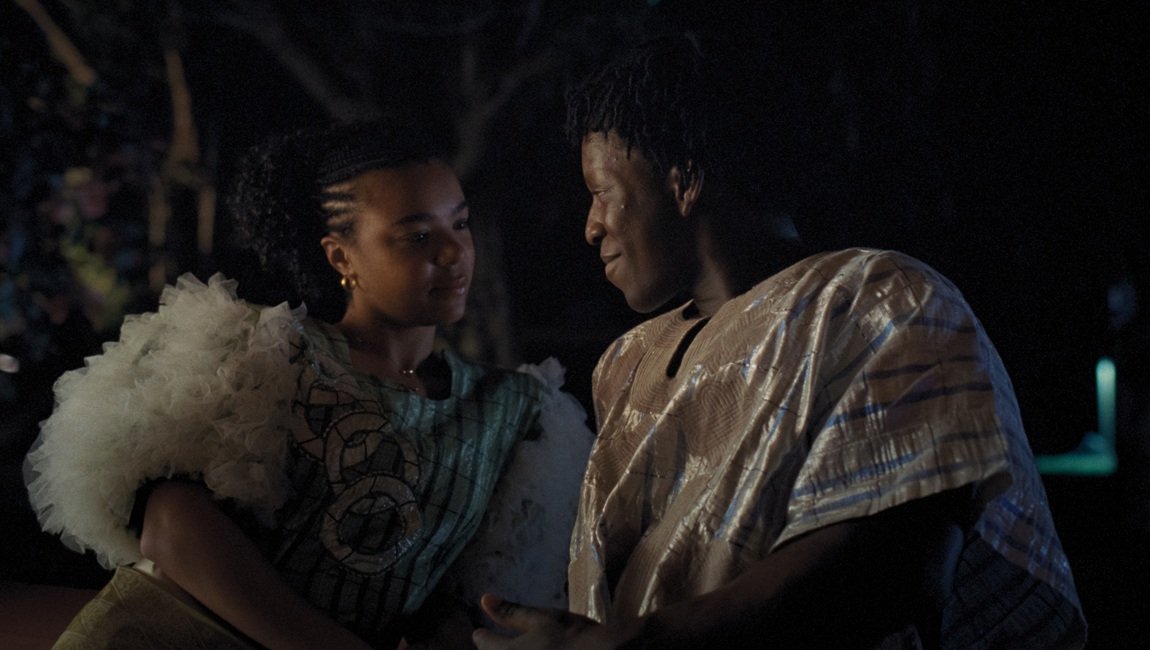
Virginia Woolf’s seminal novel Mrs. Dalloway is a daunting candidate for cinematic representation, relying as it does on the detailed evocation of the inner lives of society hostess Clarissa Dalloway and military veteran Septimus Warren Smith via a non-linear narrative and stream-of-consciousness prose. In their sophisticated adaptation, Clarissa, sibling writer-directors Arie and Chuko Esiri add an additional layer of complexity by updating the setting to contemporary Lagos, with flashbacks to a 2018 military campaign against Boko Haram in northeast Nigeria and an idyllic summer vacation in Abraka (the Esiris’ hometown) in the 1990s. Anchored by a multidimensional leading performance by Sophie Okonedo, Clarissa impresses as both a feat of adaptation and a sharp analysis of contemporary Nigerian society. Where Clarissa truly lodges in one’s memory, though, is in its sensitive, sensuous evocations of transient intimacies and long-simmering regrets.
Okonedo plays Clarissa, a wealthy woman who is meticulously preparing for a party at her home — like all other major characters in the film, Clarissa bears the same first name as her counterpart in Woolf’s novel. A series of flashbacks, elegantly interwoven throughout the film, depict Clarissa in her youth (here played by India Amarteifio) enjoying a summer at her family estate with friends Peter (Toheeb Jimoh), Sally (Ayo Edebiri), Ugo (Kehinde Cardoso), and her future husband Richard (Jable Osai). In the present timeline, all four will be in attendance at Clarissa’s party, and the romantic entanglements and minor schisms that emerged during their youthful summer take on greater emotional weight with the accumulated years. Running parallel to, and briefly intersecting with, Clarissa’s storyline is that of Septimus (Fortune Nwafor), a longtime soldier who is unwilling to accept his diagnosis of post-traumatic stress disorder, which stems in part from a violent act he witnessed eight years prior.
The Esiris mine Woolf’s novel for veins of thematic richness, which they smoothly translate to the Nigerian setting, and shed light on Nigeria’s social mores through Clarissa and Septimus, who represent opposite poles of society: Clarissa is an educated, refined, and influential woman who speaks with a British-inflected accent that echoes her country’s colonial legacy, whereas Septimus occupies the untenable position of exhausting his body and mind through military service without any meaningful social support. Cultural and political complexities are threaded throughout the film; for instance, one of the film’s most striking scenes features young Clarissa and her friends discussing colonialism and feminism with intellectual passion, only to fall silent when Clarissa’s father joins their party and berates a servant for not wearing gloves while serving food. The Esiris’ clear-eyed depictions of issues surrounding class, gender, sexuality, and political strife do not overwhelm the personal arcs of Clarissa and Septimus. Rather, as in Woolf’s novel, these cultural concerns are inextricable from the characters’ personal lives, with Clarissa’s class and gender constraining her to a luxurious but unfulfilled life, and Septimus’ taxing life as a soldier bearing down on his marriage and mental stability.
While the narrative elements and structure of Clarissa are quite similar to Woolf’s novel, the Esiris do not attempt to translate the novel’s complex, deeply internal prose. Rather, they suggest interiority and interconnection through classical cinematic techniques, including close-up and montage. Okonedo and Nwafor’s faces, often shot in long takes in medium and tight close-ups, prove to be exceptional narrative instruments. Micro-expressions cascade across Okonedo’s face, communicating Clarissa’s suppressed but roiling desires; Nwafor expresses his character’s untenable emotional strife through a mask of brooding stillness, only for unvarnished vulnerability to burst through the cracks.
Scenes of dialogue highlight the actors through precise visual direction. Most notably, two central scenes see Clarissa conversing with Peter and Sally in the present timeline (played in their older incarnations by David Oyewole and Nikki Amuka-Burd). As a young woman, Clarissa had rejected Peter romantically and fell in love with Sally; the scenes of their respective reunions must then carry the weight of decades of unspoken longing and regret. Rather than the shot-reverse-shot setup, the Esiris stage these scenes with both actors in the frame, periodically shifting the focus between them. Through this technique, the directors foreground the actors who, with thoughtful characterization and grounded emotionality, deliver the scenes’ meaning, while transmuting Woolf’s fluid shifts in perspective to the cinematic frame.
Clarissa is well-crafted all-around, with Jonathan Bloom’s warm, textured 35mm cinematography and Kelsey Lu’s lilting score lending the film a sensuality that is at once dynamic and dreamy. Particularly effective is Blair McClendon’s intuitive yet precise editing, seamlessly weaving together the time-hopping narrative, and in montage — namely the city symphony-esque opening credits that depict scenes from a busy morning in Lagos — he and the Esiris vividly evoke the rhythms of the film’s physical environments. This enveloping craftsmanship and the film’s vast narrative sweep, ultimately, are all in service of Clarissa’s deep intimacies. Details about the characters’ histories and relationships build with steady accumulation, so that by the time the film reaches Clarissa’s climactic party, the viewer is primed to read decades of history in the smallest interactions between the characters — the late scene between Clarissa and Sally, especially, somehow seems to distill the totality of their relationship within but a brief conversation. So while it’s true that the narrative and thematic intricacy of Clarissa consistently impresses and engages, Arie and Chuko Esiri demonstrate that the most resonant complexities ultimately emerge in passing gestures and meaningful glances.
Published as part of NYFF 2026 — Dispatch 2.
Comments are closed.