
A Paul Greengrass movie is a lot like finding yourself stuck next to a talkative history professor on a plane. Well-meaning, passionate, and rambling, you listen to him because the stories he tells are immediate and earnestly felt, despite the likelihood they’re grossly exaggerated. The Uprising fits squarely into this modus operandi: it dramatizes a pivotal inflection point in British history, is informed by quasi-journalistic rigor and a Hollywood veteran’s penchant for bombast, and incites reflection on the current moment’s inequities despite the fact that it stops short of full-on agitprop. It’s the farthest into history Greengrass has retreated, and while his time machine has a few rusted bolts, it suggests that backward is a potentially fruitful direction for him to go as his career reaches its threshold between autumn and winter.
The latest in his long string of action dramas seeking to set the past in the amber of a permanent present tense, The Uprising finds Greengrass placing his shaky sights on 14th-century England to tackle the famous Peasants’ Revolt — and maybe kinda sorta squeeze in a Robin Hood origin story. (Ask the folks at Focus Features about it and you’ll get one answer; ask British distributor Entertainment Film Distributors and you’ll get another — fortunately, it doesn’t matter much: the tie-in is nothing more than a last-minute button.) Shoehorned set dressing for franchise potential aside, it proves you can teach an old dog new tricks. Greengrass has learned from The Lost Bus’s pointless round-and-round wheel-spinning — The Uprising is urgent and cuts straight to the quick.
Following his family’s untimely demise during the Black Death, a field worker aptly named Ploughman travels into the nearby village to pay his taxes. Finding the taxes impossibly high and infuriated by the tax collectors’ treatment of his neighbors, Ploughman angrily sweeps a bunch of documents off a tax collector’s table, pounds his fists, and shouts “Enough!” Thus, the eponymous uprising is triggered. But it wouldn’t be a Greengrass movie without some parallel action, so we also cross-cut between the revolutionary groundswell and its impetus, the machinations of England’s boy-king Richard II and his counselors.
The narrative and thematic efficiency is refreshing, but it comes at its own cost. Because The Uprising begins pitched at a feverish timbre out of the gate, it doesn’t build so much as it hurtles recklessly forward. Until a significant reversal toward the end of the second act, the scenes play like they could have been placed in any order and not much meaning would be lost. But what meaning there is moment-to-moment ought not go unappreciated: pandemic, impossible financial constraints, the overreach of a king and his oligarchs on hardworking people — there’s a lot in The Uprising that connects to the present, yet it’s baked into the story and delivered without an overt wink toward techno-feudalism. And there’s some comfort to be found in Greengrass’s insistence on observing strategy no matter the time period: the king’s counselors unfurl maps and deliberate possible chess moves not unlike how the CIA monitors their target in The Bourne Supremacy.
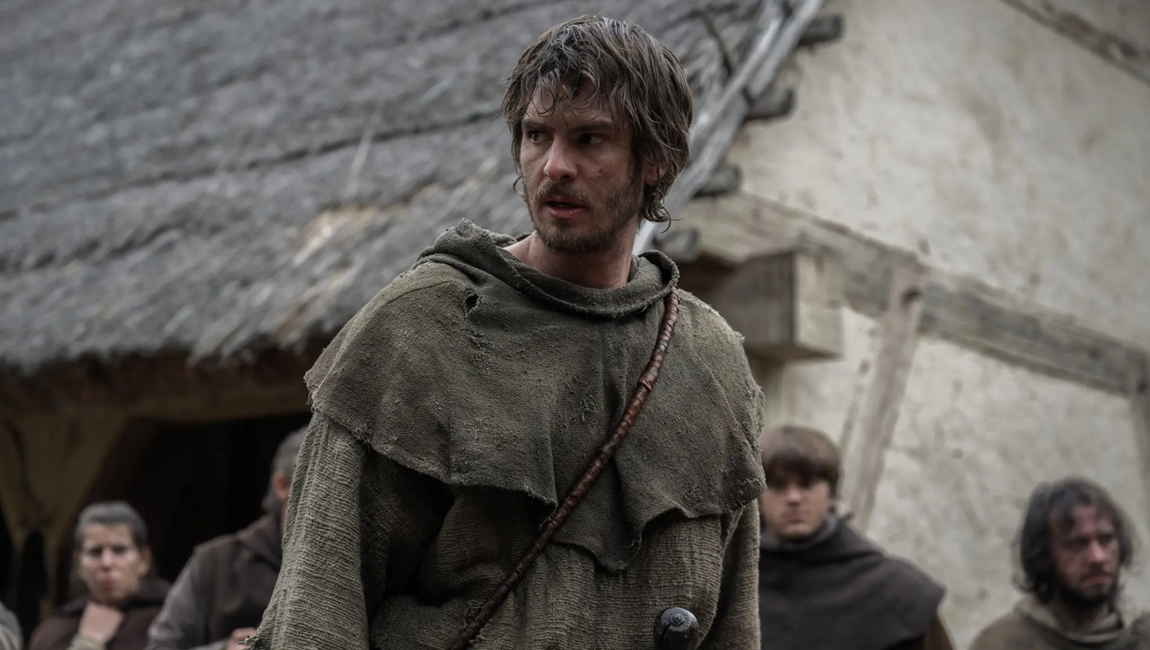
Having come from a documentary background, Greengrass’s images, like his stories, are rigorously literal, but you’d be forgiven for thinking he caught the bug for true artistry while making The Uprising. He has, at the very least, done his homework: flashes of Bela Tarr’s The Turin Horse, Aleksei German’s Hard to Be a God, and the work of Early Netherlandish painters abound, and they’re seamlessly integrated with his penchant for expertly managed chaos. He creates a lived-in world, capturing the overall dreariness of England — even when it’s sunny, the days are dreadfully gray — and costuming his characters with attire that brings to mind Trisha Biggar’s work on the Star Wars prequels. His actors, too, convincingly communicate the strain of worldly toil; or, in Katherine Waterston’s case, an inner turmoil as Queen Mother to a cowardly and unscrupulous king.
When Greengrass goes wide, however, the world falls apart. Recreating 1300s England isn’t easy, and his computer-generated vistas totally contradict the verisimilitude built in the close-ups. When the uprising grows and storms the streets of London, it’s as if the developers of video games like Skyrim or Kingdom Come: Deliverance stopped by to crash the party — huge swaths of ant-like dots swarm against plastic-looking fire and poorly-rendered structures. Christopher Nolan’s The Odyssey is a compromised work, but it’s able to depict the taking of Troy with heft reminiscent of Ben-Hur and Gladiator, epics Greengrass himself cited as influences, which he can’t really begin to emulate. Going for the same scale on a fraction of the budget is an exercise in Sisyphean futility; Greengrass’s style is much better suited for the micro.
Yet the quixotic lack of self-awareness is, in its way, endearing. “I hope [the film] is galvanizing,” star Andrew Garfield said in an interview simulcast to AMCs nationwide after an early access screening at the beginning of September. “… And I hope that if any billionaires watch it, they’re scared shitless.” The Uprising isn’t galvanizing — it’s too familiar for that — and it’s safe to assume any billionaires who catch it on their private jets between conferences won’t be changing their underwear when they disembark. It normalizes revolutionary action, though: The Uprising brings revolution out of the coffee shops and universities and into that most democratic space, the movie theater. The audience certainly won’t leave brandishing their knives, but they will see words like “comrade” and “solidarity” used with an accompanying action — a sword fight, if need be — that makes the words legible. And who knows? As Mao Zedong once wrote, “a single spark can start a prairie fire.”
DIRECTOR: Paul Greengrass; CAST: Andrew Garfield, Jamie Bell, Stephen Dillane, Tom Hollander, Cosmo Jarvis; DISTRIBUTOR: Focus Features; IN THEATERS: September 10; RUNTIME: 2 hr. 8 min.
Comments are closed.