
Aardman Animations has long been the last oddball left in an increasingly homogenized world of American animation. Founded by Peter Lord and David Sproxton over 50 years ago, and revitalized by Nick Park’s Wallace and Gromit films in the early ’90s, the firm has survived a five-year partnership with DreamWorks, a dicey two decades with Sony Pictures, and a slew of financial setbacks in the 2000s without major compromise in its creative ventures. Well, mostly. Chicken Run: Dawn of the Nugget was a confusing and disappointing reaction to the original film’s critical reappraisal, perhaps cursed by a virtually unadvertised Netflix release in 2023. But Park’s Wallace and Gromit: Vengeance Most Fowl silenced many concerns. The film soared with the same electric comedy and unnameable anxiety that defined the now-classic A Close Shave, without feeling especially redundant.
Shaun the Sheep, however, was never Aardman’s most ingenious franchise. The first film developed under the company’s Sony partnership, and though the stop-motion work was just as meticulous as ever, all of the eccentricities that defined Wallace and Gromit were glaringly absent. In the latter work, sets were dressed in a pleasantly slipshod way; creased drapes and pasty wallpaper met the equally malleable countenances of the main character. Environments held as temporary and vague, as in the work of Czech animator Jiří Trnka, where chintzy character work slowly devolves into terror and malice. One would have difficulty drawing that same line to the pleasant but mostly drab world of Shaun, where models are shiny and defined like premade action figures, the environments ordinary at best, automatic at worst.
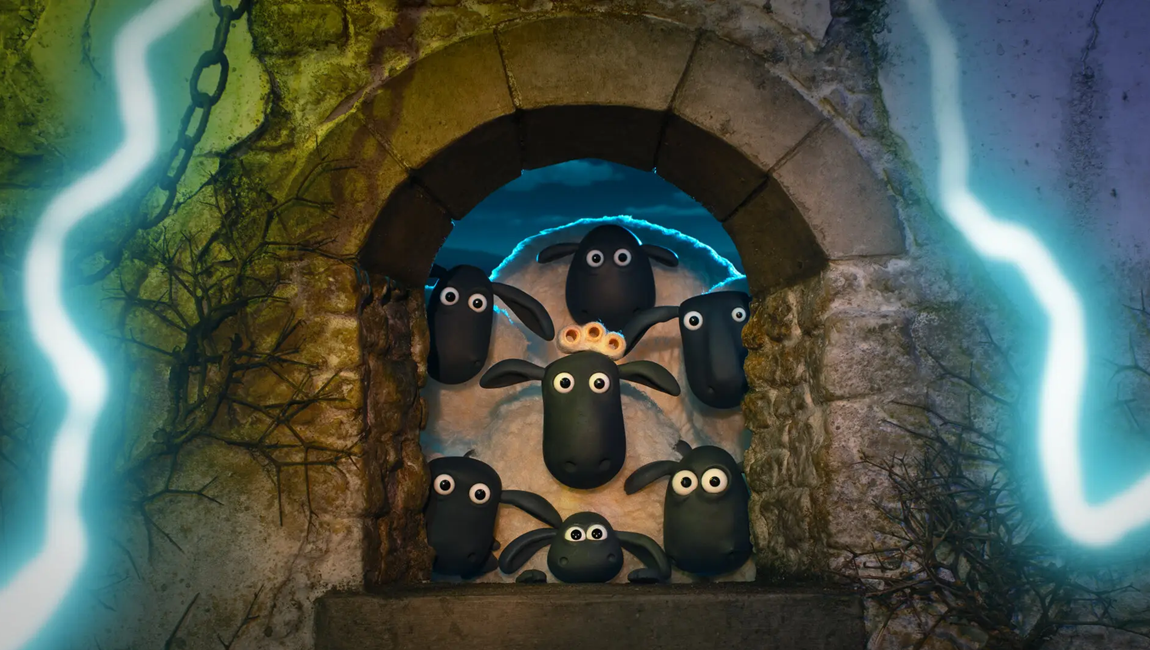
The latest installment in the series, The Beast of Mossy Bottom, is a case in point. It is almost certainly the best of the three films, but has very little of the off-kilter construction that allows Aardman’s other work to shine. Shaun and friends live on a small shepherd’s farm in the middle of autumn. The sheep grow giant pumpkins in the yard with the help of Shaun’s book of mad science. Their shepherd doesn’t seem to have much to do on the farm, instead bemoaning the loss of his ’80s youth and luscious red hair. Soon, in a classic mix-up, the shepherd finds Shaun’s serum, mistakes it for a hair growth formula, and stalks the town as a mad sasquatch. His transformation is admirably horrific, as are the lambs’ rambling attempts to turn him back, reminiscent of Hanna-Barbera. In these antics, however, there is little to suggest anything but a later episode of Scooby Doo. The new characters are wooden and gags far too underlined to have any weight; as with the other Aardman-Netflix installments, the film feels less like a feature and more like an unusually developed DVD add-on.
Still, because Aardman is behind the wheel, there is a world behind these characters that is legitimate. Painted backdrops of glowing sunsets, blue nights, and distant purple fields are the closest one gets to the Soviet fantasy traditions followed by Trnka’s generation. The cityscapes are unusually messy, full of grime and trash and stray objects; plants grow between the concrete and vines climb against brick. Unfortunately, the character work and plotting that populate these crisply rendered environs so rarely break from the usual Disney-style automation that at least 45 minutes of the film is comprised of shocked faces, plodding worldbuilding, and half-sketched models for other monsters, making for a strangely dreary installment in the Aardman catalog. The sum here would be more forgivable if digested in a short or a television episode, but at 80 minutes the film’s deficiencies are simply a bit much to overcome.
DIRECTOR: Steve Cox & Matthew Walker; CAST: Justin Fletcher, John Sparkes, Kate Harbour, Dani Dyer; DISTRIBUTOR: GKIDS; IN THEATERS: September 18; RUNTIME: 1 hr. 20 min.
Comments are closed.