
Parsing the cinema’s relation to sound, Gilles Deleuze once wrote, “…the sound as well as visual elements of the image enter into internal relations which means that the whole image has to be ‘read’, no less than seen, readable as well as visible.” It is with this quote that one approaches Nicolás Pereda’s new film, Everything Else is Noise — a work that’s own relation to sound is both narrative and titular, literal and philosophical; an astute spiritual successor to Deleuze’s sound-image.
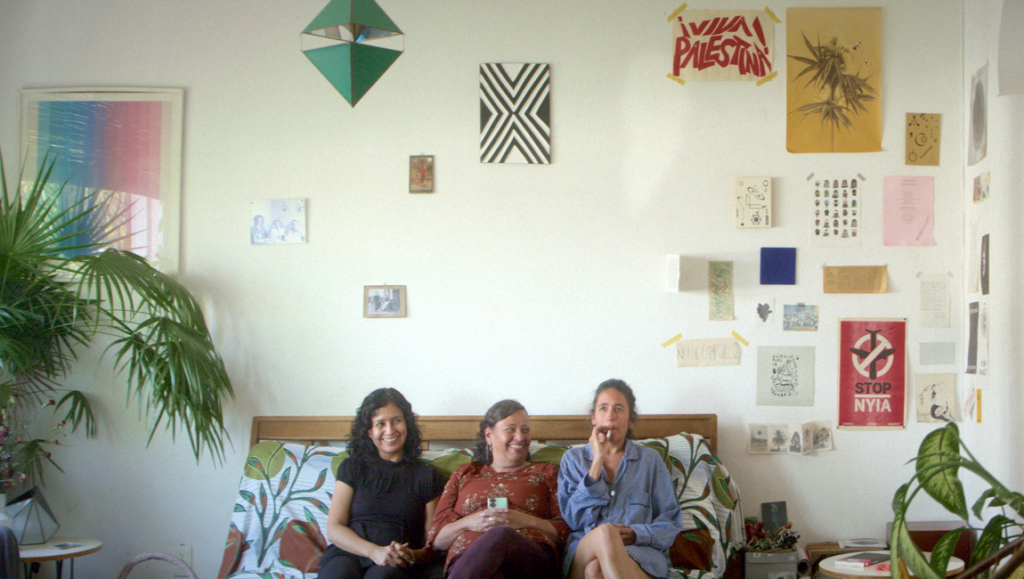
Concerning a trio of composers — Tera (Teresa Sánchez), her daughter, Luisa (Luisa Pardo), and her estranged friend, Rosa (Rosa Estela Juárez Vargas) — Everything Else is Noise crafts an absurdist tale out of ostensible banality. The film takes place almost entirely in a homey Mexico City apartment, where Rosa is interviewed by a local television network as Tera and Luisa look on, occasionally joining in themselves. What flair the film lacks visually, it makes up for in wittiness and sonic experimentation — par for the course for Pereda, whose films consistently remind us of the vitality of sound in a visual world.
Ahead of Everything Else is Noise’s screening at the New York Film Festival, I talked to Pereda about temporality, sound design, artistic inspiration, and more.
Joseph Dimacchia: Regarding the Mexico City setting, which, besides the fact that it takes place exclusively in one location — the apartment — also informs the narrative, how much of your own experiences in Mexico City would you say informed your ultimate interpretation of it? The noise, the power outages — was that something that came from personal experience or did it come about in writing?
Nicolás Pereda: Actually, it came about… not everything came about in the same way. So, like, the noise didn’t come about from either my experience exactly or my writing, but just the fact that that apartment, that space, was incredibly noisy. So it was not written in the screenplay. And my experience of Mexico City — of course, it’s a place that can be very noisy, but for some reason I never lived in a really noisy apartment. But my friends live in that apartment — where we shot — and it’s impossibly noisy. Once we arrived to shoot, I realized that if I was going to shoot there, I would have to incorporate the city in a way that I hadn’t expected.
It was always going to be a film about Mexico City musicians and the fact that they live there. There were some lines about never having enough time in the city, so the city was present even if you didn’t see it. But silently, it became much more present in the way that the world where the film happens entered my fiction. So there’s a… I wouldn’t say exactly documentary element, but perhaps there’s a documentary element that enters the film. I mean, the first five minutes of the film is a shot of stuff that’s just happening right outside the apartment that I have no control over. That’s much more documentary-like. That whole traffic jam was out of my control, but also beyond my thinking when I wrote the screenplay — it was just that we arrived there and looked out the window. I was like “This is a nightmare,” and then I thought, let’s hopefully bring this nightmare into the film in a way that makes it better. I changed the title of the film because of the location.
And then there are other elements, like the power outages and things like that — yeah, they have happened in Mexico City, but they happen maybe in other cities. I have had many experiences with power outages, but who hasn’t? So, I don’t know if that’s specific. I think the traffic is quite specific. I imagine this happens anywhere in the world — where you live in an apartment building, there’s something about the group chats of neighbors and the kinds of ways neighbors interact, and you know their names. When I lived in a Mexico City apartment, everybody was always commenting on the chat, and it becomes this kind of weird community. But maybe it’s better if your neighbors stay a bit distant, because when there’s friction and you know them better, it can become more of a problem. There are elements that feel very much Mexico City-like, but I’m not sure.
JD: I actually wasn’t expecting that. It’s really interesting how that was a spontaneous occurrence with the dog barking and some of the other noise. It reminds of the way you work with this troupe of actors consistently in your films, and it becomes a kind of metafiction because they’re playing versions of themselves — characters with names that are either slightly altered, but usually their own names. Do you approach the film with a level of spontaneity? Are you not a very technical, “everything by the books” kind of person, so to speak?
NP: More or less — it’s a balance, I think. It has changed over the years. Different films have been… I’ve approached them differently. And perhaps over the last few films, I’ve kind of come to terms with how I like working. At the beginning, I’ve made films where everything is exactly how I wrote it and very precise, but then also, that was my first film. The second film was all completely improvised. It was like, nothing written. I think over the years, I found a balance between trying to be very precise with certain things that I think are important. The films are so minimal that a kind of level of precision is important for them not to be nothing, because they could fall apart easily because they’re so thin to begin with. They’re so weightless in a sense. The narratives are almost not there, and the emotional weight is very slight.
For example, this film is not about a tragedy or a big story, or about the characters transforming themselves over time. There’s not much of a narrative arc, so there’s things of… to kind of be careful with certain ideas, like the moments when the film becomes sort of formally very rigorous. Like when Luisa says, “this kind of music, when you’re looking at it, becomes too much about what you see and you stop listening, so I’m going to ask you now to close your eyes.” So the camera looks at [the audience], and you never see the performer. So those are gestures that are very important for the film to me. Like formal gestures, because she could say that and I could still watch her, but there was something important about these sort of formal gestures that sustain the film, on the one hand. And then there are also the performances of the actors, where I need them to be very precise because the scenes are long, and if they start improvising, they can go anywhere. I also want them to keep a level of themselves in the way they talk, the words they use, and that sort of thing. They have a possibility of changing the lines, but only within a very sort of constrained parameter. So they can improvise, but it’s not exactly improvisation because they’re not coming up with new ideas of what to say or anything like that. They have to stay not only with the things that I want them to say, but within the same amount of time. They are able to change the words, but they cannot just expand — it has to remain relatively tight.
An important thing for me is that there is a level where I can still see their personalities — like who they are outside of the film, even if they’re playing characters whose psychologies are different from theirs. I want to maintain their way of gesturing, their way of talking, their way of laughing — sort of the surface elements of a human being, I want to keep. What they’re thinking and that sort of thing changes because of something I impose, but their physicality, I wanted to stay the same. So when I say action, I don’t want their bodies to transform into something else. I want them to remain the same, just their psychology changes, not their being.
JD: That’s very interesting as it relates to the formal style you’re talking about, because it’s very austere in a lot of ways. It almost reminded me of a Rohmer film with the very long takes; the camera having some movement but remaining more so sedentary. I read that this was an approach you tried earlier on in your filmmaking career and kind of stuck with. Was it simply instinctual, or were there people such as Rohmer or a director like that who contributed to that lens? Or, even more broadly, were there any films or directors that inform the kind of work that you do?
NP: Yeah, I think that when I was young, what happened was I saw the works of Chantal Akerman, Tsai Ming-liang, [Rainer Werner] Fassbinder, people like that, and Apichatpong Weerasethakul. I love Rohmer films, but for some reason I saw them later. When I started making films, he was not totally in my mind. I started to think about why I was so connected to those works and what about the long takes interests me. I realize there’s something about not just the long takes, but in those contexts, because there’s also long takes in [Andrei] Tarkovsky’s films that I love, but they’re very distant to what I’m doing.
I was interested in making films about the mundane, in many ways, about the everyday lives of people, such things that resemble, sort of, a lot of my everyday. I think that a big part of the experience of the everyday is our consciousness, our relation to time, the fact that sometimes you start feeling time in your life. You know, you become aware of the passage of time, and I think a lot of films don’t allow or want to negate the passage of time. It’s almost like you realize time is passing and you become a little bit impatient, as if that’s a negative thing and you have to keep the show going so that people don’t realize that time is passing. But I feel like that negates the experience of the everyday in a sense.
The long take puts you in the same position as the characters in relation to time — time for the characters is similar to you. Of course, we experience it differently because time on the screen is different from time outside of it, but at least that’s the closest you can get. Whenever you have a cut, even if the cut is on action — like someone raises a cup [gestures raising a cup], and you cut to their side and they’re still raising the cup. To be able to see something from two different angles, we need time, because we don’t transport ourselves. And so, if you see a tower from one end, and you want to see it from a different end, you have to walk 30 seconds to see it from the other side. Whenever we see something in our experience from a different angle, automatically — because of our experience — we assume there is time that has been taken out. Whereas in a single take, we have a direct connection to the flow of time. I feel like cutting within a scene, it necessarily cuts out time, even if it is just cut on action, because from our experience we can only see things from one perspective. If we see it from a different perspective, that takes time to get to the other place.
So I started thinking that in order to have a connection with time, with the characters, and to think about the mundane, there is something about the single take that helps me with that. But at the same time, this film does have cuts within the scenes — not that many, but here and there. When I started making films, I was much more militant about this, and so I have films where it is just single takes for the entire film, and I never cut within a scene. But I realized that I don’t have to be so militant [laughs], that it’s okay sometimes to do things one way and then change some things. And it’s nice to be playful — I still have those convictions, but I also think I have other convictions as well. I like to experiment a bit.
JD: In that way, it seems like it is more of a — as you described it — consciousness, or a continuity of consciousness, as opposed to a formal continuity of montage. Would you agree with that — that you are trying to create an interchange between the audience and the onscreen actions?
NP: Yeah, it’s hard to describe so succinctly. I don’t know if I understand what it means — that “continuity of consciousness.” It’s difficult, it’s abstract, and it becomes difficult to understand, but at least this idea that the characters are living a certain amount of time and we observe it in the same amount of time. At the same time, I think there is something like an elasticity of time, that if you watch something for two minutes, and the cameras are moving, our experience of it is very different from the experience of the characters. We all have experienced waiting for someone for two minutes at a coffee shop because they are late, and it’s nothing. Two minutes to wait for a friend that arrives late — you don’t apologize, it’s nothing. But in a movie, to see someone waiting for two minutes can feel like an eternity. The fact that the screen can elongate time is also something quite interesting. It’s not a one-to-one thing. It’s not like we are in the consciousness of the characters either — it’s more complicated. I also feel like you can compress time in strange ways, even if there’s real time. So without cutting, you can also compress time or expand time.
JD: I feel as if the sound is doing something very similar. You mentioned the scene with the cello performance and Luisa says, “close your eyes,” and you remain on the audience. And similarly, one of my favorite scenes was when the two filmmakers walk to the cafe after the power goes out. It’s almost as if they have lav mics on, as the sound is heard non-diegetically the entire time. At what point in the process did this sense of playfulness of sound design arise? Was it in production that you knew certain scenes wouldn’t have diegetic sound, or was that decided in post?
NP: That was in the screenplay. For example, when they go to the cafe and have a conversation, we never shot it — there’s no image for it. We only recorded audio because I knew it was going to go with that scene that we shot. So by design, there were some ideas of sound. I knew that if I wanted to make a film about a musician, experimental music, noise, there had to be — well, there didn’t have to be — but I was interested. In a film I made a couple of years back, I started experimenting with the idea of sound expanding the frame, or the idea that a sound creates a new image in your head that is different from the one you’re looking at. Which I think is very obvious for filmmaking. It happens all the time — you hear a helicopter, you don’t see it but you see it in your mind, so it’s this basic idea of sound design. But I hadn’t thought too much about sound before the last three or four years. I like the idea that sound allows you to be in two spaces at the same time.
I teach as well, and if I asked my students: “How would you represent two different spaces in a film at the same time?” I think the most automatic answer would be split screen, because you can see two spaces at the same time, but the split screen is very crass in some ways. It’s fine as well, I mean sometimes I love split screens, but the fact that sound can do it in a more subtle way — in split screen you automatically understand that there are two spaces, there’s no way of mistaking it. But with sound, it is a little bit more ambiguous, because when the scene starts, you see Rosa’s close-up and you start hearing something else, you still think the sound corresponds with her world, even though suddenly, the sound of the street is much louder. And then she approaches the window and looks out, and you don’t know whether the sound belongs to her or not. You think the sound belongs to her because that’s the normal thing, and then you see the filmmakers outside talking and suddenly, something shifts, but it’s not automatic. I like this idea that sound can expand, can make you be in two places at once.
JD: The use of sound reminds me of [Edmund Husserl’s] theory of appresentation — that humans are not limited to perceptual understandings, that one can create a new image in their consciousness based on certain pieces of context. And I think your film explores that very well, because with the cafe audio, I thought that you had shot that and then decided to disjoint afterwards. I wanted to ask you a production question. I read that on Fauna (2020) you had a bigger crew, whereas on Lázaro at Night (2024) it was just you and one other person. I’m curious as to your relationship to differences in the size of a crew. I don’t know what kind of a crew you had on this film, but do you find yourself preferring a more intimate crew as opposed to a larger production?
NP: I mean, I’ve never had a large production, and Fauna it was larger because it was maybe a crew of five. I think of the size of the production in relation to the scope of the film, and some films require a few more people because if we’re travelling to a different part of the world where none of the actors are from, someone has to be booking hotels, all the meals, and we need a driver, and so on. Then, it makes sense to have someone dedicated to line producing and all of that. I think it’s not so much about preferring a certain thing over another, it’s just thinking about each movie and thinking about what each movie needs. At the same time, they’re all tiny, tiny, tiny productions compared to most fiction filmmaking. Lázaro at Night we shot in 2021, so people were still wearing the Covid masks, and so the actress told me, if we’re shooting this film, we want almost no crew because we don’t want to get sick. So everybody is wearing masks, but we shot it. I said, “It’s just going to be the two of us.” But it was always like three or four or five people, so it was manageable.
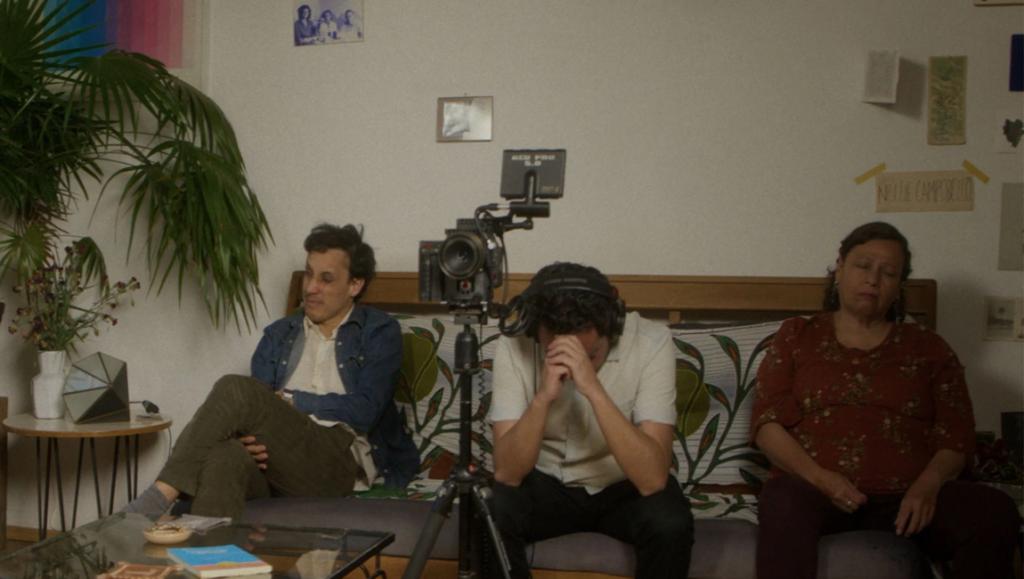
[On Everything Else is Noise] we shot in Mexico City, so everybody could go home and I didn’t need to coordinate that much. Everybody knew the city really well so I just sent them locations. Sometimes, when you go somewhere else, people need to be a little bit more catered to and taken care of. And this film was a super easy film to make, because it was all in one apartment. My friend left the apartment — my friend that lives there and her roommate as well — and I stayed in the apartment, so I lived in the apartment for the duration of the film, which was great. I would wake up and I was at the location. I could wake up at six in the morning before everybody arrived and think about the shots and so on. In the end, it was a crew of maybe five of us. It’s nice to shoot with few people — everything becomes a little bit more communal, everybody knows each other. When there are too many people involved and there’s a larger responsibility — also, I hate seeing people not doing anything. On large film sets, there’s always a lot of waiting around, so I try to move really fast. I mean, we shot the film in like five or six days. So nobody’s… I mean, the actors wait around a little bit, but we tend to all have a sense of like, everybody’s doing something at all times.
JD: That gets me thinking about how, with this film, it is three years in a row now where you’ve made a feature. Perhaps this is an exhausted question, but how do you continue to be creatively inspired? Do you have a certain sense of daily habit, such as finding inspiration in other films or novels? Or is it a kind of deliberate focus over time that keeps you moving from one film to the next?
NP: It varies a little bit, but I think it’s like a state of being, of trying to be aware, of constantly recognizing situations that could potentially be inspiring to write a film. But it’s like an unconscious state. When I’m reading, when I’m watching other films, or while I’m living situations, if anything sparks something, I start building something. And, of course, there are lots of things that I write down that never go anywhere because in life, lots of things happen. If I make a film every year or two years, not that many things have to happen. If in the course of the year, there is one or two things that happen that are quite special or something sparks, I can start from there and build something. It’s not like I need to be… I don’t have that many ideas actually. When I talk to my colleagues, they seem to be full of possible projects all the time, and I just have one or two ideas every year, which is enough to then start developing. I don’t need too much more. Perhaps people that have too many ideas, it’s harder to select what to do.
I also try to link it to my life, to the things that seem possible at a certain time. I’m making a film right now at the university where I teach, and the only reason I’m making it is because I teach here. If I wasn’t a teacher, I wouldn’t make that film because it would be difficult to have access to everything. I have access as a professor here. I’m making a film — the students are acting in it, some of my colleagues are acting in it, and it was inspired by a lot of my experiences teaching in the United States. That film is linked to my experience and thinking, “Okay, I can make something out of it.” Everything Else is Noise — my mom was a music composer and I’m quite close to her. There’s something about her world that always interested me. In making films, and also I’ve been in many interview processes — I used to work at UC Berkeley, the university, and they have the BAMPFA, the Pacific Film Archive, and I used to work a lot there during Q&As — so I had to prepare a lot for doing Q&As for the filmmakers we’d invite. And I remember that process being very difficult for me. Like, it’s so much easier to answer questions than to ask them. I can say whatever I want, but when I have to introduce someone, there’s so much more pressure. So I’ve been involved in situations being interviewed and interviewing people so many times that I thought there was something interesting about it. A lot of the things I do are linked to my experiences. Some things are more linked to things that I watch and read. I’m trying to make films that are a little bit closer to my experience in a way, so sometimes they’re directly linked — almost autobiographical — sometimes, they’re just translations of my experience into different worlds.
Comments are closed.