
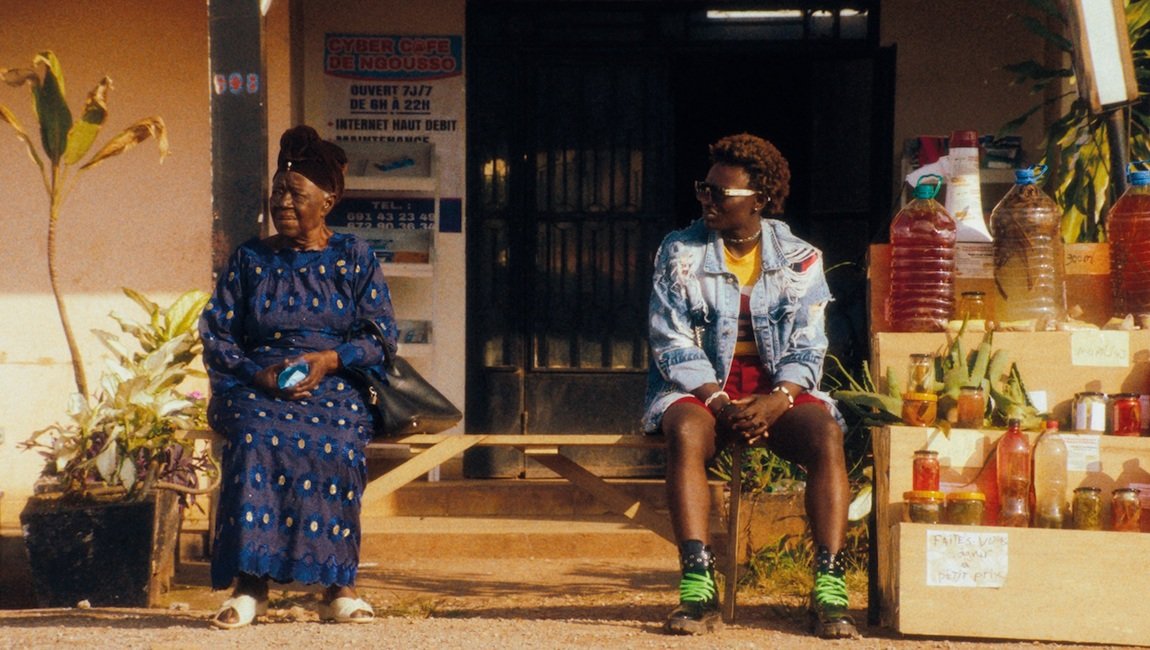
In Yaoundé, the capital city of Cameroon, Josette (Josette Kwanya) is a widowed 80-year-old living alone in her vast house. All her children are scattered to the winds across Western Europe, but Josette wants to bring them back and believes she can do so by building a house for them, the process of which she is supervising. One of her sons, Benoit, is giving her money to help with its construction, and Josette is convinced he will move into it soon enough. However, after she loses her ID card and needs help withdrawing the cash, Josette meets a young woman named Sarah (Moudjeu Pouadeu). A streetwise vendor who has a strained relationship with her own parents, Sarah helps Josette retrieve the funds (including a little extra that she swindles), but in return Sarah requests a favor. She asks Josette to pretend that she is her mother for her white boyfriend Adrien (Adrien Jolivet), and to live with her for a little bit — just for two days, or weeks, or perhaps even longer. Soon, Sarah is upending Josette’s previous routine, and as the two befriend each other, Josette finds that her perceptions about family and what her future could hold have changed. But is Sarah only the latest person destined to leave her?
With his debut House of the Wind, director Bernard Auguste Kouemo Yanghu (who won both an Orizzonti Special Jury Prize and the Luigi De Laurentiis Award for Best Debut at this year’s Venice Film Festival) was inspired by personal experience. Returning home to Cameroon and seeing his mother living alone, he originally started this project as a documentary, before gradually developing the film’s fictional elements. Indeed, there’s a palpable sense of intimacy that Yanghu brings to House of the Wind, a texture made even more apparent by some of the more potent choices he makes, like casting his own mother, Josette Kwanya (who passed away in 2024), as the central matriarch.
The camera remains locked on Kwanya throughout, seemingly transfixed by her performance as the weary and independent but also crucially lonesome matriarch. Behind Josette’s self-reliance is a melancholic core, which deepens as she faces money struggles, shattered hopes, and unimaginable loss. Kwanya’s pensive looks communicate a certain fear of dying alone, as she sees happen to an older man, while on the other hand she often seems energized by the authentic, absorbing, and occasionally humorous bond she forges with Pouadeu’s Sarah.
Often, stories of immigration are predicated on what is given up and endured by the expat, the one who has departed their homeland. However, in the press notes for House of the Wind, Yanghu (who gave up his Cameroonian citizenship by moving to France 20 years ago) has stated that he was more interested in “the people who stay behind… those who remain.” Here, he has captured Josette in all her solitude, placing her within the empty, cavernous rooms of her house and soundtracking the film with notes of yearning. The framed photos on her wall are the only physical signs left of her children, who have built their own lives elsewhere and are noncommittal about returning, despite Josette’s urging. For the most part, we only see them over video call, even for occasions like their mother’s birthday; at one point, her children even jointly purchase her a new TV so something can keep her company. In this way, whether intentional or not, House of the Wind comes to evoke nothing less than Douglas Sirk’s All That Heaven Allows, even importing some of that film’s emotional force into this new tale of a widowed mother forging a new connection with someone younger.
But more than anything, House of the Wind demonstrates the command Yanghu has over both his story and the milieu that both houses it and fills it. His depiction of Yaoundé aims for the authentic, capturing the deluge of blackouts, downpours, and — fittingly for a narrative about who leaves, who stays, and who comes back — French mixing with the indigenous Bafang language. Yet there are also some neat filmmaking touches, whether it’s the careful use of dark shadows — reflecting absence — within Josette’s home or the heightened sound of wind barreling in, lending her abode an almost spectral tenor. Certain moments and thematic ideas, like Cameroon’s population exodus and the nation’s ongoing cultural battle between tradition and modernity, might have been developed a bit further. But even given its more intimate scope, House of the Wind functions as strong debut from Yanghu, a captivatingly human portrait of companionship, loneliness, and chosen family.
Comments are closed.