
That George W. Bush’s war on terror was a farce is all but written history. The craven hunt for oil under the guise of WMDs resulted in over 940,000 casualties and drew enough bipartisan criticism to land as a talking point for Donald Trump’s 2016 presidential campaign; The New York Times, in all its queasy centrism, couldn’t muster anything kinder than “tragedy” when eulogizing Dick Cheney’s legacy. Satirizing a war so comically calamitous, especially after its 20-year tail has finally withered, is a tall bill. Still, Hailey Gates’s Atropia enters the ring: punch-drunk and underweight, but nonetheless dogged.
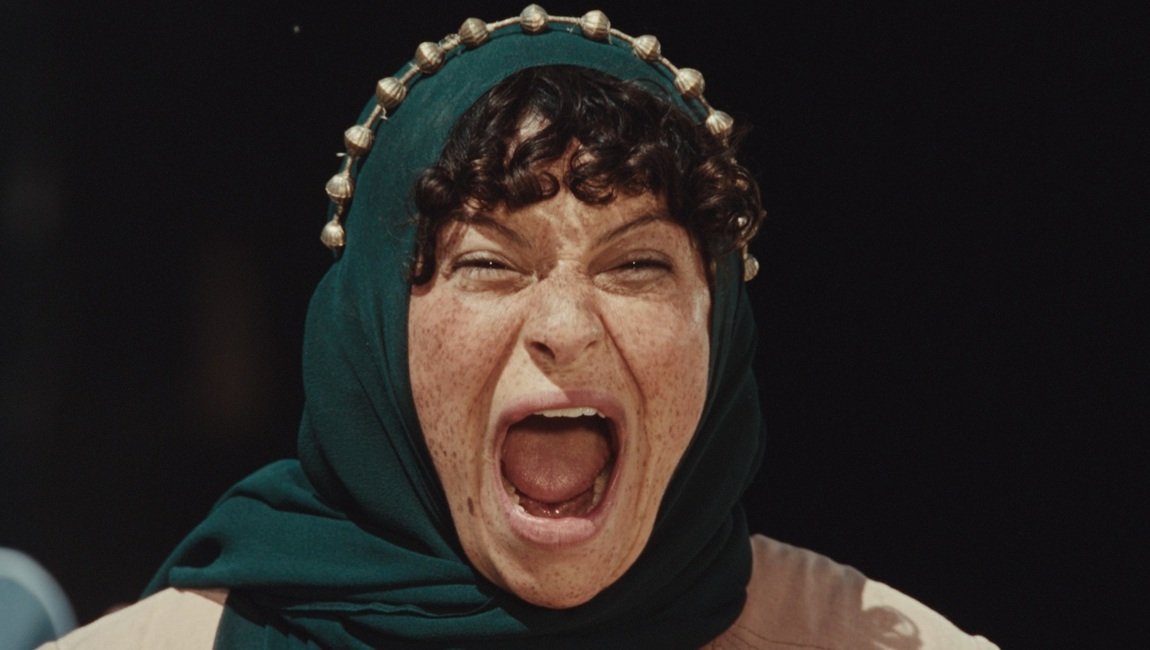
The titular Atropia is a play town built to conduct military role-playing exercises before green recruits deploy overseas — one of many facilities that, as Atropia’s ending titles note, are still in full use in America today. In 2006, long enough into the war on terror for the public to start asking questions, those towns were fashioned after Iraq. In Atropia, bit-rate actors haggle across prefab markets as knock-kneed cadets run simulations to dismantle bombs and learn the beats of new-millennium jingoism. Atropia itself sits a short drive inland from L.A. and naturally attracts its fair share of Hollywood hopefuls. One such up and comer is Fayruz (Alia Shawkat), an opportunist whose own Iraqi heritage threatens to dim the stars in her eyes.
Fayruz is committed to providing the soldiers-in-training as authentic an Iraqi experience as can be delivered, but only insofar as it might bolster her acting reel. The vapidity of L.A. wannabees is hardly new territory for a sendup, and like with the war on terror, Atropia struggles to find a unique track to run. “I’m not scared, I’m just doing my emotional prep in case this is part of the exercise,” Fayruz says in one of the many instances where the simulation threatens to go off the rails. She coaches her couldn’t-care-less colleagues through acting exercises in between drills, running vocal warmups and drawing character backstories as fog machines pump scents from chai to burning flesh through the Atropian streets. When an A-lister (a perfunctory Channing Tatum cameo) rolls through to prep for an upcoming project, Fayruz trades cigarettes and sundries with her fellow actors to ensure he sees her front and center. Everyone else seems to be running the numbers, and it’s hard not to feel like Atropia’s doing the same.
Still, there are moments in which Fayruz’s lineage challenges her pursuit toward stardom, and it’s here that Atropia shines. “We’re helping a group of teenagers to invade our home country in a gentler way,” explains Abu Saif, a casting director who guides the Atropian players — many of them Indigenous Americans — toward some semblance of authenticity. Similar compromises and rationalities lead Gates’ debut feature into its finest moments, often beautiful, sometimes arresting. When a phone call to her father, still living in Iraq, garbles before Fayruz can check in on her grandmother, she finds herself reaching for the hand of an Iraqi mannequin stashed backstage before inevitably becoming a target for test explosives. It’s about as close as the movie comes to poetry.
When a U.S. veteran joins the training center’s ranks while waiting for redeployment (a soldier who calls himself “Abu Dice,” played by Callum Turner), Atropia’s satire stumbles into something closer to a dizzy romcom. Abu Dice’s and Fayruz’s flirtations yield some of the movie’s most captivating sequences. After she complains about the facility’s water scarcity, Abu Dice rigs a kiddie pool in which he bathes Fayruz with a tenderness somewhere between the erotic and washing a disciple’s feet. But as occasionally sweet and often funny — Dice’s porta-potty fetish marks, by my count, a cinematic first — as their relationship can be, Fayruz’s and Dice’s will-they-won’t-they ultimately muddles Atropia’s already brittle perspectives. By the time it’s clear neither their romance nor the facility’s operations will receive a clean resolution, both threads fray and tangle to a point in which it’s tough to mourn either getting its due.
Atropia’s LARPing drills are overseen by two military executives (Tim Heidecker and Chloë Sevigny), comic-relief casting directors who refer to the play city familiarly as “The Box.” It’s a name that recalls the maligned work of Richard Kelly. The Donnie Darko director spent his blank check testing the public’s willingness to follow him further down the rabbit hole; The Box’s Sartrean thriller received an F from CinemaScore audiences, and 2006’s Southland Tales couldn’t gross even three percent of its $17 million budget. In retrospect, Kelly may have been ahead of his time. Released in the year that Atropia is set, Southland Tales shifts its sights toward the future, forecasting the fallout of an illegitimate war and the resulting boils of America-first populism. Kelly’s epic has rightly earned a cult following since its box-office crash out; its maximalist dystopia, once dismissed as cartoonish, has been routinely proven a prescient vision of today’s militaristic exceptionalism. Southland Tales set a precedent that Atropia may have been wise to follow: looking forward carries risks of missing the mark, but it’s even harder to punch up toward a horse long dead.
DIRECTOR: Hailey Benton Gates; CAST: Alia Shawkat, Callum Turner, Chloë Sevigny, Tim Heidecker; DISTRIBUTOR: Vertical; IN THEATERS: December 12; RUNTIME: 1 hr. 44 min.
Comments are closed.