
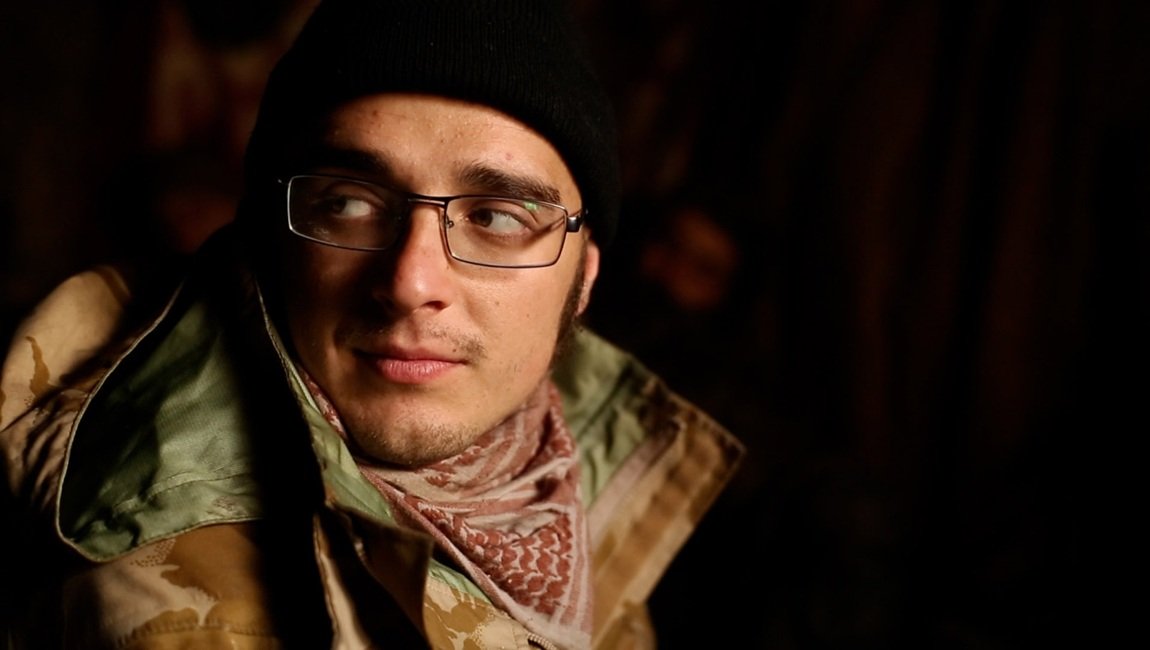
Major credit is due to KVIFF for continuing to world-premiere some of the roughest documentaries from the Ukrainian frontline. Two years ago, the festival unveiled Real (2024), consisting of 90 minutes of GoPro footage Oleh Sentsov shot by accident, in a single unbroken take from inside a trench. This year’s Special Screenings section goes even further with Yulia Hontaruk’s To Die To Live — a documentary 12 years in the making, excavating death, life, and the war’s unbearable continuity through the senses of those who know it all too well. At its center are three men known by their call signs — Shakhta, Potter, and Dancer — who, as one of them bluntly puts it in the opening scene, took up arms to kick the Russians out of their land. Having fought through the inferno of Donbas, they had already known a war much of the outside world still refused to name as such. In the wake of the Minsk agreements, they returned not with victory, but rather with severe PTSD and the certainty that the same war would soon return at a fuller scale.
Another unbearable battle then starts at the home front, as they stoically try to integrate into civilian life, to bear society’s belief in the mirage of peace, a mental fight that occupies most of the film. Hard-won trust brings Hontaruk close to their worried families, to the different jobs and hobbies they try throughout, and, more intimately, to that sudden glass stare into the void her camera grasps from a distance. At the most fragile depths of their trauma’s manifestation, the film halts, giving just enough to sense how much has happened behind the frame. To Die To Live instead concentrates on something scarier and more sacred: their broadcasted perspectives on life. Out of over a thousand hours of footage, the film distills the darkest depths of the proximity the title embodies. Most of the screen time belongs to Shakhta, who returns on camera reflecting: what does it do to the brain to keep living millimeters from death? What is it to bury so many brothers-in-arms and remain alive, inside an unshakeable survivor’s guilt? Shakhta repeatedly imagines the weapon and the position from which his death will come. Hontaruk then cuts from these horrifying confessions to moments of Shakhta with his young son, for whom he stubbornly chooses to go on living.
Heavy as its subject already is, Hontaruk refuses straightforward chronology in favor of a far more adventurous cinematic form. Adopting the dissociative sense of durée as her organizing principle, she crafts a haptic portrait of war-traumatized consciousness in which past and present collapse into a single temporal flux. It produces a physically nauseating feeling, much like the endless paralysis of a recurring nightmare. From early on and throughout, the film is penetrated as if by a glitch or mental tick, with sounds hovering between artillery thrums and dropped techno beats, while the images crash to digitally rendered silhouettes of soldiers in monochrome fog. Intrusive and irresolvable, these interferences become the film’s found syntax for the heroes’ liminal war consciousness. Hontaruk crafts a kind of mutated realism, one that no longer depends on transparency and stillness alone, but finds its grammar in fragmentation, temporal collapse, and the lingering afterlife of memory.
While every attempt to heal and belong marks a fragile moment of happiness and hard-won personal victory, To Die To Live is a very grim and graphic picture. The viscerality of its combat footage rivals what Mstyslav Chernov delivered in 2000 Meters to Andriivka (2025). Within that paradigm, Hontaruk makes even bolder choices: filming a funeral procession, deploying the bodycam of a wounded (or perhaps even killed?) soldier mid-combat, and at one point leaving a camera alone on the ground to capture the double-tap destruction of an entire house. Paradoxically, such discursively ethical choices are precisely what Hontaruk owes her protagonists: to accept the uncompromising reality of their experience without any softening. This uncensored brutality serves the larger commentary of a war whose violence, technology, and cinema co-accelerate, feeding one another with increasing velocity.
Framed between Donbas in 2014 and the full-scale invasion, the film also reveals the changing frontline mise-en-scène of each epoch of the war, a historical transformation every bit as horrifying as the ultra-graphic images themselves. In a lengthy early sequence, assembled from soldiers’ tactical cameras, the combat looks uncannily archaic. We see how one soldier peers through a handheld optical scope and handles a rifle of a past generation, the bodycam’s image poor in resolution, accompanied by soundscapes from a bygone era. When the anticipated invasion suffocates them back, a vertiginous, numbing montage of the last four years arrives, with a full arsenal of operational vision and state-of-the-art weaponry. From FPVs on their “safari” hunts to AI-guided interceptor drones and unmanned ground vehicles, all of it is seen through an operational vision whose crystalline resolution almost feels obscene beside the blood, shit, dirt, and tears it records. The sheer insanity of those montages altogether captures how Ukraine keeps on fighting, within roughly the same bare square kilometers, with the same people at the front and the same people behind the cameras, whose own documentary battle undergoes its own ontological evolution.
What gives To Die To Live an even heavier weight is that this is the latest work of Babylon’13, the legendary film collective founded during the first days of the Revolution of Dignity in 2013, whose members have continuously shot the escalating war. Hontaruk, among the collective’s earliest members, has long combined remarkable fearlessness with unusual sensitivity, as seen in her Fortress Mariupol short film cycle available on YouTube, assembled remotely through calls with the defenders trapped inside the hell of Azovstal. Over 13 years, Babylon’13 has evolved alongside both the war and the technologies used to record it, continually redefining what war documentary can be, all while applying a personal sensibility to war experiences.
Montage mastery has always been the collective’s signature. Among this film’s six editors is Roman Liubyi, whom the reader might know for what is arguably the collective’s most famous work: Iron Butterflies (2023), a multi-source experimental doc about Russia’s downing of MH17 that premiered at Sundance. Shortly after, Liubyi himself mobilized, editing To Die To Live while serving at the front, which brings yet another layer of firsthand experience to the film. The same holds for much of the Ukrainian crew, who have spent the past 12 years filming, producing, editing, and quite literally living the history their documentaries record. Like the three men at the film’s center, the Ukrainian industry at large somehow continues to endure — and, against all odds, manages to make exquisite cinema out of this inexhaustible pain.
Comments are closed.