
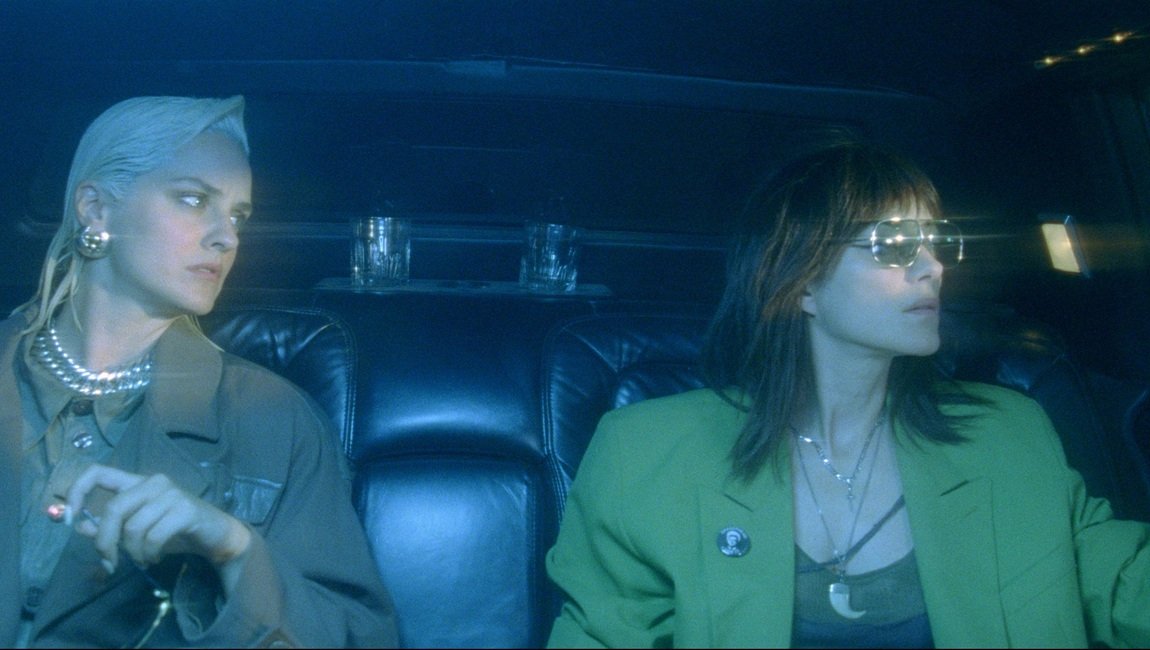
A purveyor of artifice and decadence, the films of Bertrand Mandico are at their most interesting on the purely visual plane. He fills his frames with cluttered mise-en-scène, gargoyle-esque character actors, and abstract lighting designs that call back to the erotic energy of ’70s and ’80s exploitation flicks. They feel interminably evocative of a better era in arthouse cinema, when Fassbinder and Fellini were at their most erratic and inscrutable, making dense dream-like panoramas of freakish ’70s types fighting and screwing one another into hysterical historionics a la Satyricon, Roma, World on A Wire, or Querelle. Unfortunately, he’s just a little too buttoned-up to really lapse into any true poetics of perversion, and his perfectly designed worlds end up being closer to Wes Anderson at his most affected rather than any true old school arthouse or genre master. They’re Bataillian doll houses, filled with a semblance of transgression that is too plastic to ever carry any real charge.
His latest, Roma Elastica, is about a famous French actress, Eddie (Marion Cotillard), visiting Rome in 1982 to shoot a science fiction film that is described as “if Antonioni made Escape From New York,” with references to Mario Bava and Lucio Fulci thrown in for good measure. Retreading much of the same ground as Fellini’s medium-length film Toby Dammit, Roma Elastica is largely a semi-psychedelic portrait of Eddie’s encounters with various actors, producers, teenage bikers, perverts, and artists in Rome. Accompanied by her make-up artist, assistant, body guard, and best friend, Valentina (Noemie Merlant), Eddie begins to psychologically unravel from the pressures of the film and a growing drug addiction thanks to a group of leather-clad, Fassbinder-looking punks staying in the apartment next door to her.
The film starts from a place of absolute weirdness — one of the film’s first conversations has Valentina tell Eddie of how she once carried a turd around in her handbag because she felt bad leaving it in the luxurious bathroom she was using — but fails to meaningfully build in shock value or campy transgression. It’s a monotonous journey with each neat new trick coming across as just one more gimmick rather than genuinely creative ideas. It’s a shame because there are a handful of sequences that do effectively dazzle the viewer — a black-and-white sci-fi sequence at one point, a love scene where both characters suddenly find themselves growing janus-like doppelganger faces on the back of their heads at another point — but they all feel listless, almost phoned-in, lacking true poetic or emotional value. Even the film’s visual style, which feels genuinely and lusciously bizarre with its neon blue and silver color schemes and gauzy, smokey mise-en-scène, very quickly becomes rote. The glitzy dolly shots Mandico favors, meanwhile, which glde across almost every scene, gracefully ogling the opulent, expressionistic sets, are ultimately just one more sign of the film’s emptiness, gestures of hollow technical prowess.
The film’s most essential flaw is its lack of dramatic development which might force any meaningful tension onto these pretty surfaces. The film is instead content to leave Eddie as a clear type, the diva tired of being a diva, and gives very little nuance or depth to her emotional exhaustion. Each scene finds her floating near the same level of affectless confusion, even as the demands of the film production and her drug addiction are ostensibly wearing her down further. Cotillard adds little to the underwritten role, playing the same stiff note of weary bitchiness over and over again without any of the charm one would expect her character to exude. The supporting characters all also fail to inspire, consistently skirting the grotesque, yet too often coming across more like fashion models playing punk than genuine creatures of the subversive.
Like a piece of elastic, the film feels defined by a stretchy consistency, able to generate a world that feels expansive at times, yet always ends up snapping back into the same artificial shape. Unfortunately, genre cinema — and most vital pieces of cinema — needs the ability to break, to fall apart, and to risk stepping outside of pre-conceived forms. For all his oddball irreverence, Mandico is too beholden to a certain stylistic sub-nostalgia mode to take any genuine risks. Less a genuine reworking of form, Roma Elastica is a cheap tchotchke: it can remind us of better eras, but it fails to either transport us there or inspire anything new.
Published as part of Locarno Film Festival 2026 — Dispatch 4.
Comments are closed.