
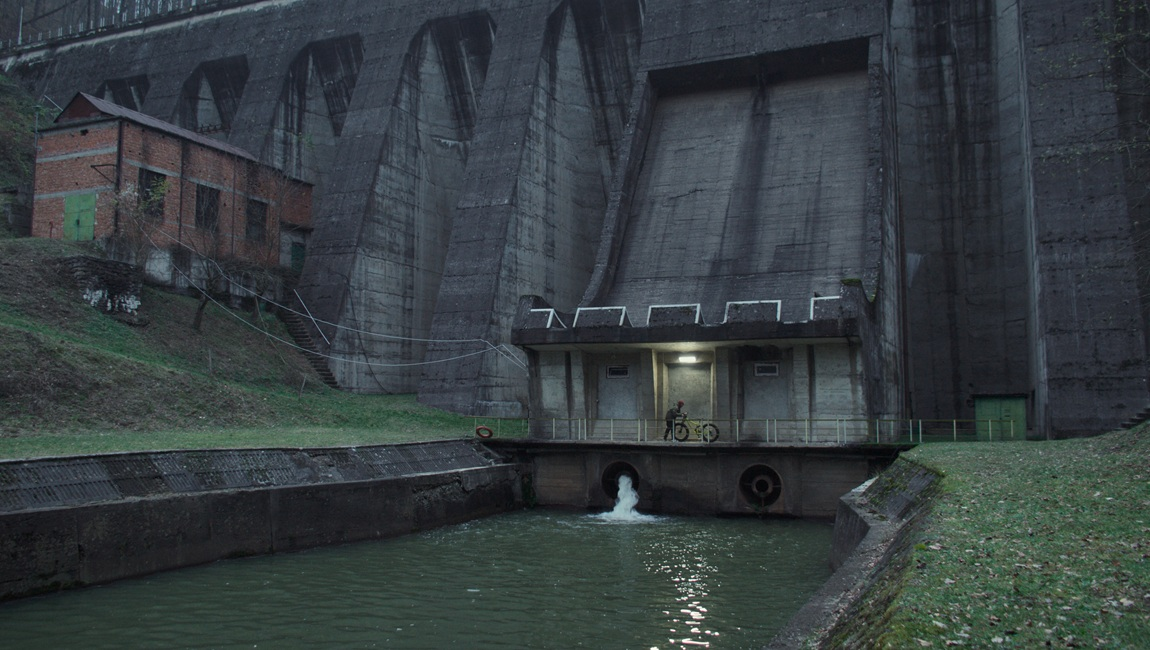
A staid frostiness envelops the frames of Florin Şerban’s smoldering latest feature, whose clinching of the top prize at its Locarno premiere serves as an almost reactionary vindication of the haunted psychological portraitures that have, of late, seemingly gone out of fashion. In particular, as the auteurial specter of Radu Jude rears its playful hand across the canvas of contemporary Romanian cinema, punishing miserabilism no longer comports with arthouse sensibilities the way it used to, or at least its tropes are more readily deconstructed and demystified for the world to see. Yet Şerban’s return to international prominence (after 2010’s If I Want to Whistle, I Whistle) with You Don’t Belong Here is a less straightforward affair. Throughout the glacial course of its runtime, the film revisits the many checkpoints favored by its spiritual predecessors: the rot and stagnation of Romania’s post-communist society, the resurgence of a conservatism that never quite left, etc. But it does so by centering the action, so to speak, on the tepid aftermath of an event; post hoc, the crime is done, one can only dream.
Though our protagonist is not much of a dreamer, he has in place a set of ideals instilled since youth, ideals which he never sought to question or have others call into doubt. Marius (Adrian Văncică) is the chief of his local hospital, in the small town of Reșița, west of Bucharest. He oversees the staff, administers complex surgeries, and moves through life with a sense of purpose. His son, Ioan (Teodor Butănescu), does not. Shy of 18 and overweight with the pallid flush of a sedentary lifestyle, the boy bears a constant reminder to his father of his failed legacy. “Every crow thinks its chicks are swans,” muses Marius to his colleague and casual lover Dana (Cristina Richter), recollecting his own desire, at 18, to win the Nobel. The minutiae of his daily life neatly unfurls in You Don’t Belong Here, whose numerous interior and static shots gradually tease out the surgeon’s moral and mental world. Order is cleanly circumscribed throughout, like a scalpel unto skin; no one but Marius may occupy the center of things, whether in the conversations he has with his subordinates or in the subtle imposition of his way, his last word, everywhere he goes.
The quiet chauvinism of these passages takes hold insidiously, without the overt fashioning of the film to foreground its thematic weight. When Marius’ high-school friend, the police inspector Silviu (Alexandru Conovaru), comes to visit, it is a numbingly uneasy encounter belied by mutual joviality. A Gypsy man has died, bludgeoned to death by unknown assailants, and his son is seeking both justice and the assurance from the hospital not to perform an autopsy on the deceased. To do so would be to further desecrate him, and while Marius awaits the many developments surrounding this murder case, his own reflections lead him deeper down a cesspool of misanthropy. As the plotlines of father and son inevitably converge in a third act of fierce despair, Şerban effectively sucks out the air to relish an atmosphere of tense foreboding that accentuates the various instantiations and manifestations of a larger masculinity in crisis. The young man has, for his naïveté and inexperience, committed a heinous crime; the older man, trudging along his self-imposed path of duty, is awoken, somewhat, to the senselessness of it all.
Where a more clichéd hand would clamor to couch the film’s ostensible central event — a racist attack by neo-fascist thugs on immigrant property and persons alike — in sensational, luridly outraged terms, Şerban excavates his national anxieties less as convenient talking points and more as a means to process the generational anomie that, unmoved and unsullied, easily reduces its citizens to husks of their ideals. The clinical gaze of the camera recalls the works of his countrymen; Cristi Puiu, in particular, has evinced a style of holding shots past the natural span of action and attention, and so too does You Don’t Belong Here gesture to the earlier oeuvre of Cristian Mungiu. Deceptive in its lethargic appearance and slow-burning in its rumbling interiority, the film effectively serves as an antithesis to Mungiu’s Fjord, a highly bombastic yet unenthused rally against “wokeness” that itself harbors a perverse instinct to expound and exploit its version of miscarried justice. From its somber tunes (opening with Mahler laid over the unassuming town environs) to its voyeuristic long shots (the province of DoP Liviu Mărghidan’s calculated coldness), it speaks not just of a nation’s violent and reactionary xenophobia, but crucially of a fundamental rupture and displacement between its image and its people.
Published as part of Locarno Film Festival 2026 — Dispatch 4.
Comments are closed.