
Pure Reason
Where experimental film is concerned, that subsection we call “structural film” is characterized by a radical transparency. This may seem like an odd claim to the uninitiated, but like all aesthetic claims, it must be understood in historical context. While structural films are by no means “normal” films (i.e., narratives), they tend to adopt a set of principles and procedures and follow them through to their logical conclusion. So if you pay attention to the pattern — numerical, alphabetical, looping or repetition with incremental differences, what have you — you can usually infer what the film is likely to do. Structural film tends to reward pattern recognition, letting the viewer make hypotheses and test them out over the course of the viewing.
Sofia Bohdanowicz’s latest film Pure Reason certainly partakes of the methods of structural film, but in some fairly significant ways it avoids actually being one. It does indeed introduce a set of images arranged in a particular order. Each of the film’s seven iterations is centered around a particular color. With each pass, Bohdanowicz tracks right to left over a set of Greenbergian color field images, with thin unmixed paint applied to a surface so that the various colors bleed into one another. (For reference, these sequences look a lot like the canvases of Sam Francis or Helen Frankenthaler.) Then, in almost every instance, we see the following: a written list; a hand holding an object of one particular color; a full screen of pure color, a digital paint sample as it were, with a serial number in the lower-right-hand corner of the screen.
After this, Bohdanowicz shows us a textured wall that appears to be the color associated with that iteration. However, the hue is typically lighter and inconsistent, shifting in relative intensity from moment to moment. In most cases, we then see the camera move laterally, with the brighter, purer color imprinting itself on the film like an end flare. The accompanying sound varies from segment to segment. Sometimes we hear ordinary domestic sounds, like a canary singing or a child asking a question. Other segments have distinct musical motifs. Most notably, the purple segment features the first three notes of Prince’s “Purple Rain,” before ambling off into a more generalized drone.
This use of variant sound textures is the first signal that Pure Reason is diverging from the path of structural film. Typically, the sounds would be the same, or they would metamorphose in some discernible progression or regression. But each is wholly distinct, bearing little relationship to the others. In fact, the use of “Purple Rain” in the purple section miscues the listener to expect similar textual references in the selections (for example, “Greensleeves” in the green section) or leads us to wonder whether the other sounds feature some color-based reference we simply don’t recognize.
But more importantly, in the fourth section (green), Bohdanowicz alters the order of presentation. Instead of list/object/paint sample/wall, we get list/wall/object/paint sample. This is not a palindrome or a simple reversal. There is no obvious way for the viewer to make sense of this change. The fifth and sixth sections (blue and teal) revert to the original order, and the final section (orange) uses the same order as green.
The more we reflect on Pure Reason, the more anomalies begin piling up. What exactly is happening in the colored wall segments? Sometimes, but not always, we hear the clicking of a slide projector. So there is a good chance that we are seeing the same neutral wall, with Bohdanowicz projecting colors in the general vicinity of the wall, so that we are seeing ambient light spilling over onto the wall. But the written lists we see at the start of each section seem to break those colored-wall sections down into precise increments of time. After noting what one assumes to be a lens selection (“91/50mm”), the list provides a breakdown. From the orange section:
6:24 am orange wall
6:29 am orange wall6:31 amm orange wall
And so on, until we get to: 6:47 am drank orange juice. The list continues through 7:02 am, with all times labeled “orange wall” except for 6:51 am (“sunrise”) and 6:55 am (“drank tea”). All the other lists are similarly interrupted with “distractions” from the wall. The red section features notations such as “the red still hasn’t appeared,” and later on, “I’m bored.” The teal list includes “sliced some mango” and “offered Dorota mango.” And so forth.
So what are we to make of this? The lists would indicate that Bohdanowicz is simply observing chromatic phenomena, rather than generating them. And various daily tasks pop up here and there to interrupt her attention to said phenomena. But what is crucial here is that there is no way for the viewer to know. Bohdanowicz provides data without giving us the framework for interpreting that data. So we understand that a structural procedure is being enacted, but we cannot know exactly what it consists of, or what it might mean.
This uncertainty, it seems, cracks Pure Reason wide open. Rather than appearing as mistakes, these inconsistencies point to the film’s unwillingness and maybe even the overall impossibility of making a perfectly systematic film. The title, after all, directs us to Kant’s Critique of Pure Reason, in which the philosopher distinguishes between a priori and a posteriori judgment. A priori judgments are derived from universal abstract principles, whereas a posteriori judgments are based on experience, especially sensory experiences. So in some respects, Bohdanowicz follows in the footsteps of structural filmmakers like Paul Sharits, attempting to take the sensory data of color perception and organize it according to a conceptual system. But Pure Reason’s system is impure. The painted sections show us colors blending into each other, and the wall sections provide only suggestions of the color under investigation. Time, available light, and human perception are muddying the waters of pure theory.
This leads us to other curious aspects of the film, and what Bohdanowicz might be telling us about the legacy of structural film. For instance, we discover that the blended, “impure” colors may in fact be the studio walls of Canadian painter Jaan Poldaas. Poldaas’ canvases are composed of sharp blocks of color that abut one another but never intersect. Bohdanowicz could be referring to these clean, systematic paintings by looking at the environment of their making, which is far messier than the products that emerge from them. This might mirror the domestic sounds we hear on the film’s soundtrack, or the list notations that tell us that the contemplation of (im)pure color has been interrupted by commonplace human tasks.
The critical rap on structural film in its heyday was that it was an axiomatic cinema, one that radically narrowed its parameters so as to subject them to an almost scientific kind of control. This made the resulting films vaguely akin to research. But every artwork, every creative artifact, comes from somewhere. The making of art is an immanent process, even when it aspires to transcendence. Pure Reason alludes to strict compositional controls but also appears to invite the chaos of lived experience, which also happens to be where the phenomenon of color — a perceptual artifact, not an essential element of things — actually resides. Pure Reason dangles the temptation of absolute knowledge before our eyes, and by distracting us from that theoretical chimera, directs us to a greater, more grounded form of truth. — MICHAEL SICINSKI

Mirage
More than a decade after his first feature, For the Plasma (2014), Bingham Bryant revisits his fascination with images, interpretation, and, crucially, the ways images are mediated before our eyes, with El Espejismo (Mirage). But perhaps fascination isn’t strong enough. In the case of Maria (Maria Novo), a young woman who pursues the elusive image of a man she once saw through her binoculars, something even stronger than fascination presses its advantage.
If something stronger than fascination is required to characterize Maria’s sudden change in behavior, then Bryant takes his instruction from San Sebastian (Donostia in the regional Basque language) itself. Its pervasive, militaristic architecture, the castillo on Mount Urgull a stoic sentry against occupying forces from generations past, is fertile thematic ground for Bryant’s ideas and images. The word “obsession” derives from the Latin “obsesio,” meaning a blockade, siege, or encirclement. In English, it has taken on psychological and religious connotations; an occupation of the mind against one’s will. For Maria — whose story of mounting obsession is recounted in the words of her sister Margarida (Francisca Alarcão as a young woman, and filmmaker Rita Azevedo Gomes as an older woman), and told to a young Frenchwoman (Constance Rousseau) who has come to San Sebastian to observe recently reported mirages — the experience, at once overwhelming and, crucially, inexplicable, feels cosmically aligned with her surroundings.
Maria and Margarida are students (architecture and psychology, respectively) in San Sebastian. Their lives are mundane, occupied by concerns with funding for their studies and a well-meaning but, according to Margarida, obsessed ex-boyfriend who, apparently, won’t stop following her around the city. A trip to an antiques market unites Maria with a pair of binoculars that, after looking through them from the wrong end, alter the way she sees the world. Eventually, Maria mysteriously disappears from Margarida’s life, going weeks without making contact, or offering weak excuses for her absence from their tightly integrated lives when she does.
As told by the older Margarida, these events ostensibly take place in the past, but Bryant’s approach, and certainly his material limitations (the film participated in last year’s FID Development Lab, but received no funding from it), mean that this past occurs within a distinctly recognizable present. Cell phones might be scarce, but other markers of contemporary life (cars and buses, and new buildings at odds with San Sebastian’s lofty ruins) are not hidden by clever tricks. There’s a satisfaction in seeing Bryant’s time-melding strategies — which often play out within long, unbroken shots by way of simple conceits of blocking, choreography, and voiceover delivery — unify into an organized aesthetic principle; a little destabilizing but never alienating, they confer meaning about the slippery nature of perception without forcing the issue.
As high-minded as Bryant’s concepts regarding images and image interpretation can seem, Mirage delivers a quietly affecting story of sisterly love and loss. Gomes (who previously collaborated with Bryant on her 2025 FID Marseille premiere, Fuck the Polis), as the elder Margarida, is excellent, and it’s upon her warm, knowing presence that Alarcão’s younger interpretation expands and contextualizes. Novo, as well, conveys a wispy detachment with conviction, never sacrificing the audience’s hope that she can come back from the brink of her quiet emotional spiral even as she moves further away from Margarida.
Perhaps more illustrative of Bryant’s intentions, however, is Mirage’s subtle adherence to the narrative structure of conventional horror films, in which the role of a near-mythical physical object produces inexplicable effects on those who use it in ways it’s not meant to be used. Recounted from the future, Maria’s ambiguous, fantastical fate — best left unspoiled — plays like a sweetly cautionary tale; a gentle warning to Margarida’s audience of one, who is also interested in the spectre-like nature of images, to remain, like the labyrinthian fortresses of Old San Sebastian, vigilant against their advances. — CHRIS CASSINGHAM
Foam of Worlds
Given that present-day existence has been thrown into disarray by — in roughly chronological order — the smartphone, COVID-19, and the resurgence of fascism, how exactly do we make it through the day? More specifically, how can we characterize our current experience of quotidian time? We can often feel suspended between the cataclysmic and the mundane, learning another harrowing fact about impending environmental disaster and then having to walk the dog or make macaroni and cheese for the kid. A general numbness can feel like the only way to stave off the complete dissolution of the self.
Anna Marziano’s debut feature, Foam of Worlds, represents a conscious occupation of this subjective gulf. It’s a film that constantly shifts its attention between the global and the immediate, but does so with a notable lack of tonal disruption. Instead, Foam of Worlds is a film of placid continuity, so much so that at times it feels static, as if its viewer were observing it through the prism of a fugue state. It’s a series of present moments, inching their way forward but almost imperceptibly.
Marziano is one of Italy’s premiere experimental filmmakers, and her work has often focused on the body, specifically the female body, as it finds itself in circumstances both hostile and confusing. Her 2011 film The Mutability of All Things and the Possibility of Changing Some consisted of a series of tableaux in which ordinary scenes of daily life were made strange by a recognition that the body doesn’t always “fit” into the spaces in which it finds itself. Her silent 2024 film Farsi seme actually went inside the body, examining blood as both an extension of the self into space and a bold chromatic phenomenon, perhaps explaining why the history of cinema has shown such an attraction to the stuff. In a sense, Foam of Worlds expands on Farsi seme, bringing it into a semi-narrative frame. The new film is about water, although it takes awhile to recognize this. From ocean waves to murky creeks, water is flowing through much of the film, and in time we come to recognize that it poses an encroaching threat.
A single mother, Antonia (Laura Fantacuzzi), and her young daughter Lena (Alea Lori Marziano) live on the Venetian island of St. Erasmo. Between eating meals and playing with Lena, Antonia is a lawyer who is hard at work researching a case for the European Court of Human Rights. Building on a landmark case in Switzerland, Antonia gradually considers a plan to prosecute inactivity regarding climate change, arguing that it victimizes future generations and deprives them of their basic rights. As it happens, coastal levels around St. Erasmo are steadily rising, so this is a problem that threatens to literally consume Lena’s home if it continues unabated.
Marziano organizes the film in a way that tamps down any sensationalism or fearmongering regarding climate change. In fact, there is a patient, subdued tone that permeates Foam of Worlds, preventing any one scene from drawing undue attention to itself. We observe Lena in school learning to spell, Antonia preparing dinner, and the two of them acting silly and goofing around. And yet there is a somber atmosphere throughout the film, seemingly alluding to the fact that even as we go about our lives, there is an existential threat always looming in the background.
We see Antonia reading and researching about climate change in terms both scientific and legal, and this provokes eerie juxtapositions that Marziano’s editing and framing tend to smooth out. At times, Foam of Worlds evokes the documentaries of Gianfranco Rosi, with their broad scope and dialectical examinations of Italian life. And yet that observational atmosphere is interrupted by scholarship and data, beaming in like transmissions from another reality.
But, of course, that’s the point. Impending climate disaster is our reality, and we tend to suppress this knowledge to allow ourselves to conduct our daily affairs. For those of us with children, this dissonance is especially pronounced, since we cannot allow ourselves to believe that we brought new life onto the planet only for it to die an agonizing death. So if we must partially deny the truth in order to live, what hope is there? Foam of Worlds provides a possible answer. By depicting scholarship, education, and activism as coextensive with daily life, rather than a disruption or digression, Marziano suggests that we can gain awareness and take action without lapsing into the paralysis of despair.
Roberto Rossellini claimed that Freud’s theories of the sex and death drives were incomplete, because they ignored a third drive that he believed was every bit as primal. This is the drive for knowledge. Foam of Worlds does not ignore the possibility of death, but Marziano counterbalances it with education, and the hope that by facing reality head-on, we might yet be able to steer it away from death and toward the possibility of sustained life. — MICHAEL SICINSKI[/vc_column_text][/vc_column][/vc_row]
Also Playing
Mare Sapiens
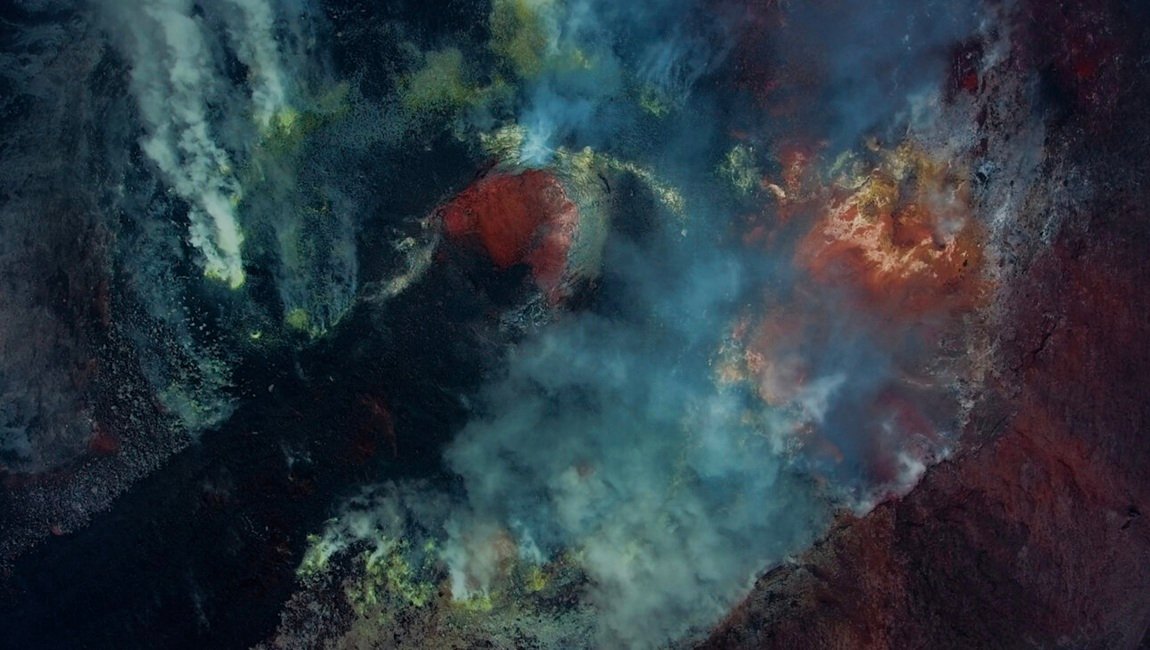
A camera navigates the Mediterranean’s vast cerulean depths. Its gaze is foreign and robotic — an intruder within a dark maritime realm intensely averse to documentation. In its strikingly saturated images, divers are rendered more foreign than the inhabitants of the ocean floor. Their murky waters are crammed with sunken remnants of decayed scrap metals, fishing nets, and cables left behind, and a cacophony of mechanical creaks, drips, and sloshes rings a soundtrack of dread throughout an otherwise silent seabed. Entirely filmed underwater, beneath the Bay of Marseille, Aurélie Darbouret and Jeff Daniel Silva’s Mare Sapiens (2026) isn’t quite comparable to other oceanic or scientific documentaries. It does not seek to inform or display, so much as it aims to evoke.
Affiliated with both Marseille’s Fabrique des Écritures Ethnographiques project and Harvard’s Sensory Ethnography Lab, Mare Sapiens is a byproduct of an anthropological tradition more so than that of conventional filmmaking practice. The film is observational, visceral, and meditative. Accordingly, this ethnographic approach forgoes the documentary genre’s traditional pedagogical function. Instead, it is a sensorium of underwater tension, best defined by its lack of context, narrative, and interpretive authority.
This laissez-faire style of cinema was largely popularized by Lucien Castaing-Taylor and Viera Paravel’s like-minded film, Leviathan (2012), and has since been utilized by other 21st-century ethnographic documentarians and visual anthropologists. Like Leviathan, which consists entirely of GoPro footage aboard an American fishing vessel, Mare Sapiens is heavily reliant on its overwhelmingly rich audio. Darbouret and Silva, alongside ecologists at the Mediterranean Institute of Oceanography, began their project as a soundpiece, recording noises of sea life and maritime traffic with hydrophones.
Like their original fieldwork, Mare Sapiens remains audio-centric. Its sonic dimensions far exceed what can be seen on screen. At many times, viewers don’t quite know what they’re hearing, yet the accumulation of these sounds cultivates a unique sensory experience. The recording’s gargles, white noises, and robotic drones are vividly ominous, and it’s in this manufactured discomfort that Mare Sapiens masters its most poignant quality: tension, without ever offering its viewers a release.
As Darbouret and Silva manage to film in conditions once thought to be unfilmable, the many stimulating facets of Mare Sapiens accrue pressure: between viewer and ethnographer, between technological presence and the seabed’s unreachable contours. In this suspense, viewers expect a climax. Yet Mare Sapiens’ crescendo is silence. This sonic and visual eeriness, both an anthropological and cinematic feat, is left only to reverberate throughout the ocean’s expansive emptiness. — LANDEN FULTON
I Promise I’ll Come and Rescue You
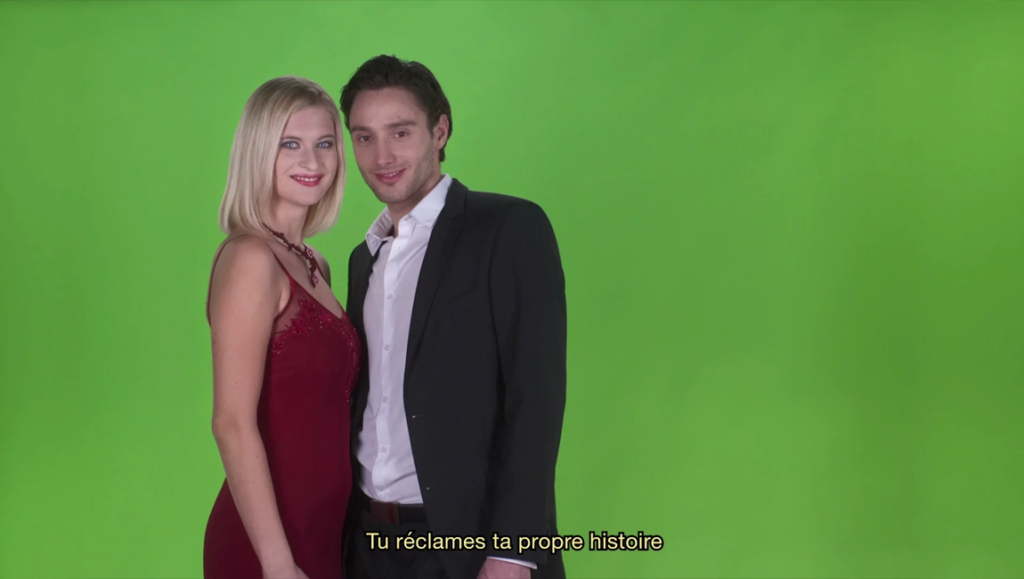
“I have to find a way.” This opening voiceover, soothing yet fraught with anxiety, doesn’t initially sound ironic. It sounds sincere, and fitting, as the image it accompanies is that of a highway viewed through a windshield and hands upon a steering wheel. But then the visual loops, and the voiceover keeps repeating the same phrases. Sincerity becomes vacuousness, and sound and image develop an incongruity — who is this person who has to find a way, when she’s clearly on one already?
Actor Vimala Pons’ first work as a director, I Promise I’ll Come and Rescue You, has found its way right from this opening gag — wry and gently withering, it’s a collage of unrelated stock footage of banal luxury set to a soundtrack of soothing spa reception music and Pons’ disembodied voice. She muses, rambling, as if expressing the inner voice of imagined characters within the scenes she plays and replays in short clips. She snivels and sobs over a cup of coffee being poured, rants and raves over a POV of a jet ski rider, and comically imitates sexual pleasure over a shot of raw steaks fondled by a gloved hand.
Where Pons’ narration feels most germane to the footage, even if generally in gently mocking irony, the movie is seemingly at its least abstract, though it’s elsewhere that she exposes the thesis behind it. What relation a shot of bread rolls ascending a factory belt bears to her repeated utterances of “my youth” is difficult to discern, and the movie’s fundamental discordance in such moments forms its purpose. These are sterile pictures, clear and uncomplicated, and Pons’ voice sounds crisp and mellifluous — there’s no grain, no grit, no semblance of an identifiable reality. None of it is unfamiliar, yet it has a distinctly alien timbre.
What is identifiable, however, is the disconnect that Pons depicts, the brainrot experience of a vapid inner monologue droning over as the eyes scroll through picture after picture of a manicured unreality. I Promise I’ll Come and Rescue You has the appearance of comfort in its images of sandy beaches and smiling women, but Pons presents these images as a balm that’s less soothing than numbing. If the monotony of it is intentional, and certainly persuasive, it also inspires another disconnect, this one between viewer and movie, creeping in gradually after one notices, processes, and appreciates Pons’ point.
But that’s by her own admission too — in the film’s final clip, her voiceover states: “I have no idea what I’m doing.” It’s not quite true in reality, as the clarity of her critique of the 21st-century manufactured lifestyle is undeniable. And it’s a sentiment that’ll likely resonate with most viewers who can relate to the experience she depicts in this movie, even if it is just one elongated bit on the emptiness of modern life. — PADAÍ Ó MAOLCHALANN
you dreamt you saw yourself but couldn’t see your face
Shireen Seno’s short film you dreamt you saw yourself but couldn’t see your face begins with a small video image situated in the center of the screen. We see an older gentleman in a tam walking in a park, eating a pear, while we hear him whistling a seemingly random tune. This introduction sets the parameters for the remainder of Seno’s film, which is primarily concerned with water and landscape. As we enter a different set of images, which fill the entire screen, we still hear the whistling. So this emphasizes the absence of the older man in the newer footage while also permitting him to occupy this space as an echo.
Seno provides a series of images of the water’s surface, reflecting the space around it: clouds, telephone wires, trees on the shore. In the fourth or fifth shot, we see a large stick penetrating the surface of the water, which both disturbs the reflections and alerts us to the presence of an unseen figure. In time, we see the person’s hand enter the frame. But coming and going across these shots is a man reflected on the surface of the water. Although his general shape resembles that of the older man in the opening segment, it is not clear whether Seno has photographed an actor or whether the man’s presence is layered in through digital editing. As with the sound of the whistling, this image is an echo of a previous presence.
In formal terms, you dreamt you saw yourself; treats the water’s surface as a reflecting plane, one that occupies the entire frame or part of it, depending on the camera angle. This results in a prismatic film, one that keeps the flat surface of the water as a constant but pivots the viewer’s perspective around that plane. In the final minutes of the film, Seno provides close-ups of the water, with leaves floating by as the current moves through the frame. In the final minute, we see the reflection of a hand holding a plastic bag, and realize that this person is spreading ashes on the water. The film is dedicated to Jolly Tecson Seno (1947-2024), presumably the director’s father. This makes the emotional stakes of the film crystal clear. This location is where the elder Seno now “is,” even though he is no longer there. His remains, like his memory, are moving ever further away. — MICHAEL SICINSKI
Comments are closed.