
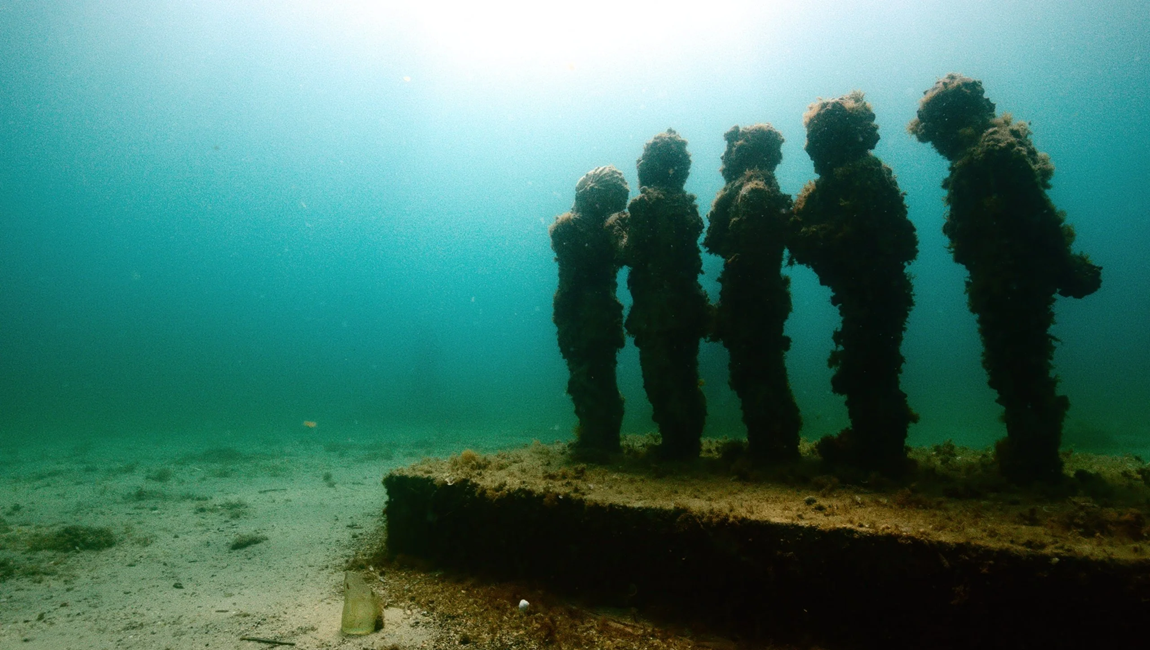
A camera navigates the Mediterranean’s vast cerulean depths. Its gaze is foreign and robotic — an intruder within a dark maritime realm intensely averse to documentation. In its strikingly saturated images, divers are rendered more foreign than the inhabitants of the ocean floor. Their murky waters are crammed with sunken remnants of decayed scrap metals, fishing nets, and cables left behind, and a cacophony of mechanical creaks, drips, and sloshes rings a soundtrack of dread throughout an otherwise silent seabed. Entirely filmed underwater, beneath the Bay of Marseille, Aurélie Darbouret and Jeff Daniel Silva’s Mare Sapiens (2026) isn’t quite comparable to other oceanic or scientific documentaries. It does not seek to inform or display, so much as it aims to evoke.
Affiliated with both Marseille’s Fabrique des Écritures Ethnographiques project and Harvard’s Sensory Ethnography Lab, Mare Sapiens is a byproduct of an anthropological tradition more so than that of conventional filmmaking practice. The film is observational, visceral, and meditative. Accordingly, this ethnographic approach forgoes the documentary genre’s traditional pedagogical function. Instead, it is a sensorium of underwater tension, best defined by its lack of context, narrative, and interpretive authority.
This laissez-faire style of cinema was largely popularized by Lucien Castaing-Taylor and Viera Paravel’s like-minded film, Leviathan (2012), and has since been utilized by other 21st-century ethnographic documentarians and visual anthropologists. Like Leviathan, which consists entirely of GoPro footage aboard an American fishing vessel, Mare Sapiens is heavily reliant on its overwhelmingly rich audio. Darbouret and Silva, alongside ecologists at the Mediterranean Institute of Oceanography, began their project as a soundpiece, recording noises of sea life and maritime traffic with hydrophones.
Like their original fieldwork, Mare Sapiens remains audio-centric. Its sonic dimensions far exceed what can be seen on screen. At many times, viewers don’t quite know what they’re hearing, yet the accumulation of these sounds cultivates a unique sensory experience. The recording’s gargles, white noises, and robotic drones are vividly ominous, and it’s in this manufactured discomfort that Mare Sapiens masters its most poignant quality: tension, without ever offering its viewers a release.
As Darbouret and Silva manage to film in conditions once thought to be unfilmable, the many stimulating facets of Mare Sapiens accrue pressure: between viewer and ethnographer, between technological presence and the seabed’s unreachable contours. In this suspense, viewers expect a climax. Yet Mare Sapiens’ crescendo is silence. This sonic and visual eeriness, both an anthropological and cinematic feat, is left only to reverberate throughout the ocean’s expansive emptiness.
Published as part of FIDMarseille 2026 — Dispatch 1.
Comments are closed.