
Love takes miles. In 1977, PK Mahanandia, a 23-year-old street artist living in Delhi, met the girl he was sure he was destined to marry. Lotta Von Schedvin was a young Swedish tourist drawn to PK’s portrait stand under a spell of curiosity and serendipity; 10 minutes and 10 rupees later, they were in love. Life naturally brought Lotta back to her home country, and PK, hopeless romantic that he was, couldn’t stand to be apart. PK was born a Dalit — or, historically and uncharitably, an “untouchable” — into India’s caste system, which meant hopping on a plane to Sweden was out of the picture. So, he decided to take the 6,000-mile journey into his own hands: he’d travel by bicycle.
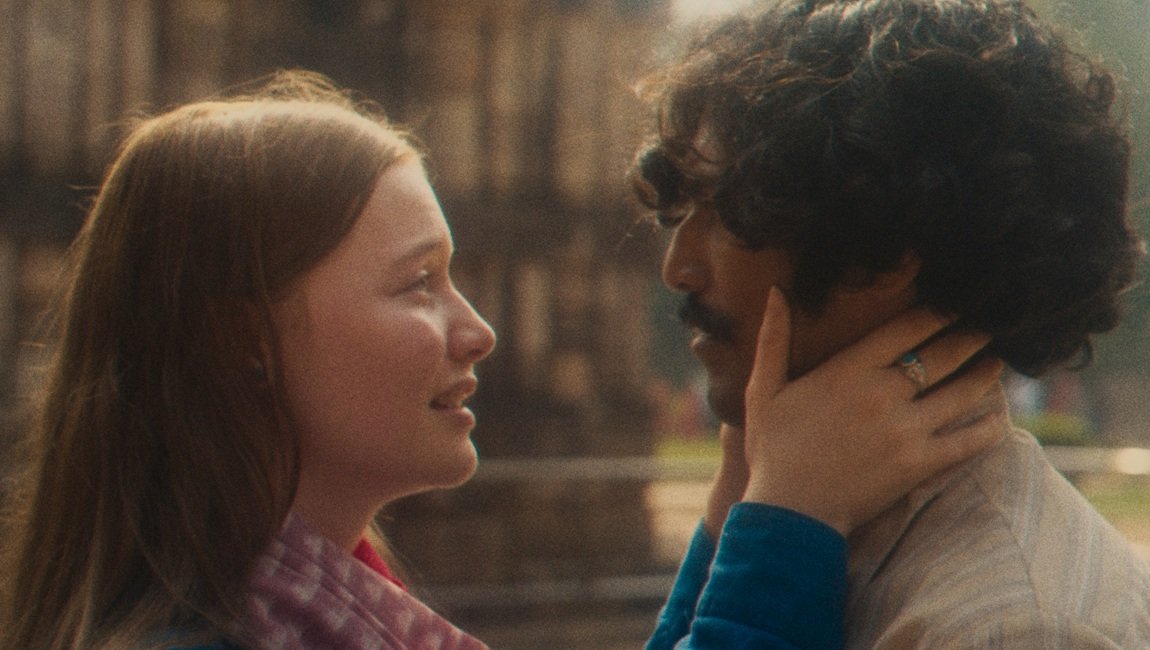
PK and Lotta’s story is the sort of once-in-a-lifetime miracle romance that demands to be documented. With The Cycle of Love, verité director Orlando von Einsiedel endeavors to shoot the moon. Equipped only with a handful of grainy photographs, the director constructs a full documentary of PK’s journey from Delhi to Borås, Sweden. Einsiedel’s method for supplementing those photos is novel but not unprecedented. With two trained actors playing young PK and Lotta (Chirag Lobo and Mina Dale, respectively), The Cycle of Love improvises a recreation of PK’s international bike trek, with dozens of non-actors — and, occasionally, the real PK and Lotta themselves — in the periphery.
Einsiedel’s experiment is punctuated by traditional talking-head interviews of PK and Lotta today, each filmed in their native homes. PK’s charm is explosive: he’s a head-in-the-clouds romantic whose commitment to the unbelievable is gripping enough to challenge your idea of what’s possible. As a child, PK explains, his father had commissioned a prophecy that foretold PK’s life partner would be a Taurus, musically inclined, and would own a jungle. To hear PK say it is to believe it must be true. Lotta — who is indeed a Taurus, musically inclined, and whose family owns forestland in Sweden — is in turn more reserved but no less endearing. Even with 6,000 miles and 50 years between them, their eyes alight during their interviews, their brief meeting in India smoldering like a coal in their memories.
When PK left Delhi in the late ’70s, he worked to fund his trip by peddling the same street portraits he’d sell at home in India. It’s here that Einsiedel’s method edges toward the revelatory, often recalling the cockeyed realities of Iranian director Abbas Kiarostami. As did the real PK, Lobo’s improvisations find unprecedented intimacy with the strangers he draws. Men and women across India, Iran, Afghanistan, and Pakistan spill their souls as a plucky stranger sketches their likeness at the speed of a boardwalk caricaturist. None of Lobo’s subjects are trained actors; all comprise The Cycle of Love’s finest moments. As Lobo scribbles, the sensation of being seen collides with the desire to be known: these former strangers transform into conduits of kindness and empathy, many even offering a plane or train ticket to ease the burdens of PK/Lobo’s travel. Einsiedel employs grain and sepia to lend his constructed archival footage a sign of the times, but these scenes are no less authentic for the patina.
Lobo and Dale are admirably sincere in their performances. The Cycle of Love’s recreation of their early romance, though, is less successful. The modern-day PK is prone to screeds on titanic, metaphysical forces like love and destiny. He’s always compelling and often poetic. “I have conquered the whole empire of love!” he shouts after recalling his first kiss with Lotta. Einsiedel’s scenes, comparatively, are frustratingly literal. Dale’s smile is infectious as she fields surprises from Lobo, whose own buoyancy ripples across border checks and flat tires to lift the faces of virtually everyone he meets. But their scenes together are dwarfed in the shadow of Lotta wiping a tear after reading one of PK’s old letters, of PK darkening while tuning up the bike that brought him across the world.
Love might not have been the only catalyst to have sparked PK’s wild-eyed journey. His place in the caste system haunts him throughout his trek and up until today as he works internationally as an advocate for change. As a young PK, Lobo breaks bread with other men and women disenfranchised by casteism, fields heartbreak from earlier, intercaste relationships, and shoulders denied visas time and time again. Einsiedel, a British director, is sober and delicate in his delivery, but a few Western fingerprints smudge the edges of The Cycle of Love’s nuance. Archival footage of Indian men and women from lower castes is scored by British reports of the brutality and inhumane lives those men and women suffer; the same cultural voyeurism sprouts in scenes in which Western tourists flout their progressive ideologies and karmically ambivalent tattoos (Be Love on a forearm, Create Your Own Destiny on a bicep). If an antidote is to be accepted, it comes via PK himself. He is staggeringly vulnerable about the ways in which the caste system affects him even in old age, and his lived experiences are given their due and meticulously rendered time.
In interviews and press releases, Einsiedel is effusive toward the directors that paved the way toward his blend of the real and the constructed: Chloé Zhao, Wim Wenders, and, notably, the Ross Brothers. The Ohio directors’ Bloody Nose, Empty Pockets is particularly instructive. That film mixes a slurry of trained actors and seasoned barflies to recreate the last night of a Las Vegas neighborhood dive; the borders between who’s acting and who’s showing up for free drinks, the practical and the metaphysical, blur with each round of well shots. The Cycle of Love is decidedly more delicate than Bloody Nose but no less effective in its inventions. PK is a boundless spirit who will burst into fits of tears and laughter in the same sentence. To watch him trail his younger self on a reckless journey toward his soulmate is to share in his conviction that love is real.
DIRECTOR: Orlando von Einsiedel; CAST: Chirag Lobo, Mina Dale, PK Mahanandia, Lotta Von Schedvin; DISTRIBUTOR: Variance Films; IN THEATERS: August 28; RUNTIME: 1 hr. 38 min.
Comments are closed.