
Crows Are White is sharpest when its images expose what director Ahsen Nadeem’s narration would prefer to soften. It is least convincing when, at the end, it asks an image to soften the damage for him. His frequently funny documentary presents itself as a search for enlightenment, but gradually reveals a director using the search as an elaborate detour. Raised in a devout Muslim household, Nadeem travels to a Tendai monastery on Mount Hiei rather than confront his family with his relationship to Dawn, a non-Muslim woman he eventually marries without their knowledge. Crows Are White turns his evasion into its structure, while remaining candid enough to let us judge the man doing the evading.
Shot across five years, the film reorganizes a failed observational project into an autobiography. Nadeem initially pursues Kamahori, a monk undertaking the punishing kaihōgyō, as though sufficient access to another man’s sacrifice might furnish an answer to his own divided life. When Nadeem’s phone rings during a ritual, his muttered insistence that he thought it was on vibrate supplies a comic alibi; the crew’s expulsion delivers the harsher verdict. The edit turns failed access into a hinge: the expulsion returns the film to the confession he has blocked at home. The documentary’s apparent change of subject is therefore its real disclosure.
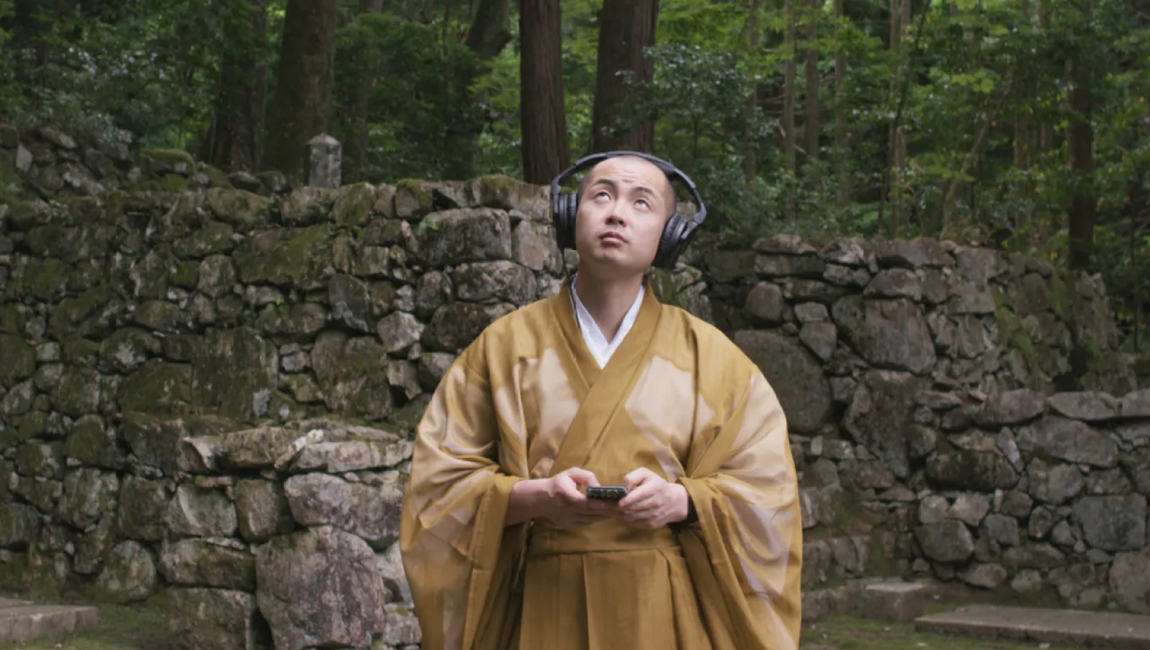
The Mount Hiei footage has a luminous calm that Nadeem never quite possesses. Clear light settles across the interiors, and frames place bodies within spaces already organized by ritual. The monks first register as a collective defined by order, and the film’s attention to posture and clothing, then to moments of guidance and rebuke, gradually separates them from that first impression. Nadeem, meanwhile, appears as the body that cannot hold its assigned place. His crew and his questions repeatedly test boundaries controlled by the monks. The ringing phone finally ruptures, in sound and conduct, the discipline that the images have patiently established.
Nadeem distributes himself across unstable cinematic positions. He questions his parents from outside the frame before appearing as the fumbling protagonist of his own investigation. Over both positions, his retrospective voiceover claims an authority that his conduct keeps undermining. Narration lets him shape embarrassment into a punchline, often placing wit against solemn images before the viewer can judge him unaided. Once his body enters the frame, however, the edit preserves awkward pauses and other people’s responses that escape this protective tone. The camera can no longer protect him as completely as the narration does.
Ryushin is the film’s most seductive discovery and the consolation Nadeem is most eager to accept. The low-ranking monk works in the gift shop, loves ice cream, listens to Slayer, and treats monastic severity with an ease Nadeem instantly recognizes. Ceremonial duration gives way to outings and open-ended conversation; at the concert, amplified distortion breaks the monastery’s soundscape of chants and quiet footfalls. Ritual arrives through recurrence and discipline, the concert as immediate release. This gives the film comic oxygen and allows Nadeem to imagine contradiction as a stable way of life. Yet Ryushin is a mirror, not a cure. The danger lies not in his example, but in Nadeem’s wish to read it as permission.
Ryushin’s ice cream and Slayer say nothing definitive about the depth of his devotion, and Kamahori’s endurance proves little beyond the extremity of his commitment. Nadeem nevertheless begins to treat the two men as possible answers to his own problem. His circumstances are different, but the choice he keeps avoiding is familiar enough. Christian scripture gives divided allegiance a severe vocabulary: Christ rebukes the church of Laodicea for being neither cold nor hot (Rev. 3:15–16), while elsewhere warning, “No one can serve two masters” (Matt. 6:24). Crows Are White is not a Christian allegory, nor does Nadeem frame his crisis in those terms. Its structure nevertheless arrives at a comparable demand for choice. He wants to keep his family and inherited faith while keeping Dawn, too, without paying the price that either choice seems to demand. He wants the best of both.
The film’s title makes the demand for submission literal. One monk recalls that his training required accepting the master’s word without appeal: if the master said a black crow was white, the disciple answered yes, end of discussion. For Nadeem, the lesson only produces more desire and chaos. The image also has an older, darker echo in the myth surrounding Asclepius’s birth. In Ovid, Apollo’s raven is originally white. It reports finding Coronis, pregnant with Apollo’s child, with a Thessalian youth; enraged by a truth he does not want, Apollo condemns the messenger’s speech and blackens its feathers. The suggestive connection leaves an uncomfortable possibility hanging over his delay: telling the truth may expose the damage rather than repair it, and may bring punishment to the person who finally says it.
Ellipses move Nadeem through repeated visits and from relationship into marriage, while the necessary disclosure remains fixed in the distance. Years pass without any of the moral work being done, and eventually the delay itself begins to count against him. The pacing draws comedy from delay, though the film’s willingness to follow those detours sometimes lets the pressure dissipate.
Nadeem’s vulnerability must still be distinguished from innocence. The filmmaking that makes this honesty possible also gives Nadeem something to hide behind. He eventually stages the confession to his parents as a formal interview, an absurdly professional setting for a familial crisis. Their grief resists any suggestion of therapeutic release, and his father finally rises, declares the film over, and orders the camera stopped. Framing the feared confession as his film’s climax gives Nadeem a procedure to follow and a camera behind which to retreat. He finally does what he has spent the film postponing, but he still does it on terms shaped by the camera.
Crows Are White then appends a final, distant wide shot in which Nadeem brings his parents together with Dawn. There is no dialogue. From afar, they exchange flowers and perform the outlines of apparent happiness. By withholding speech and keeping the bodies at a remove, the film can picture reconciliation but cannot demonstrate it. The crow remains black. The final shot asks us, once more, to call it white.
DIRECTOR: Ahsen Nadeem; CAST: Ahsen Nadeem, Dawn Light Blackman, Ryushin; DISTRIBUTOR: Memory; IN THEATERS: August 26; RUNTIME: 1 hr. 38 min.
Comments are closed.