
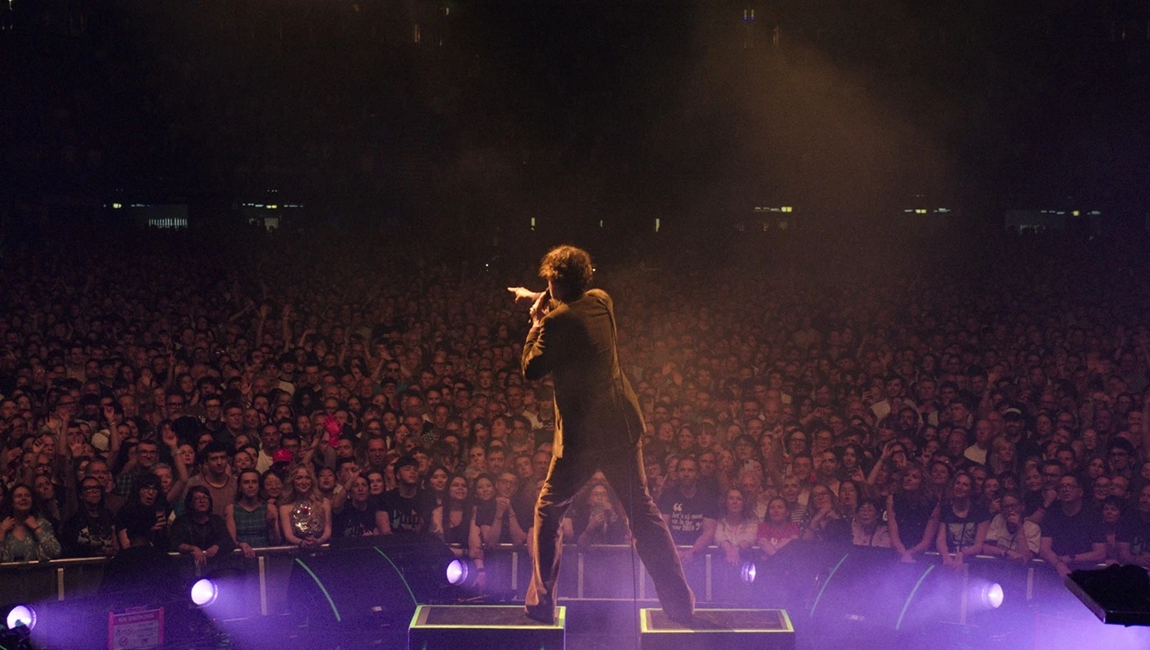
Ah Pulp: national treasures, indie disco floor-fillers, perennial smartarse answer to “Blur vs Oasis.” And in frontman Jarvis Cocker, they had the gawky underdog turned chronicler of the malaise at the heart of Britain in the ’90s, and a retro-futurist vision of how pop could sound. They remain a prime example of what Britain does better than maybe anyone else: the smart, funny, working-class pop band. Here, in Garth Jennings’ concert film-cum-retrospective documentary titled Pulp: What Do You Do for an Encore?, we catch the band on their recent tour off the back of their first record in 25 years, playing a mammoth show at London’s O2 arena. The gig is presented in tandem with Cocker narrating the band’s story from his teenage sketchbooks through their ’90s pomp and all the way up to the present day.
The concert footage finds a Pulp that have come a long way, wilfully so, even. It’s a proper arena spectacle, leaving behind the days when Cocker’s insouciant stage presence and erratic flailing were the only thing drawing the eye. There are choirs, orchestras, big, daft stage structures, all of which are there to hammer home that this is a big-deal show. Thankfully, none of this serves to distract from the songs — and with songs as good as Pulp delivers, what luck would they have if they tried? There are barnstorming versions of “Do You Remember The First Time?” and “Disco 2000,” after all, and even if this late-career Cocker is so uncharacteristically lathered in autotune that he sounds like Charli xcx, and even if the band members are mostly in their sixties, they remain an energized and committed unit.
But What Do You Do for an Encore? is a film, not a gig, and Jennings frequently breaks his documentary away from the concert to catch up with Cocker narrating a journey through the band’s story up to this point, making pains to emphasize that their story is a piece with the collaged spirit of the band’s assimilation and collation of pop cultural detritus. This narrative strand follows the example of Cocker’s book Good Pop, Bad Pop, which told his early story through things found in his loft, and the film similarly engages in this spirit of bricolage, if in a kind of half-hearted fashion. The style works well with regard to the early unseen footage, which is the most revealing in the doc, particularly in dispelling the notion that Pulp took a decade and a half to break through because the British public weren’t ready — the footage instead suggests they were simply pretty duff for a long time. And it’s in this early-days exploration when the film is at its best, Cocker fully in his element while finding little details that cut to the core of things with a light comedic touch: case in point, noting that the teenage soul-patch Cocker adopted was in emulation of one Hugh Cornwell from The Stranglers had — or, as the fact may be, never did.
Indeed, it’s lucky these details are there in the early stages, because the overarching narrative that Jennings spins up as lead-in to the concert footage is one that even the most casual fan will know well: the teenage Peel session as a false start to 15 years of obscure toil before going supernova in the midst of Britpop, only for fame to sour on them; the subsequent break-up; a reunion; another fallow decade; and now their first album in 25 years. Once the band finally split up, the film seems to run out of anything to say, with little of the survey being given any depth: not the reasons for the initial schism, not the reasons for the reunion, nor the impact of the recent death of longtime bass player Steve Mackey. It leaves the film’s latter half to feel like a decided retread, particularly when Jennings falls into using old footage of talking head interviews, at which point his film begins to resemble a standard BBC4 Paul Morley doc.
To be fair to What Do You Do for an Encore?, none of this is reflective of its aims or content, as it is to function more as a victory lap than interrogation, but it does make for a slightly confused watch. On the one hand, you have a band energized and interested in excavating something new in themselves during this renaissance moment; on the other, you have a film that is far too happy to largely repeat a story that’s been told many times before. That said, you could end basically any film with “Common People” being played to the kind of rapturous reception it deserves, and one would be likely to walk out feeling like something is right with the world. A cheat code perhaps, but it’s hard to argue that Pulp hasn’t earned it.
DIRECTOR: Garth Jennings; CAST: Jarvis Cocker, Candida Doyle, Nick Banks, Mark Webber; DISTRIBUTOR: MUBI; STREAMING: September 25; RUNTIME: 1 hr. 39 min.
Comments are closed.