
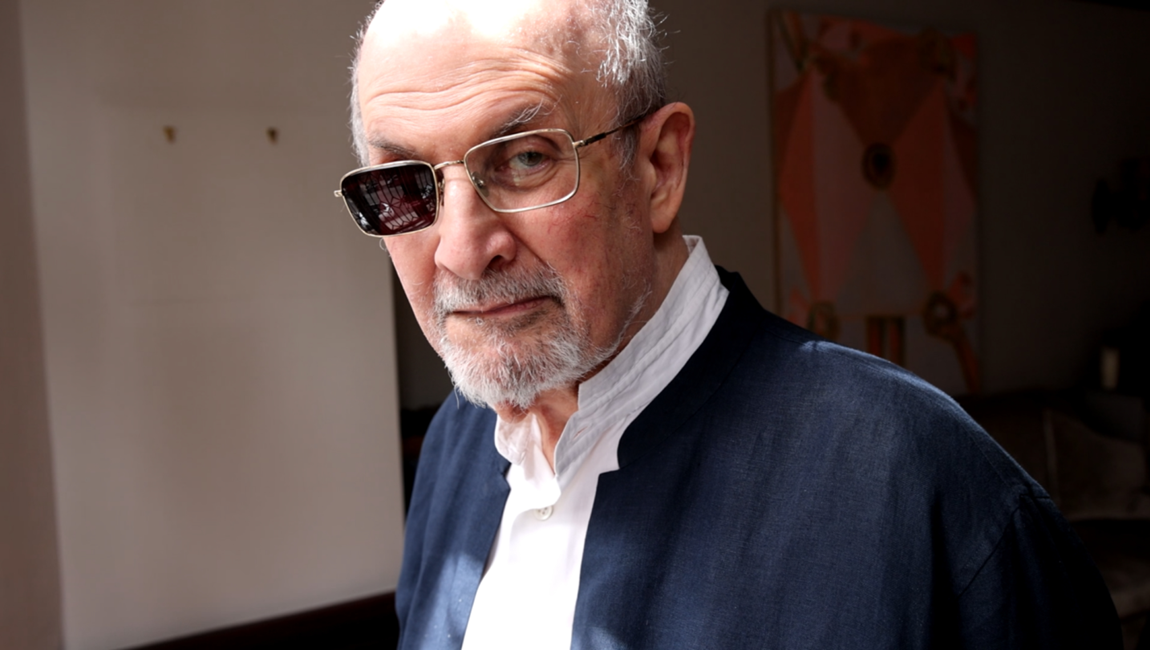
The novelist Salman Rushdie never wanted to become the world’s symbol for free speech against oppressive regimes. He just wanted to be a writer, and he happened to have a gift for stringing verbose sentences together with a truthful marvel. His life changed forever after publishing The Satanic Verses in 1988. The “satanic verses” refer to a contested moment in Islamic history when the Prophet Muhammad retracted verses he had memorized, believed to be revealed through the Archangel Gabriel, after discovering the revealer wasn’t Allah through Gabriel but instead Satan. Rushdie’s book isn’t even about this or Islam more broadly, but that didn’t stop Ayatollah Khomeini, the Supreme Leader of Iran, from issuing a fatwa (a legal opinion) calling for his assassination. Multiple of the book’s translators were attacked. The Japanese translator, Hitoshi Igarashi, was killed; so too were 37 people in Türkiye in an attack targeting his Turkish translator. In 2022, Rushdie himself was stabbed 15 times while speaking at the Chautauqua Institution in southwestern New York. He lost his left eye.
Documentarian Alex Gibney’s Knife: The Attempted Murder of Salman Rushdie is an adaptation, loosely speaking, of Rushdie’s own account of the event from his memoir Knife: Meditations After an Attempted Murder. It tells the story of that violent day in August 2022, as well as his lengthy recovery process. Gibney also pushes the narrative further into the past, back to Rushdie’s childhood and early creative years, with a focus on the way the publication of The Satanic Verses ruptured his life and sent him into years of hiding before resurfacing into the public eye in New York City.
The footage mixes archival footage, original interviews with Gibney and his cinematographer, Benjamin Bloodwell, and hospital-bed home footage captured by Rushdie’s wife, Rachel Eliza Griffiths (a poet, novelist, and photographer in her own right). From the recovery bed, the great novelist still possesses a larger vocabulary than most — though, during that period, he seems hyperfocused on feeling and giving love. Griffiths is the object of much of this sappy deluge of affection, and when she dances with him in his hospital bed, his face glows with the joy of a child receiving a gift. Wes Anderson and Juman Malouf call him only a few days into recovery, and Rushdie immediately jumps to the topic of love. Like his own characters, whether that be the titular murderer in his novel Shalimar the Clown or the mythological lovers of Orpheus and Eurydice in The Ground Beneath Her Feet, Rushdie is presented by Gibney not as the novelist or the PEN America mascot for free speech, but the compassionate lover and dear friend that he is outside the public eye.
Those with ommetaphobic tendencies must be warned: the close-ups shown here of the author’s eyes in the immediate days after the attack are grizzly and grotesque. His face, no longer symmetrical, now looks Frankensteined from the hospital bed. (The stapled-together neck doesn’t help either.) Griffiths denies him the freedom to see a mirror for a while, shielding him from what would surely be a shocking reveal. We, however, are not shielded from the ugly repercussions of the 15 stabs. His neck flattens with unnatural fat from swelling and bruises to a color a neck should never turn; a deep cut rivals the length of his torso; his eye, or what is left of it, is now tuna-red and protrudes an inch further than it should, the cornea and pupil barely recognizable. The doctors sew his eyelid shut once its swelling recedes, and Gibney reenacts the operation from the most painful vantage point: the orbit itself. We watch the light go black one last time.
Narrated by the author himself, Rushdie’s words from his latest memoir and several of his novels echo into the documentary’s present. His musings to Gibney seem almost off the cuff, yet they hold a similar introspective poeticism to that of Jonas Mekas’ diary films. “We would not be who we are today without the calamities of our yesterday,” the writer orates, and he has many calamities to include in his tally. Most of all, Rushdie questions his own actions, and whether or not he reversed course too sharply with his return to public life in New York. In this, there is some shared DNA with the common misogynistic rhetoric that surrounds sexual and domestic violence victims — that somehow he bears the blame for the violence of another — though the circumstances are of course miles apart and the comparison imperfect. And ultimately, as expected, he retracts nothing. The Satanic Verses will never go out of print. He knows who holds the moral blame — Hadi Matar, though Rushdie only calls him “A,” for assailant — but there is still a truth to wrestle with: that had he made different life choices, he would still see with two eyes. The dissonance bothers him. A metaphorical myopia became permanent thanks to the pointy end of a terrorist’s knife.
Gibney, for his part, leans into Rushdie’s retrospective hall-of-mirrors narration with his filmmaking choices. The strongest formal element comes through an endless supply of superimposed images that bleed into one another. À la the final scene of High and Low, there is a powerful dreamy sequence whereby Rushdie imagines how a conversation with “A” would go, with Gibney superimposing Rushdie’s head next to A’s and vice versa as they talk; the words are spoken in a mind-reading back-and-forth of internal monologue as their mouths stay shut. This spectral nature of Rushdie’s presence in the imaginary conversation not only reflects a specific interiority that has arisen in the author in the wake of his trauma, but also brilliantly matches his own magical realism that blends the fantastical and a near-journalistic truth in re-enchanted memories of disenchanted worlds.
Knife: The Attempted Murder of Salman Rushdie is a straightforward account of a very public man. The world knows his story already, and very little within the walls of Gibney’s documentary will surprise anyone, beyond perhaps the palpable vulnerability of the novelist. There are no skeletons to raise, no bodies to bury, and Gibney gives the author the final word in the very act of making the film: “We need to document this,” the author tells his wife after the attack. By sharing their own account with the world, the author raises his middle finger one last time, an affirmation that Salman Rushdie will never be silenced.
DIRECTOR: Alex Gibney; CAST: Salman Rushie, Rachel Eliza Griffiths; DISTRIBUTOR: Abramorama; IN THEATERS: September 17; RUNTIME: dd
Comments are closed.