
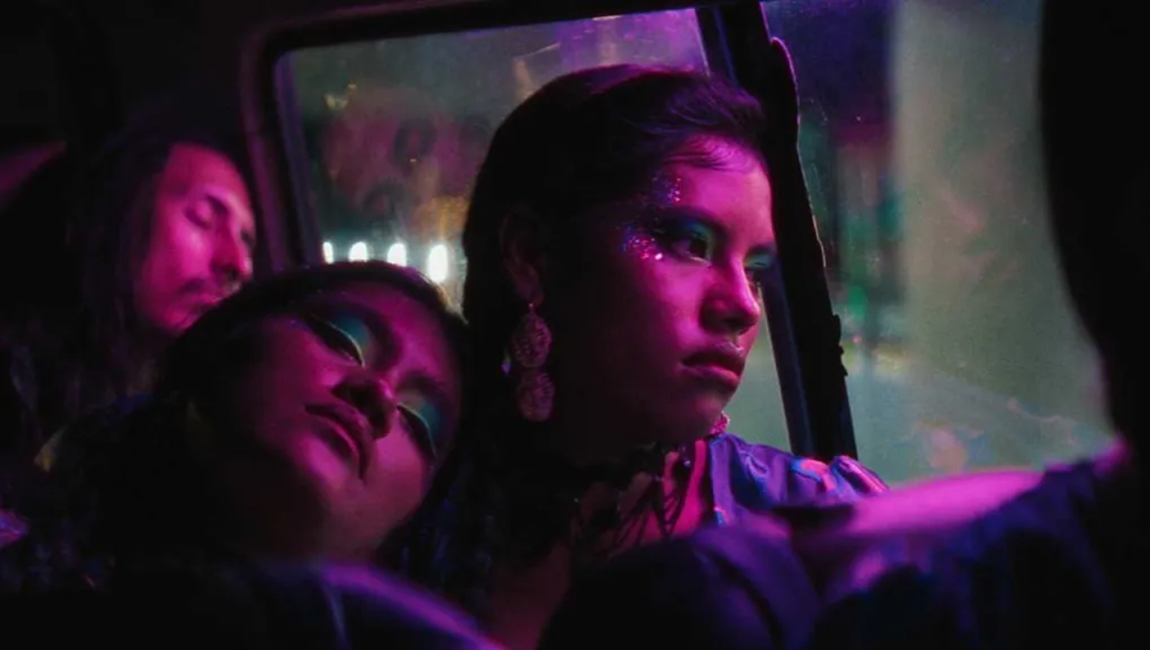
There’s no shortage of films that tackle generational differences, particularly parental figures and their often limiting expectations for their children. From Zac Efron in Disney Channel’s High School Musical to Zac Efron in The Iron Claw (and a whole spectrum of non-Efron entries), nearly every angle of this familial tension has been explored in nearly every genre. The new Bolivian film The Condor Daughter, directed by Álvaro Olmos Torrico, easily sounds like it could live within the Disney milieu. Clara (Marisol Vallejos Montaño) is a young Quechan midwife-in-training apprenticing under her surrogate mother Ana (María Magdalena Sanizo) in a village in the Bolivian Andes. Clara wishes to be a singer, a dream that would require her to move out to the city and abandon the torch that awaits her. Ana, naturally, is displeased with Clara’s growing restlessness. As in most films about children giving up their parents’ dreams, they fight about tradition versus modernity — the latter of which, against the strict and misogynistic nature of the village, would seem like the clear winner.
The film begins by introducing us to Clara’s abilities as a midwife, patiently walking viewers through a home birth concluding in a Quechan song sung in Clara’s gentle soprano serenade, guiding the infant through the shock of birth. The viewer understands this routine is sacred. Though there is spiritual meaning, Ana’s practice is about stewardship at its core. Each baby is seen through emergence with practiced motions and songs of blessings. Tradition, here, isn’t painted as old-fashioned, but about holding intent behind every action. Olmos Torrico respects these long-held rituals, and that empathy applies to the agricultural work that sustains the village. Cinematographer Nicolás Wong Díaz (whose previous credits include Jayro Bustamante’s La Llorona and the recent Peruvian film Mistura) captures the effortless agrarian beauty of the Andean community, replete with sun-dappled cornfields and panoramic views.
When Clara ultimately sets out for her dreams, the landscape changes. The crops fail and the livestock dies. Her selfishness — and that of other young defectors — is determined to be the cause of their misery. There is collective resentment toward this betrayal. It is the children who are wrong for forsaking the customs that have always kept the cycle going. Pachamama, the deity that oversees all life, is displeased.
It’s in the film’s second half that it becomes clear that The Condor Daughter’s interests are bigger than mother-daughter disagreements or the dreams parents project onto their children and how they envision (and begrudge) themselves. The familiar familial plot is merely a metaphor for understanding the belief system represented by Pachamama: nature, reciprocity, and cosmic connectivity. It is Ana’s failure to support Clara that has upset the balance, and that realization is conveyed well by Marisol Vallejos Montaño’s mostly wordless performance as the conflicted mother. Though it is her first screen performance, Olmos Torrico trusts the actress to communicate Ana’s waning conviction in the tenets that have defined her life. She, too, has been failed by this community, discouraged from her own early interest in music, and subjected to gendered expectations. There’s no place for her — not in the city, full of bar brawls and for-hire girl groups, and not in the village where her midwifery is increasingly questioned by both mothers and municipal health agents. There’s no place for Clara, either. She’s best positioned to practice as a singer in the city, but her gift is most meaningful as a midwife. She returns to the village to find there is hardly anyone left to steward the land and no one remaining who will attentively welcome each new child into the world. Something went wrong here, and there’s uneasiness about whether it can be brought back.
Many movies have shown fissures between parents and children, punctuated by lines like, “I’m not giving up on my dream, I’m giving up on yours.” The Condor Daughter probes deeper, asking something much harder to answer: how can we stop ourselves from failing the things we bring into the world? Whether a child or an ear of corn, the movie exalts the age-old practices that uphold stewardship while interrogating how many of those traditions betray the responsibility to nurture, a cosmic imbalance that will deplete the Earth until there is nothing left but the condors that feast upon the dead.
DIRECTOR: Álvaro Olmos Torrico; CAST: María Magdalena Sanizo, Marisol Vallejos Montaño, Nely Huayta, Alisson Jimenez; DISTRIBUTOR: Outsider Pictures; IN THEATERS: September 11; RUNTIME: 1 hr. 49 min.
Comments are closed.