
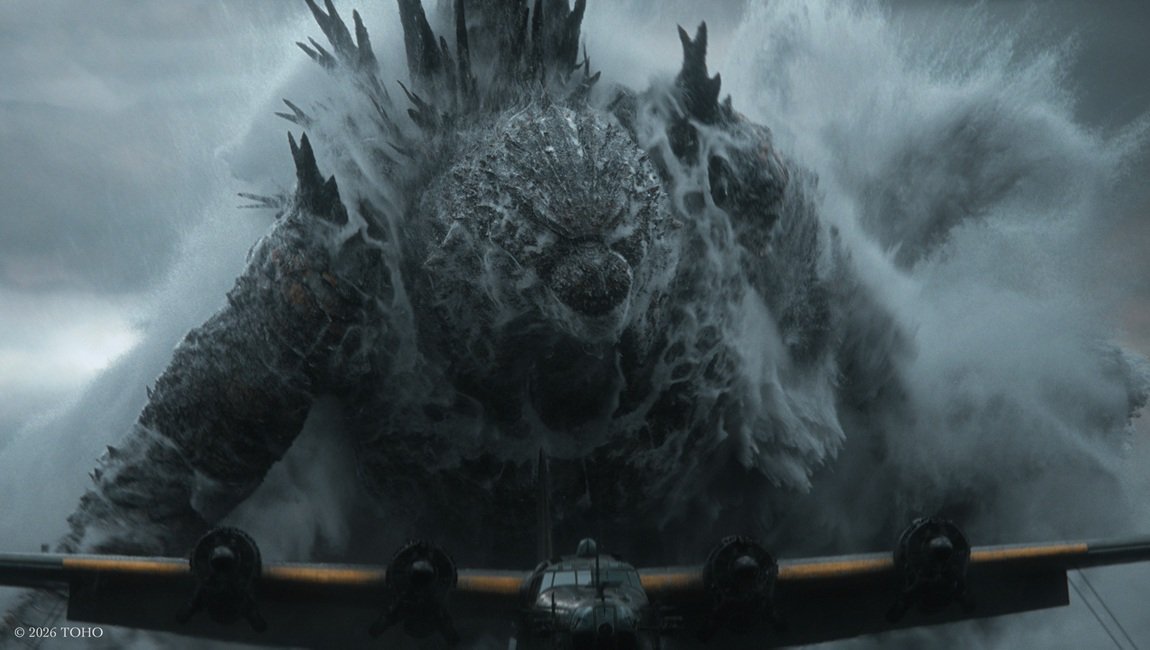
Shin Godzilla exists in a class of its own, nearly experimental in its focus on political red tape in the face of a developing catastrophe, and a creature design that is downright terrifying. Taking that film out of the equation here, Takashi Yamazaki’s Godzilla Minus One (2023) proved a refreshing, exhilarating antidote to the anemic Hollywood reboots that began with Gareth Edwards’ installment in 2014, and have since devolved into unadulterated CGI slop. If AI hasn’t been used in that franchise already, it’s only a matter of time.
Yamazaki’s follow-up, Godzilla Minus Zero — set two years after the events of the first film — cranks up the voltage (quite literally) by introducing tangible mass carnage — between 800 and 2,000 deaths per individual attack — in the form of a frightening, ever-imposing Ghodirah. The three-headed, skin-shedding, rapidly-evolving, gold-electricity-beaming behemoth far outshines Godzilla in his own movie, which is arguably the film’s greatest strength. More latent, but genuinely provocative, is its underlying theme of reckoning with nuclear devastation and foreign intervention.
Godzilla as an IP has maybe lost some of its novelty as an allegory for the atomic bomb in recent decades, especially once Western studios really leveraged it and stripped it of its teeth. But that doesn’t change its fundamentally Japanese impetus; as J. Hoberman puts it, “Godzilla transformed the trauma of the war into fun… [in] a daring attempt to fashion a terrible poetry from the mind-melting horror of atomic warfare.” That idea of terrible poetry is one that resonates in Yamazaki’s sequel, in which bursts of goofy, melodramatic antics are often spliced with disarmingly bold and potently political choices.
The most enduring example of this tonal dance can be seen in Professor Murakami, a character who bounces between absurdly stoic and deeply emotionally disturbed. He is continually haunted by imagery of piles of scorched bodies amid the wreckage of Hiroshima. As a survivor and as a government scientist who now assists with the effort to suppress Ghodirah’s onslaught and must also deal with geopolitical interference from American forces, he harbors a quiet but roiling vengeance toward the U.S. In a particularly unforgettable sequence during the film’s final act, we find Murakami disgruntled in his lab, surrounded by scientific ephemera that store plentiful data on Godzilla’s abilities and potential for weaponization. A whiplash of editing captures the professor at multiple angles as he cracks a maniacal rictus across his face and fantasizes about New York City being leveled by Godzilla.
It would be remiss to ignore in these moments the visual parallels to 9/11. Godzilla begins with the Statue of Liberty, crushing the totem to dust, before setting its sights on Lower Manhattan. Perhaps strategically absent is One World Trade, but the sentiment is there nevertheless — slo-mo shots of pedestrians burned alive in real time, skyscrapers detonated, and the monster’s enveloping blue energy beam slicing right through the cityscape. This is what revenge would look like for the acute, irreversible decision to drop A-bombs on Hiroshima and Nagasaki. Godzilla weaponized against the United States, no longer wreaking havoc or causing further atomic aftermath for the already traumatized island nation. Off to foreign shores.
This sequence is striking aesthetically and politically, offering an uneasy conclusion to the buildup of Murakami’s ongoing flashbacks throughout the narrative. He catches himself for thinking so violently, and is berated by fellow colleagues for wanting to weaponize Godzilla in the first place, but in the end this fleeting fantasy sequence is pivotal when it becomes clear who the true villain of the story is. Spoiler alert: it’s not Ghodirah, it’s not Godzilla, and it’s not the Japanese scientists and officials.
To focus only on the film’s political contours, however, would be a mistake and would overlook most of its other thrilling details. There are the tactile textures of its CGI, which sell its genre trappings and work in slick tandem with the film’s subtly slapstick sense of humor. There are the actors’ performances, which strike a nice balance between soapy and earnest, and are neatly of a piece with the film’s postwar narrative arc. There’s the fact that Yamazaki disrupts expectations and effectively builds momentum by steering clear of big action set pieces; essentially, there’s just one in the first quarter and another in the last. Everything else, then, is human folly, strategy, empathy, and bureaucracy. And so, the stage being thus set, when Godzilla Minus Zero’s large-scale kaiju battles arrive, they are one helluva good time. Terrible poetry, indeed.
Published as part of NYFF 2026 — Dispatch 3.
Comments are closed.