
As the growth and ubiquity of AI continues to accelerate at a terrifyingly rapid rate, so do the horror films that seek to capitalize on the dangers of artificial intelligence. There was AfrAId, which derived its terror from something as commonplace as a digital home assistant, and of course there was M3GAN (and its sequel), adding an element of smack-talking, high-stepping sass to a sentient murderbot. This is not anything new: killer AI has been around since HAL 9000, nearly half as long as the existence of cinema itself. Subsequent classics as The Terminator, The Matrix, and A.I. Artificial Intelligence repeatedly warned us of a future that might already be here, and now we are doomed co-exist alongside something that was until recently relegated to popular science fiction.
One particular lane AI can operate within is deepfake technology — generated media of a real person saying or doing something they never actually did, usually presented in terms of shock value — which forms the basis for Appofeniacs, a new film by writer-director Chris Marrs Piliero (Electra Woman & Dyna Girl). Piliero has the nugget of a promising idea here, in that it’s about an absolute shithead of a human being wreaking havoc with a series of hastily-produced viral deepfake videos for the purpose of ruining the lives of all who’ve scorned him. The problem all lies in Piliero’s execution, which has melded its premise with the moldy tetxure of 1990s Quentin Tarantino knock-off, replete with ultra-violence and cheap pop culture references. Smug, mean-spirited, and very, very gory, Appofeniacs does such an incredible job at making everyone and everything supremely unpleasant that watching the film can feel you’re being physically assaulted by it.
Speaking of Tarantino, Appofeniacs takes a page from Pulp Fiction by kicking things off with the textbook definition of “apophenia,” to address its ungainly title. It means the following: 1. the tendency to perceive a connection or meaningful pattern between unrelated or random things; 2. confirmation bias; and 3. paranoia. The paranoia is exuded in full in the film’s opening moments, which consist of a husband watching a video of his wife having sex with one of his closest friends, prompting him to ambush her in their own home and shoot her in the head. Roll title card. Suffice to say, things only grow nastier from there. Of course, that was not the man’s wife nor his friend on the video, but an elaborate deepfake video generated by Duke (Aaron Holliday), a technological lowlife with a propensity for capitalizing on the latest in AI apps on his phone like an even scuzzier version of Lenny Nero from Strange Days, if such a thing were possible. Duke’s modus operandi consists of the following: meeting someone, getting wronged by them, and then posting a deepfake of them online with the hopes that a video of them doing something obscene will attract enough attention to ruin their lives, often with deadly results. In essence, Duke is a man who has found a way to weaponize cancel culture to its extreme endpoint, single-handedly causing the deaths of multiple people with his actions.
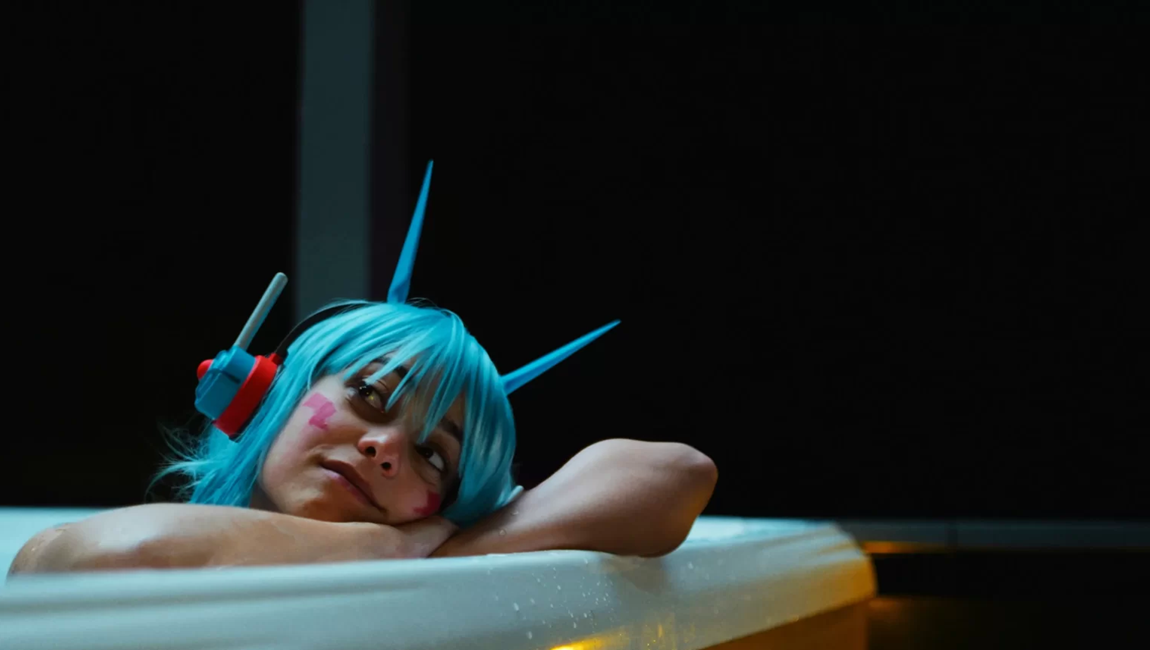
Appofeniacs takes further pages out of Pulp Fiction with its structure, revolving around intersecting lives of different groups of people, all affected by Duke’s reign of terror. One group of friends is vacationing out in a desert home, where one blue-haired gal has invited her rideshare driver to have sex with her in front of her husband, satiating his bizarre cuck fetish. This group also includes the friend from the deepfake sex video in the film’s opening moments, causing the husband to track them down with bloody results. Another prominent character is an actress who insults Duke in a coffee shop, triggering him to post a staged video of her spouting racial slurs online to damage her reputation. There’s also Clinto Binto (Sean Gunn, who executive produces), a craftsman of high-end armor and weaponry for cosplayers, also finding himself on the wrong end of Duke’s phone when they can’t come to an agreement on payment for goods. It’s a lot of different scenarios and marks to cycle through, but these never feel like real people, just fodder for Piliero to inflict gruesome deaths upon, lurching from scene to scene with a haphazard, disjointed touch. The extent to which Piliero fashions himself a modern-day Tarantino is more embarrassing than inspired, often grinding the sub-90-minute runtime to a halt so characters can argue about the naming schemes of Girl Scout Cookies, the value of retaining physical media, and one particularly lengthy sequence that sees Duke go on a tirade against tipping in the aforementioned coffee shop. Mr. Pink he is not.
If riffing on QT’s dialogue represents one side of Appofeniacs, violence represents the other. Piliero engages with bodily harm like it’s going out of style, dreaming up new ways to torture, maim, or kill his characters. Beatings are common, as are stabbings and shootings, with one particular character’s botched suicide resulting in his eyeballs grotesquely bulging out of his skull. Another has his hands and face bonded to a table top with industrial-strength super glue, forcing him to rip off chunks of flesh off to escape. And Clinto Binto’s various gadgets pay off in the film’s third act, fulfilling the desire of anyone who ever wanted to watch Cloud Strife’s Buster Sword sever its way through a man’s torso. The whole approach is more dismal than anything else, but the violence against women in particular is distressing, finding Piliero leaning on their suffering for uncomfortable periods of time — technology may not be as problematic as his apparent misogyny, if reading his distribution of violence correctly. Ultimately, there’s very little to recommend with Appofeniacs. Sure, some extreme gorehounds may revel in the film’s brutality, while others may be tickled by the severe lengths Piliero goes to in order to hammer his message home. But while the dangers presented by AI are certainly very real, any interesting reflection of the actual threat it imposes is in Appofeniacs rendered completely neutered by the film’s exaggerated register and cribbed style.
DIRECTOR: Chris Marrs Piliero; CAST: Sean Gunn, Jermaine Fowler, Scarlett DeMeo, Michael Abbott Jr., Harley Bronwyn; DISTRIBUTOR: Magenta Edge Films; IN THEATERS: October 2; RUNTIME: 1 hr. 31 min.
Comments are closed.