
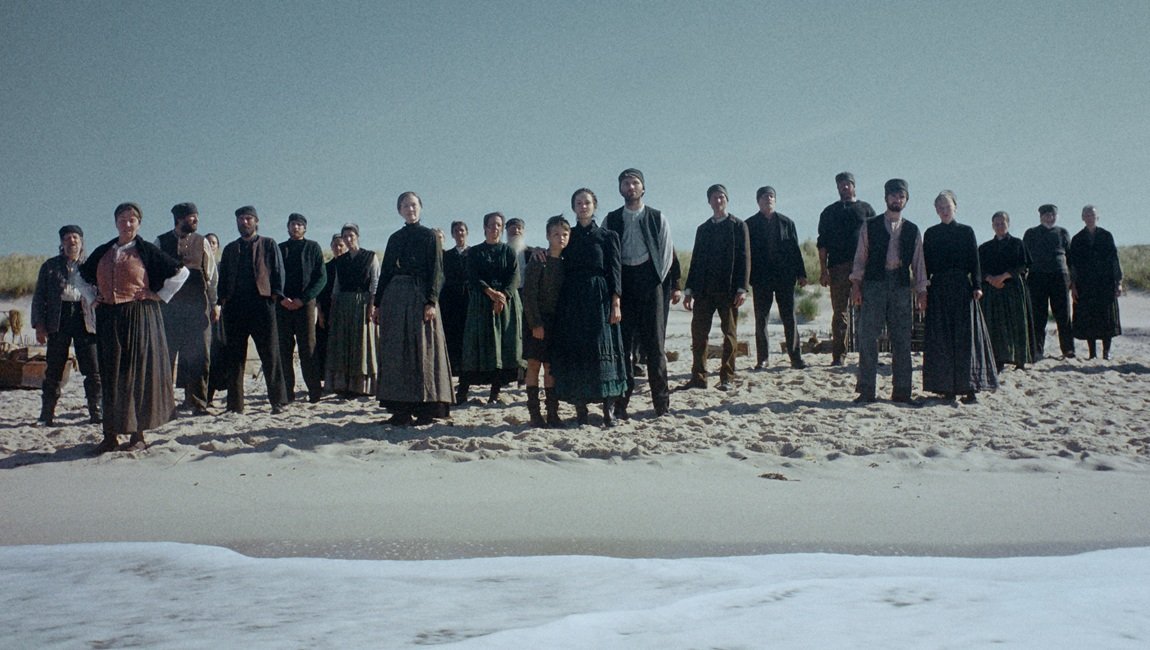
In German, Kai Stänicke’s debut feature Trial of Hein bears the title Der Heimatlose, which translates as “the stateless person” or “the homeless.” This is an interesting discrepancy, since the original title places the film’s protagonist, Hein (Paul Boche), front and center, whereas the English title emphasizes the process whereby Hein is relentlessly judged. This is a film about the conflict between the individual and society, specifically how the social contract often relies on the individual subsuming their needs and desires in the interest of community cohesion. In its highly stylized way, Trial of Hein is about conservative small-mindedness and how it can persistently assert itself as an overriding virtue.
Hein left the small fishing village of his birth 14 years prior, and the action of Trial of Hein is precipitated by his unexpected return. Although Hein remembers everyone, no one in the village recognizes him. His younger sister Heide (Stephanie Amarell) was very young when Hein left, and their mother (Irene Kleinschmidt) is in the throes of dementia, so Hein has no family to vouch for him. The townsfolk fear he may be an impostor, and so a three-day trial has been established during which the community will determine whether Hein is who he says he is.
It is a highly artificial premise, and a viewer will recognize that these events do not exactly stand up to scrutiny. Why would someone return to this “godforsaken place” (as one outsider calls it) pretending to be a member of the community? One person suggests that “Hein” may be someone from the mainland looking to encroach on their fishing rights. As Hein interacts with the villagers, particularly his best friends Friedemann (Philip Froissant) and Greta (Emilia Schüle), the mass inability to recognize this man seems decreasingly plausible, more deliberate and performative. There are cracks in the community’s harsh façade, and it’s clear that Stänicke does not expect us to take this scenario at face value.
The formal organization of Trial of Hein is also a very big clue that we are observing something allegorical, and not a naturalistic depiction of genuine xenophobia. The buildings in the village are unnaturally close to one another, and each has at least two missing walls. Everybody can see everything everywhere. Most viewers will recognize right away that Stänicke has borrowed this stage-setting arrangement from Lars von Trier’s 2003 magnum opus, Dogville. This in itself is quite jarring. Dogville is a singular film with a format so radical that one would never expect to see it repeated. But Trial of Hein appears to be quite explicitly drawing not just on von Trier’s physical artifice, but also its primary theme of small-town insularity and paranoia. Like Dogville’s Grace (Nicole Kidman), Hein is a figure whose worldliness threatens to reveal this close-knit community’s darker nature to itself, something that will not be tolerated.
But unlike Grace, Hein was once part of this clan, and the implication is that by leaving, he renounced any potential right to return. Over the course of the trial, Hein discovers significant discrepancies between his own memories of childhood and those of the population at large. Even photographic evidence that Hein finds among his mother’s things seems to suggest that the past may not be exactly as he remembers it. Then again, we observe that aside from fishing, the primary preoccupation of the villagers is an inscrutable card game called “lies.” Hein’s readjustment to life in his hometown rests in part on remembering his ability to play this game and win.
Trial of Hein is an extremely well-crafted film, complex and engaging. If it has one real flaw, it is its overall perfection. Which is to say, we eventually discern what Stänicke is trying to say to us, and the film really admits of only one conclusion. Like a perfectly sculpted short story, Trial of Hein has a clear purpose and very little will divert it from accomplishing that goal. It unfolds with a certain inevitability, and while one cannot help but admire it, it also leaves very little for the viewer to chew on. Nevertheless, a debut film this accomplished bodes very well for Stänicke’s future endeavors. Not many filmmakers could wrestle with a titan like von Trier and end the match in a draw.
Published as part of New Directors/New Films 2026 — Dispatch 2.
Comments are closed.