
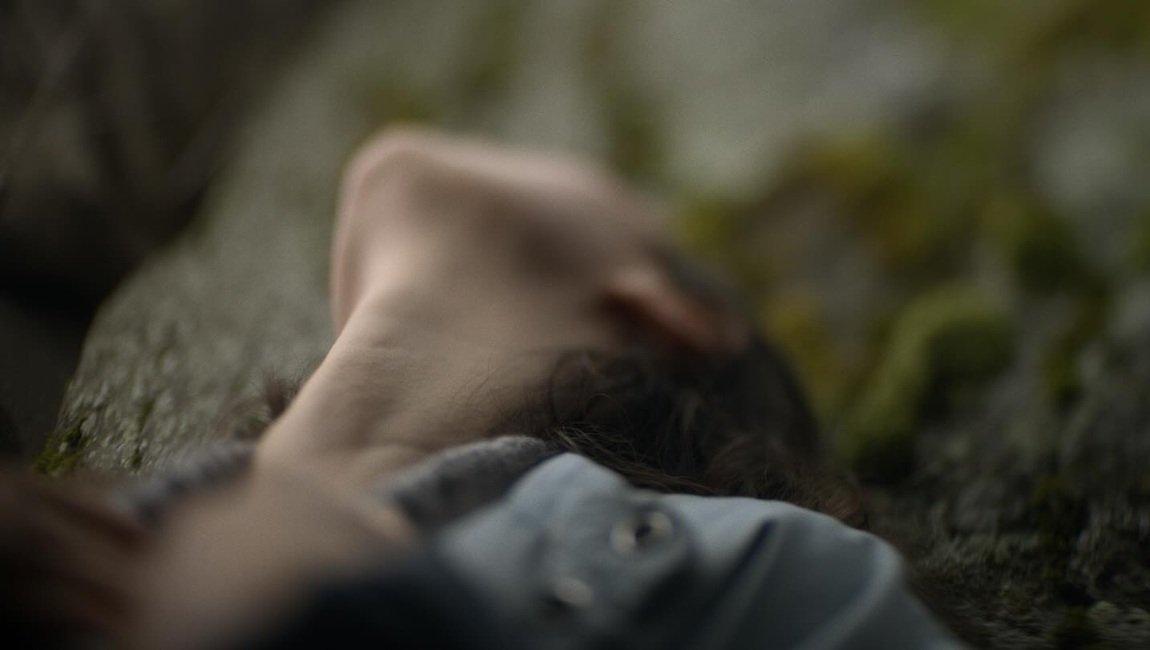
It’s hard to do justice to the images in Christine Haroutounian’s After Dreaming through words alone. Their quality is of a blinkered, bleary kind, as if conjured in the seconds after deep sleep. Focal points do not rest on expected subjects, and the vignettes around them construct a scuzzy film. In her conception of Armenia, where the film was made and from whose war-marred history and present it draws its subject matter, Haroutounian has captured a malaise so marrow-deep it alters consciousness.
After Dreaming’s loose narrative coalesces around a road trip taken by an Armenian soldier, Atom (Davit Beybutyan), and the young woman, Claudette (Veronika Poghosyan), whom he is escorting to a relative’s house after her father is murdered. The story, however, is much less important than the abiding atmosphere of oppression blanketing it like a fog. Haroutounian commits to long, sustained silences punctuated only by ambient noise. Her shots, too, composed with cinematographer Evgeny Rodin — who held a separate lens in front of the camera to achieve the signature roving blur — draw out the feeling of real-time beyond our own perception.
The effect is, understandably, dreamlike. But this isn’t a dream from which one can easily wake. Just like the horse mired in a mucky lake in the film’s opening frame, Claudette and Atom are each trapped: she the family’s youngest daughter, confined to divinity courses and a narrow path to marriage; he the soldier destined only for death. Just after they set off, a police officer pulls them over and prods Atom, suggesting he might be shirking his duties. “After me, the flood,” he jokes, suggestively. Late in the film, when Atom and Claudette’s journey inevitably seems to be taking much longer than it should, they argue over whose life is more meaningless. “Life goes on without you,” Claudette says.
In between these two points, Atom and Claudette encounter an array of figures strewn across the Armenian countryside, each of them grappling with the effects of war in their own way. An older woman who gives them shelter during a storm proudly calls herself “tater” (grandmother) rather than its diminutive, “taterik.” In any context other than the soul-crushing, genocidal one in which she finds herself, semantics like this might not matter. Perhaps it’s this assertion of a more substantial identity that prompts Atom and Claudette to have sex that night. In the woman’s cave-like basement, its walls almost dripping with lust, the flirtatious parameters of their dynamic engorge. They undress in front of each other without a word. Atom’s hand pushes on the back of Claudette’s head, which hovers inches from the surface of a bucket of water; the threat of submersion seems to entice and repulse her. At night, he rests his head on her lap, she tells him she loves him, and he cries himself to sleep.
Society’s three pillars: the military, marriage, and religion, promise a total immersion — mind, body, and soul — in ritual; it is this broken society’s organizing principle. As harnessed by Haroutounian, however, a group of soldiers’ marching and chanting are as much functions of order as they are impulses. Her camera glides through a squad of soldiers’ parallel formations like a ghost, as their chants of “freedom, independence” lead us into the bowels of a stone monument; like the blue box in Mulholland Drive, it is a portal to a subconscious realm.
Claudette’s religious studies are also a kind of mechanical performance as well as a duty. Her and her classmates’ sonorous rendition of the Lord’s Prayer has a quality of finely tuned perfection, emotionless and somehow engrossing. Haroutounian immerses her camera in the group of young women, no face other than Claudette’s particularly visible; while they gossip about her nearby, the camera’s signature blur expands and contracts across the screen, bending this awkward situation away from the painful realm of reality into something resembling dissociation.
After Dreaming’s most striking sequence comes about an hour in, when Claudette and Atom attend a mass wedding in a small village. After dozens of couples have dutifully signed their papers and taken their government-mandated sums of cash, they gather around a quartet of musicians playing celebratory music. As the sequence stretches beyond 20 minutes, the images’ focus once again becomes erratic, and the once familiar blur distorts objects and figures into abstractions. The sustained intensity of the music gives this ostensible moment of celebration a trance-like quality, facilitated by the music’s pattern of dissonance and resonance, which feels like it will never end. Only Claudette and Atom stand motionless, arms at their sides and faces blank, among the throng of happy couples. Later, military formations are made dizzying by an erratically mobile camera, and church bells and fireworks become indistinguishable from alarms and gunfire. Perhaps Claudette and Atom see something in this pageant, manufactured in the face of so much spiritual degradation, that others don’t. After all, a dream that never ends can only be a nightmare.
Published as part of Los Angeles Festival of Movies 2026.
Comments are closed.