
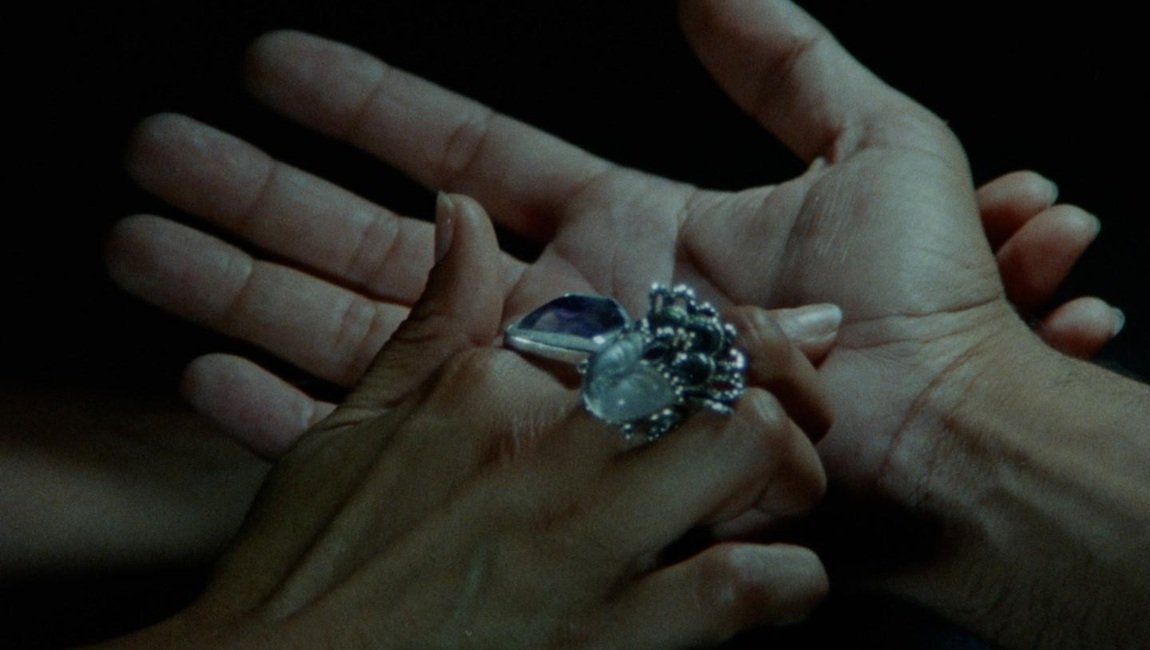
At this point in film history, the city of Los Angeles has been photographed in absurdum. However, the particular neighborhoods in Anouk Moyaux’s Selegna Sol have rarer sightings in the canon. The northeast part of L.A. is a treasure trove of the city’s historical records. Among some of the oldest communities in California, this is where student walkouts across seven high schools ignited the Chicano liberation movement in 1968. And where the infamous Night Stalker killer was hunted down by locals in the vein of Fritz Lang’s M. Moyaux’s film pictures this, the people’s streets, shot exquisitely on 16mm where every frame is a measured endeavor in Hellenistic beauty.
The film’s sparse narrative follows Gibran, a Mexican immigrant saving up to buy land in his hometown of Tecate. He does odd construction jobs and bemoans the cost of the land he works. He spends time with two friends drinking Modelos and smoking weed in a car overlooking a branded skyline. A cadre of indiscriminate leaning palm trees make silhouettes against the sunset, and the city feels bigger and more interesting than anything the characters have to say. While occasionally funny, the dialogue often comes across as blocky and feels inorganic on top of the formal achievements of the images. Gibran receives his American citizenship in a montage that leverages a hairbrained speech about how betting on America is always a losing hand against footage of Los Angeles that evokes its vastness both physically and historically. The best sequence of the film, it leans into Moyaux’s eye for contradiction without being burdened by the otherwise very omnipresent propensity for didacticism.
Selegna Sol offers so much sensory aesthetic pleasure that one almost feels distracted, if not pestered, by the occurrence of a narrative. That isn’t to say that every scene with spoken dialogue appears out of place; the vignettes that feel like walking into the middle of a conversation work especially well — for instance, when it’s unclear whether Gibran’s friend Claudia is also a lover. Twice she asks him whether he loves her or his motorcycle more, and both times he answers in a matter-of-fact tone: “Don’t ask that question.” Or there’s the scene where we see Claudia with her three girlfriends at the beach, talking about how the city is so big that you can have long distance friendships even if you both live within its limits. The conversation is followed by a wonderfully rhythmic sequence of the four of them rollerskating, and again Moyaux’s composition verges on the serene. Another especially strong sequence is a montage of a casino with engrossing dissolves of stunning halations. In the same way that Matías Piñeiro seemed to be inventing new ways to see the reflection of light on a body of water with You Burn Me, Moyaux stacks light and movement into an intense vertical investigation of being an immigrant on stolen land, a losing bet if there ever was one.
By the end of the film, it’s unclear but nonetheless seems improbable that Gibran will ever have enough money to buy land. And yet he is already threatening his friends with symbolic dreams of Tecate calling him home. He’s mourning leaving the city while they reassure him that he won’t miss out on anything but the ever rising cost of living. In Selegna Sol’s final scene, Gibran is alone in his car holding a gold nugget he found after inadvisedly wading into the L.A. River. Whether or not it is real gold, whether or not the manifestation of his American dream would come down to a stroke of unbelievable luck, the last frame feels like a reductive place to end a film that otherwise is so attached to the materiality of its location. But then again, wasn’t it in fact gold that turned that land into a cavity prime for extraction?
Many manage to do both well enough, but it’s always confounding to encounter a filmmaker with such a clear knack for poetic cinema who finds themselves concerned with any sort of linear relation of events. Just imagine Nathaniel Dorsky’s Before Sunset or Edward Owens’ The Irishman. Selegna Sol settles for being a beautiful film with nothing to say, in that it struggles to find an adequate language for its images — perhaps because the fragmented montage was a round hole to the saccharine hero journey’s square peg. The film’s observations are unsurprising and rendered infinitely more dull by its striking visual language, and this errant sort of vacancy threatens to skew its entire undertaking into the realm of the purely ornamental. Maya Deren’s children are refusing to put the plot down.
Published as part of Los Angeles Festival of Movies 2026.
Comments are closed.