
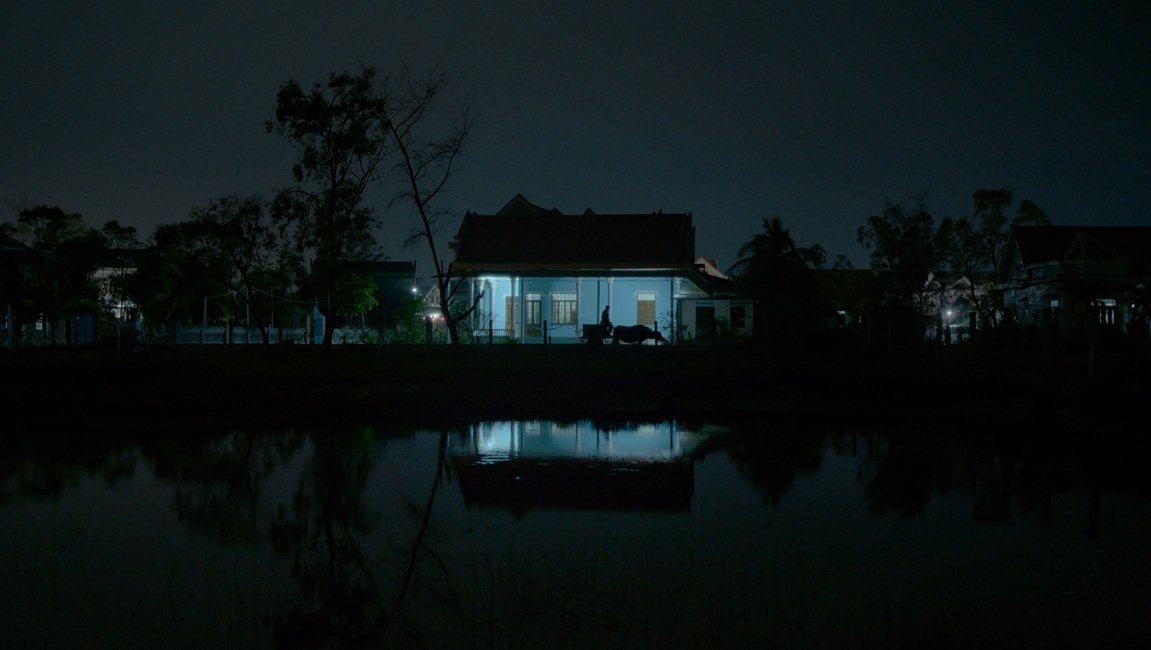
Carol Nguyen is a Canadian-Vietnamese filmmaker who has steadily climbed the ladder of the national industry since her prolific run of breakout short projects, in which she explored a diverse directorial vision during her years in high school and throughout her undergraduate studies. Capping off that stint of both familial documentaries and existential dramas/experimental projects, she directed and produced No Crying at the Dinner Table — a short that went on to vie for an Academy Award nomination and win a slew of awards and critical accolades, alongside establishing what has been an irrefutable path for East Asian-Canadian filmmakers, their confrontations with familial secrecy and traumas now so consistently referring back to that short for inspiration and technique. Carol, after a review of her CV, has had as robust a career in documentary cinema as an emerging filmmaker can have, working closely with major distributors and A-tier festival labs, and becoming a face others might aspire to. Her debut feature, Still Night, Burning House, in title and idea, creates a very pointed throughline across her filmography. No Crying at the Dinner Table is an obvious predecessor to this project, the feature acting less as an interrogation into the silence that permeates her home, à la No Crying, but instead her latest becomes an investigation into the emotional weight that her uncle’s suicide has left on the family. Looking a bit earlier into her filmography, the short This Home is Not Empty, an experimental project observing a diorama of a house going up in flames, presses in abstract but discerning methods the kind of volatility and estrangement that her cinema has taken itself to confront and excise, to its best ability: an ongoing interest that this debut does not stray from.
Where No Crying at the Dinner Table could very incisively enforce a therapy, which holds the collective stoicism of a partially agreed-upon silence on trial, Still Night, Burning House has a far more difficult task, unable to enact itself in the constrained, controlled spaces of the familiar, the safe, or the intimate — No Crying, as the title might suggest, takes place almost entirely in the family’s kitchen, indeed at their dinner table. Instead, Nguyen reaches across the globe, back to Vietnam, where the wishes and secrets of family reach beyond the known cloister where tragedy struck. Drawing this line is important because it’s fairly transparent where it seems this project cannot find the connective tissue to evoke a legible sentiment or observation on the intangible ways the death of Nguyen’s uncle has affected her family. There is grief, of course, and it is explicated, relitigated, brought out into the open, but the dynamics are too rigid, repetitive, and often aimless. It very much feels like an earnest moment to find the project’s thesis was not something that ever came out, was not something the filmmakers were lucky enough to stumble upon, and so instead had to cut around a gaping hole of emotional and structural coherence in order to conceive of the project at feature length. Nguyen has previously demonstrated her strength at grasping onto a moment of profundity and interrogating it with sympathy and compassion, but also firmness. Here, no such moment exists, and what that renders is a distancing effect.
Nguyen is never seen, only heard as narrator and interviewer, either to explain some cultural dissonances a Western audience might need or to push on certain themes her subjects are finding difficulty in articulating (though the latter happens only a small handful of times). Her lack of a presence is felt, because in the absence of any epiphanic realization or ruminative rationalization on the dynamics at hand — namely, with regard to Nguyen’s other uncle and her father, the brothers who hold the suicide closest to their heart with guilt and shame aching in the background — what is instead plain are the projections of her family’s traumas and the role they play in watching each subject maneuver how they must mediate these feelings and histories, without landing in a place of meaningful conclusion, or at least meaningful reflection. In so many ways, then, this becomes Nguyen’s least inquisitive project, the tumult of her family made transparent as object and never really considered in a reflexive light. In truth, Reflexivity has not yet been a part of the director’s thematic rolodex, and Still Night, Burning House begs the question of why, as the gap left in the wake of a 70-minute feature, pushed out of mid-length territory via an extensive use of languishing and under-instrumentalized B-roll, troubles the role cinema has in partaking in this family’s journey. Could all of this have happened in the exact same way without the mediation of cinema? Many will undoubtedly appreciate the film and the subjects for their willingness to be vulnerable, to open up for the public a discourse viewers might bring home, and that can certainly be appreciated. But there is still the fundamental question of translating this intimate, shared sadness to the space of theaters and audiences in formal and structural terms that remains here unconvincingly answered.
Published as part of TIFF 2026 — Dispatch 4.
Comments are closed.