
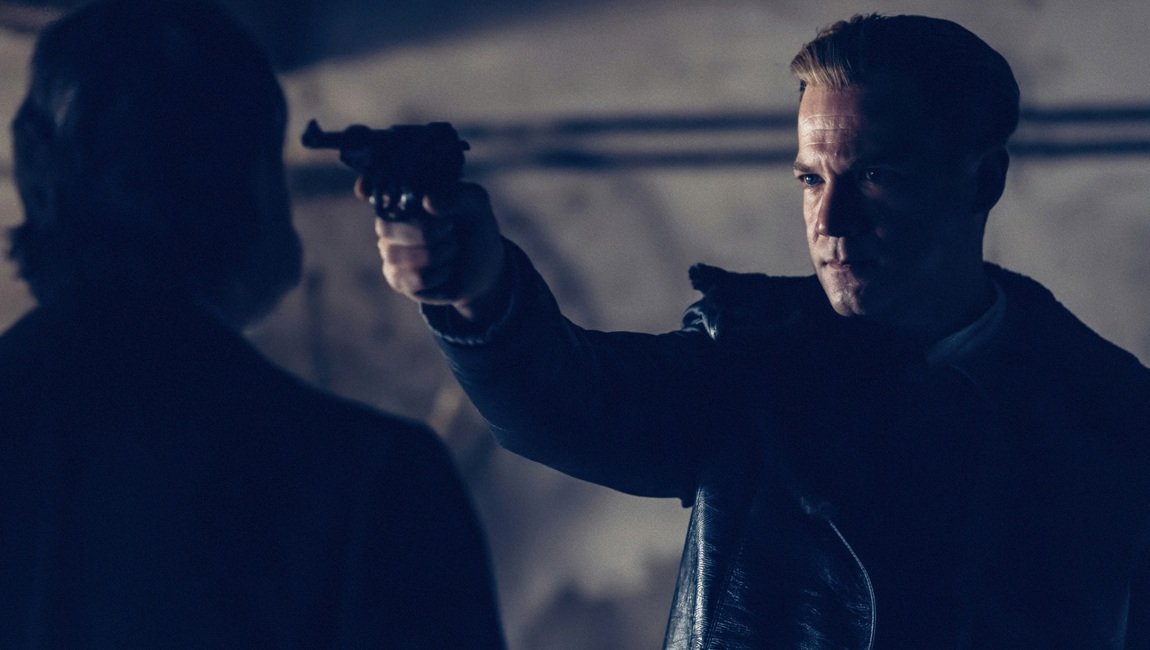
Western movies come with certain promises: of adventure and lawlessness, of chiseled jaws and gun smoke, of riding into the sunset with the horizon for your taking. But a proper Western also sows its roots in destitution, in doomed shootouts and bloodied barroom floors. Such is the path of Jan Holoubek’s Wild Wild East, an atmospheric WWII mystery that builds its scaffolding at the intersection of John Ford and Fritz Lang. It’s a chilly, severe movie, one that wields the horrors of history as a cudgel toward its characters and audience alike.
It’s 1943, and Nazi Germany is in decline. The Nazi’s invasion of the Soviet Union is bleeding their Eastern power and resources, but the regime keeps enough faith to exert what influence it can — including one Martin Wolff (Itay Tiran), a Nazi clerk who descends on the snowy Polish borough of Zalesie Małe off a tip on hidden Jewish gold. Wolff is angular, blond, and severe, and he waltzes into town as if off the set of a Sergio Leone flick. Far from the world power of the USSR, Poland still buckles under German occupation, and Zalesie Małe has shuddered its doors and windows like a ravaged frontier town. The empty streets almost beg for a gunfight; if it weren’t so snowy, a tumbleweed might blow into frame.
Historical genre films lend themselves easily to bombast and hyperbole, but Wild Wild East is decidedly sober in its style, favoring the icy desolation of The Assassination of Jesse James by the Coward Robert Ford to the antics of Tarantino. Holoubek coats Poland in the oppressive gray tartan of modern war films; the perpetual overcast bleeds into ash-coated snow to furl into a single, endlessly bleak canvas. When Wolff saunters into the remains of the town’s sole surviving hotel, you can almost feel the building’s stove failing to heat its drafty rooms.
Wolff enters the hotel in pursuit of a lawyer named Kowalski, the alleged keeper of the gold, who has (allegedly) long since fled. Instead, he’s met by Kaim (Robert Więckiewicz), the hotel’s mustachioed caretaker who shuffles through the hobbled Polish town like an ersatz Wyatt Earp. In Zalesie Małe, it seems that everyone has something to hide. Kaim guides Wolff through his compulsory searches as if on a wire, steering him past not only the rumored stashes of gold but also an illegally kept distillery, which he runs with his fellow townsfolk to sell under-the-table vodka to the occupying SS.
Among those ranks is Kurt Städtke (Jan Bülow), a Nazi captain who believes Wolff might be harboring secrets of his own. In one of Wild Wild East’s most efficient constructions of character, Städtke first approaches Wolff in a parted, boyish haircut and all-white joggers that recall the villains of Michael Haneke’s Funny Games, slicing a pubescent menace that pervades the full Third Reich throughout the film. Städtke is both flamboyant and precise, a cat playing with its food before it strikes for the kill; the turn from his friendly façade toward Wolff is not a matter of if, but when.
As a genre exercise, Wild Wild East is a studied and polished Western but an even tighter noir. Each privately held secret — between Kaim and his fellow commoners, between Wolff and his fellow SS — stokes and inflames the other, until the entire Polish hamlet is locked into a standoff. As if things couldn’t get tenser, Holoubek introduces another player: a Ukrainian vigilante (Oleksandr Yatsentyuk), draped in furs that nod to Warren Beatty in McCabe and Mrs. Miller, who’s hot on the trail of gold himself and devoid of fidelity to any party but his homeland. The better half of Wild Wild East is refreshingly coy with its allegiances, allowing as much blood to fall on the hands of the oppressed as does the oppressors. It’s a fine and dense moral web that stands out in a crowded canon of war films.
But within that moral web, the historic inhumanity of the Holocaust is conspicuously absent — that is, until a secret is finally unearthed. Curiously, it’s in the wake of this reveal that Holoubek takes the first opportunity to introduce the terrors that his rendering of the Nazis enact. But waiting until this point to introduce the Holocaust is as much a rebuke toward Wild Wild East’s audience as it is the character this reveal indicts. To fashion genocide as a narrative hair shirt is careless at best, and reads closer to craven manipulation.
Wild Wild East isn’t the first WWII film to keep the Holocaust out of frame. The most recent example that comes to mind is Jonathan Glazer’s The Zone of Interest, a Martin Amis adaptation that follows the quotidian lives of the German bureaucracy as a people burns next door. That isn’t to say The Zone of Interest keeps genocide off-screen out of narrative convenience; its SS throw picnics under ashen skies, choke on the fumes of burning bodies, raise their voices at dinner over thundering rifles. It’s a calculated and cautious account of the suspension of humanity necessary to erase six million lives, one especially powerful amid an ongoing genocide in Palestine. A more careful hand may have been able to craft something similar with Wolff’s story. As it stands, Wild Wild East is happy to erase the goodwill earned through its admittedly successful genre exercises with an unwieldy, moralistic twist.
Published as part of TIFF 2026 — Dispatch 4.
Comments are closed.